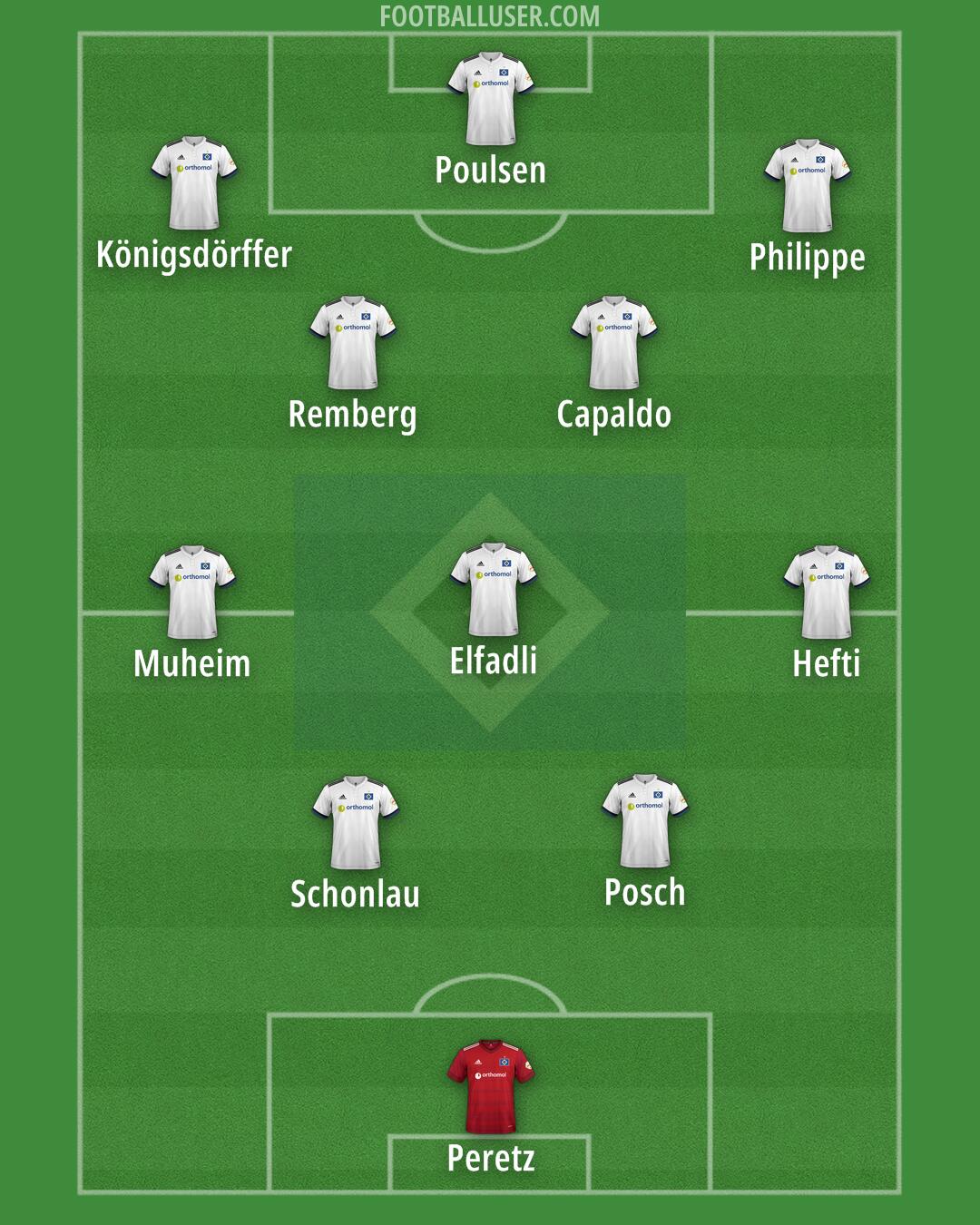

Hamburg Football Formation
 August 16, 2025


Starting Lineup
Muheim · Hefti · Schonlau · Posch · Elfadli · Capaldo · Poulsen · Königsdörffer · Philippe · Remberg · PeretzHamburg relies on a heavy defensive foundation and quick transitions through a 5-2-3 formation. This lineup is built to play a way that prioritizes defensive solidity and sudden bursts of speed. The goal is to stay compact in a mid-block and then hit the opposition on the break when space opens up.
Peretz guards the goal to anchor the defensive unit. The back line functions as a narrow defensive block with a back five. Elfadli sits in the center of the three central defenders to hold the line, while Schonlau and Posch act as covering defenders to pick up runners. On the flanks, Muheim operates as an attacking wing back on the left, and Hefti acts as an attacking wing back on the right to provide width. The defensive unit works together to squeeze the space and force the opposition to play wide.
A double pivot provides the shield for the defense. Capaldo and Remberg sit in front of the back five to control the center of the pitch. The former works to intercept passes and win the second ball, while the latter looks to carry the ball forward to connect the defensive and attacking lines. Both players are tasked to press in a mid-block and prevent the opposition from playing through the lines. This pairing is essential for the team to recycle possession and build play from the back.
In attack, Hamburg uses three forwards to stretch the defense. Poulsen leads the line as a lone striker who can hold up the ball and work in combinations. Philippe and Königsdörffer play as wide attackers who look to cut inside and threaten the goal. The wingers press the opposition back line to trigger a press higher up the pitch. This movement creates space for the wing backs to overlap and deliver crosses into the box. The team looks to hit in behind on the transition to catch the opposition out of position.
This formation offers significant tactical advantages such as compactness when defending in a low block. The combination of three central defenders and a double pivot ensures numerical superiority in the middle of the pitch. Furthermore, the team can create wide overloads when Muheim and Hefti push up to support the wingers. These movements force the opposition to defend against constant overlapping runs.
This formation is a resilient way to play that focuses on defensive strength and rapid breaks. It is best suited for games against dominant teams where Hamburg can sit deep and counter at pace.