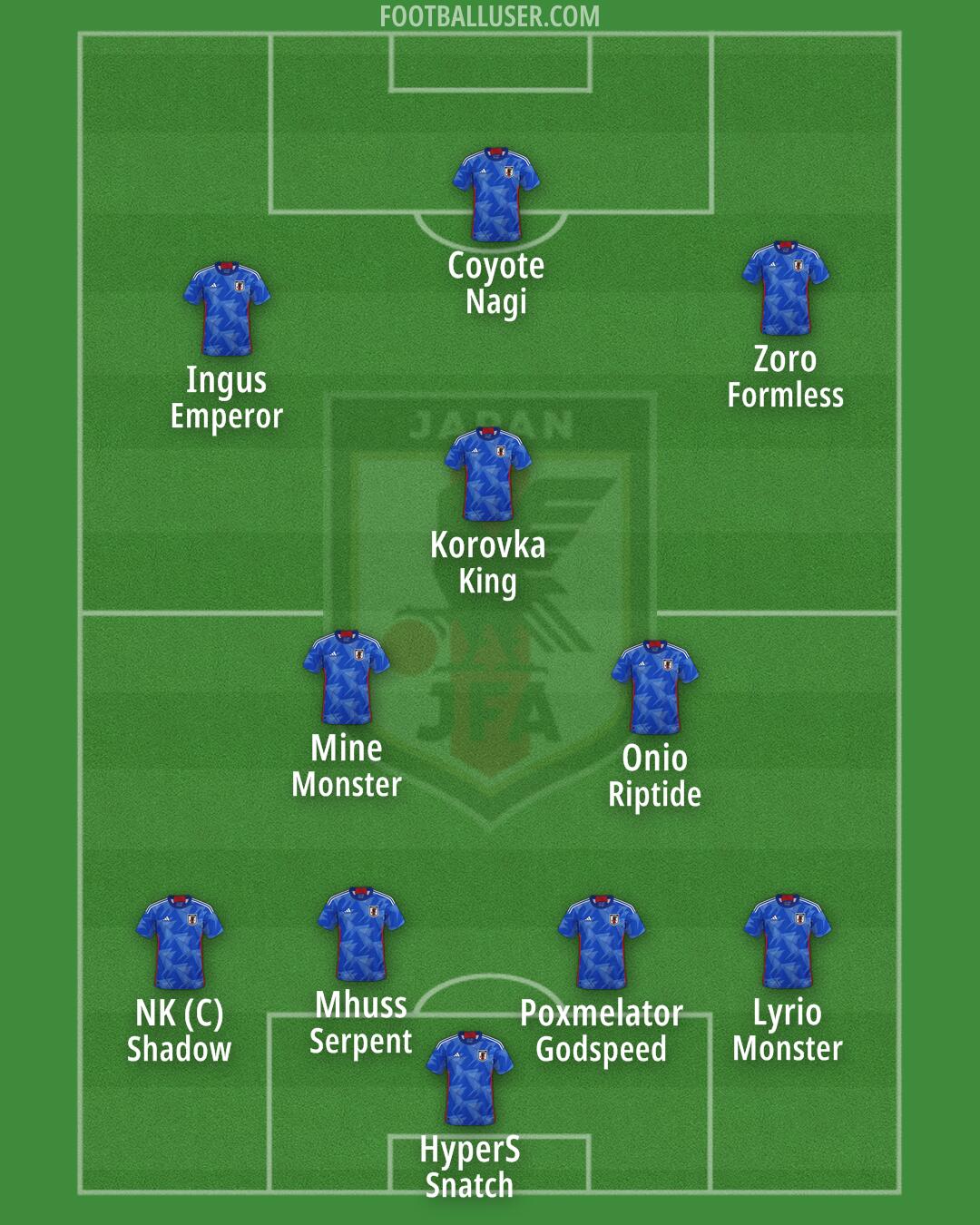

Japan National Football Team Formation
 August 25, 2025
 NK_Leonardoburst


Starting Lineup
NK (C) (Shadow) · HyperS (Snatch) · Mhuss (Serpent) · Mine (Monster) · Onio (Riptide) · Korovka (King) · Poxmelator (Godspeed) · Zoro (Formless) · Coyote (Nagi) · Ingus (Emperor) · Lyrio (Monster)Japan focuses on a high press and quick transitions through a 4-3-3. This formation is built to win the ball high up the pitch and immediately attack the space behind the opposition. The lineup aims to squeeze the space in the middle while keeping plenty of width in the final third to stretch the defence.
HyperS guards the goal as the last line of defence. The back four operates with a high line to keep the team compact. Mhuss and Poxmelator act as the central defenders, with Mhuss providing coverage while Poxmelator looks to step up into midfield during build up. NK, the captain, plays as the left back and must track back quickly when the team loses possession. Lyrio operates on the right as an attacking full back, looking to overlap the winger and provide crosses.
The midfield consists of a three man midfield with a carrier and two supporting players. Onio and Mine sit in the middle to shield the defence and recycle possession. Mine works to win the second ball in the middle of the pitch. Korovka plays as an attacking ten behind the striker, looking to find pockets of space between the lines. Korovka drives forward to link the midfield with the attack, often making late runs into the box to support the front three.
Japan uses three attackers across the front to pin the opposition back. Coyote acts as a pressing centre forward, working to force a long ball from the opposition defenders. On the wings, Ingus and Zoro act as inverted wingers who cut inside to create passing lanes for the full backs. Ingus looks to isolate his marker one on one, while Zoro moves into central areas to allow Lyrio to push up. This movement creates constant tension in the wide areas and allows the team to attack in combinations.
This formation offers several tactical advantages for Japan. The team can create wide overloads when Lyrio and Zoro combine on the right side. There is also an ability to press high in coordinated waves, with the front three and Korovka triggering the press to win it back high up the pitch. The presence of Korovka in the hole helps to create numerical superiority in the attacking third.
This 4-3-3 formation relies on high intensity and quick ball movement to unsettle the opponent. It is best suited for games against teams that play a high line or struggle to play out from the back.