
Brazil National Football Team Formation
 August 27, 2025


Starting Lineup
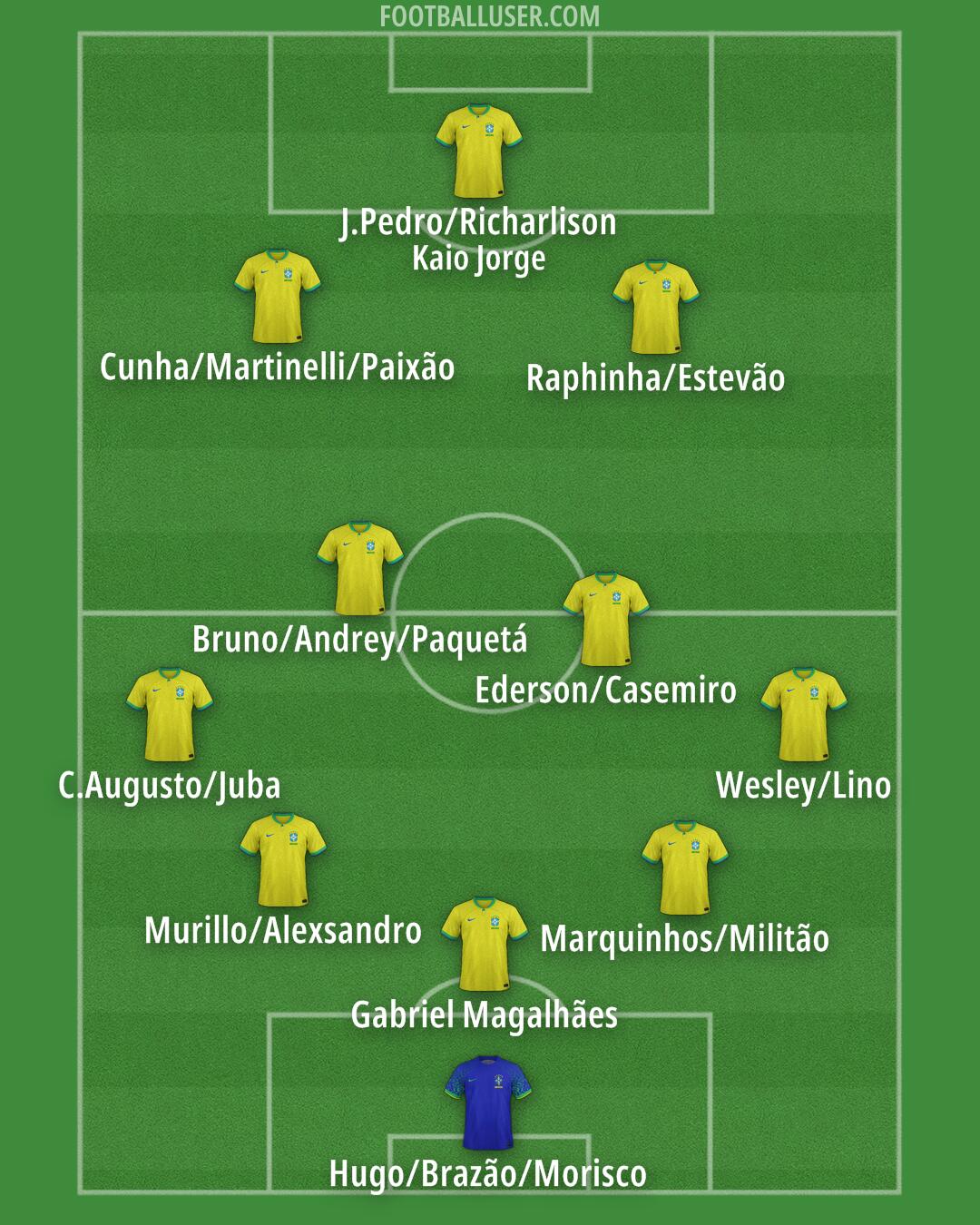
Hugo/Brazão/Morisco · Murillo/Alexsandro · Gabriel Magalhães · Marquinhos/Militão · C.Augusto/Juba · Wesley/Lino · Ederson/Casemiro · Bruno/Andrey/Paquetá · Cunha/Martinelli/Paixão · Raphinha/Estevão · J.Pedro/Richarlison (Kaio Jorge)Brazil prefers to play a high press and use heavy verticality with this 3-4-3 formation. The lineup is built to overwhelm opponents in the final third by using width and constant movement to break the line. This system relies on quick transitions to catch the opposition out of position before they can settle.
Hugo/Brazão/Morisco operates between the posts to start the build up. The defensive unit uses a back three consisting of Gabriel Magalhães in the center with Marquinhos/Militão on the right and Murillo/Alexsandro on the left. Gabriel Magalhães acts as the central pillar to win the header and clear the lines while the wide centre backs are expected to cover the space left by the midfielders. The defensive unit stays compact to ensure they can shift quickly to the side where the ball is played.
The midfield operates with a central pairing of Ederson/Casemiro and Wesley/Lino. Ederson/Casemiro sits deeper to shield the defense and win the second ball. Wesley/Lino drives forward with the ball to link the lines. Bruno/Andrey/Paquetá plays as an attacking ten behind the striker to find the feet of the striker and create chances. This midfield group must press aggressively to win it back high up the pitch and keep the pressure on the opponent.
In the attacking phase, Brazil uses three attackers across the front to stretch the defense. Raphinha/Estevão occupies the right wing while Cunha/Martinelli/Paixão stays wide on the left. J.Pedro/Richarlison leads the line as a pressing centre-forward to force the opposition back into their own half. The wingers often cut inside to create space for the midfielders to arrive late into the box. The team looks to play through the lines to find combinations between the front three.
A primary advantage of this Brazil lineup is the ability to press high in coordinated waves to force a long ball from the opposition. The wide players and the attacking ten create numerical superiority in the final third which makes it difficult for defenders to mark everyone. This formation also allows for quick wide overloads when the wingers and midfielders combine to cross on the run.
This 3-4-3 formation is designed for teams that want to dominate possession and hunt for the ball high up the pitch. It is best suited for matches against opponents who sit deep and struggle to deal with constant vertical pressure.