Southampton Football Formation
 August 29, 2025


Starting Lineup
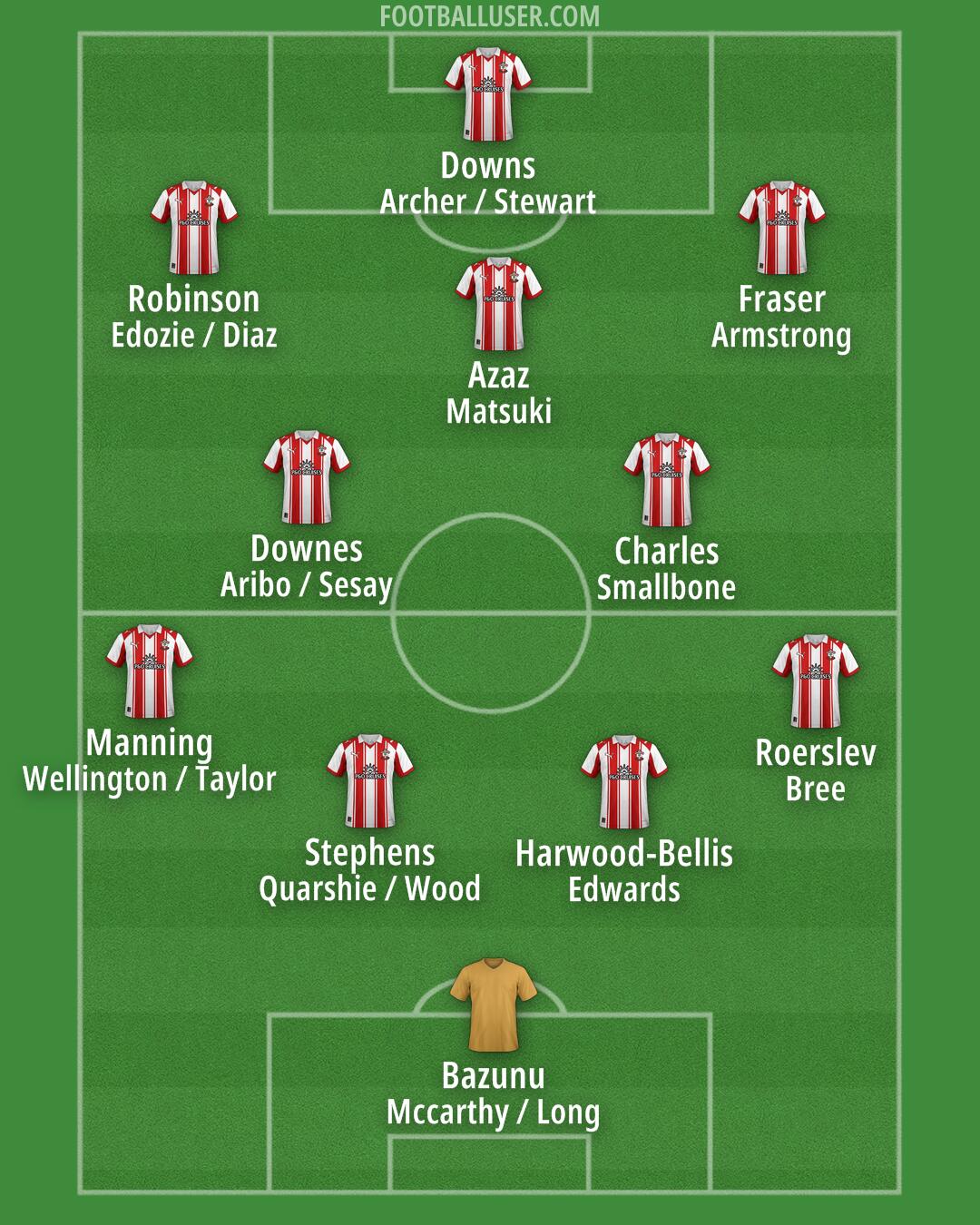
Bazunu (Mccarthy / Long) · Stephens (Quarshie / Wood) · Roerslev (Bree) · Harwood-Bellis (Edwards) · Manning (Wellington / Taylor) · Downes (Aribo / Sesay) · Charles (Smallbone) · Azaz (Matsuki) · Fraser (Armstrong) · Robinson (Edozie / Diaz) · Downs (Archer / Stewart)Southampton relies on a direct and high intensity style of play using a 4-2-4 formation. This lineup aims to stretch the opposition by using significant width and heavy pressure in the final third. The goal is to create many chances by staying high up the pitch and forcing turnovers close to the opponent goal.
Bazunu acts as the last line of defense, playing out from the back to start the build up. The back four functions as a flat line with Roerslev at right back and Manning at left back. Both full backs look to push up when the ball moves forward to provide width. Harwood-Bellis and Stephens act as the central pair, with Harwood-Bellis often looking to win the second ball and Stephens providing cover. The defensive unit tries to squeeze the space by keeping a high line to keep the team compact.
The midfield relies on a double pivot of Charles and Downes to control the center of the pitch. Downes works to shield the defense and intercept passes, while Charles acts as a carrier to drive the ball forward. These two must work hard to cover the ground left behind by the advanced attackers. They connect the defense to the front four by recycling possession and looking to play through the lines quickly. When the team loses the ball, they must immediately press to prevent the opponent from breaking forward.
Southampton uses four attackers to pin the opposition back. Robinson and Fraser play as wide wingers, with Robinson often looking to cut inside while Fraser stays wide to stretch the defense. In the center, Azaz and Downs operate as a front two. They work together to find pockets of space and make runs in behind the defense. This front line is designed to attack in combinations and win the ball high up the pitch. The forwards press in pairs to force a long ball from the opposition.
This formation offers clear tactical advantages, particularly the ability to press high in coordinated waves. By having four players close to the opponent goal, Southampton can trigger a press very effectively. Another strength is the ability to create wide overloads when Roerslev or Manning overlap the wingers. This constant pressure makes it difficult for the opposition to build play from their own half.
The 4-2-4 formation makes Southampton a very dangerous side in transition. It is a lineup best suited for games against teams that sit deep and struggle to deal with high pressure and rapid attacking movements.