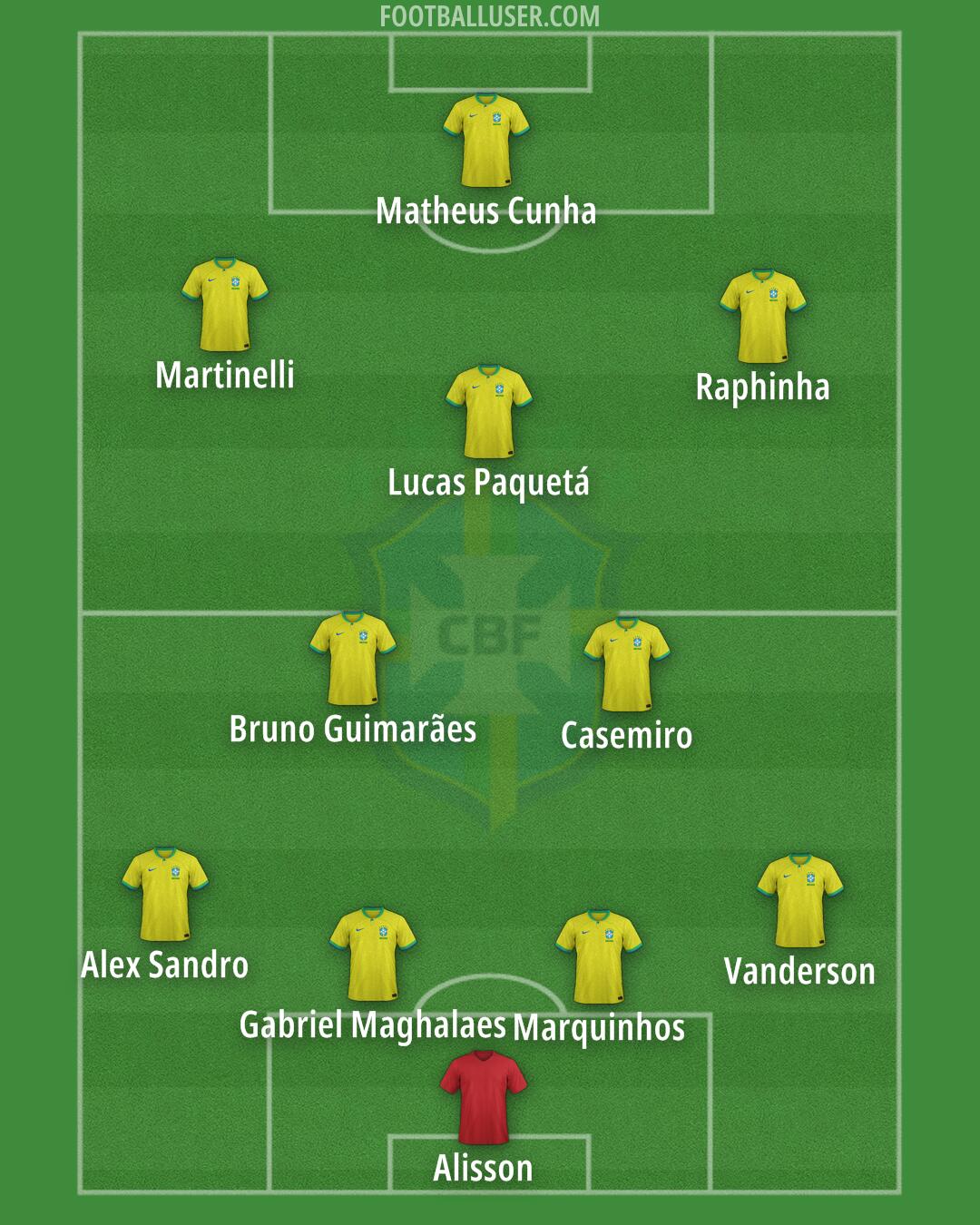

Brazil National Football Team Formation
 August 30, 2025
 gersonmv


Starting Lineup
Alisson · Vanderson · Marquinhos · Gabriel Maghalaes · Alex Sandro · Casemiro · Lucas Paquetá · Bruno Guimarães · Raphinha · Matheus Cunha · MartinelliBrazil focuses on winning the ball back high up the pitch and playing through the lines with a 4-3-3 formation. This lineup aims to control the tempo of the game through quick transitions and high pressing triggers to keep the opposition under constant pressure.
Alisson operates between the posts to sweep behind a high line when the team pushes up. The back four stays relatively high to compress the midfield, with Vanderson acting as an attacking full back who likes to overlap the winger. On the other side, Alex Sandro provides balance while Marquinhos and Gabriel Maghalaes defend zonally in a flat back four. Marquinhos acts as a ball playing defender to start attacks, while Gabriel Maghalaes uses his aerial strength to defend crosses and clear the lines.
The midfield functions as a three-man midfield with a carrier and a defensive anchor. Casemiro acts as the single pivot who shields the defence and breaks up play. Next to him, Bruno Guimarães drives forward with the ball to connect the defensive and attacking lines. Lucas Paquetá plays as an attacking ten behind the striker, looking to find the feet of the striker or arrive late into the box to create chaos. This unit works to squeeze the space between the lines to ensure Brazil maintains control.
In the final third, the attack uses three attackers across the front to stretch the defence. Martinelli plays as an inverted winger who cuts inside to create space for Alex Sandro, while Raphinha stays wide to deliver crosses. Matheus Cunha acts as a pressing centre-forward, working to pin the last defender and hold up the ball to allow others to join the attack. The forwards work in combinations to exploit the spaces behind the opposition full backs through quick one-two passes.
One major advantage for Brazil is the ability to press high in coordinated waves, forcing the opponent into mistakes in their own half. The formation also creates wide overloads when Vanderson and Raphinha combine to pull the opposition defender out of position. This makes it difficult for teams to defend against the speed of transition when the ball is won back.
This 4-3-3 formation is built for a team that wants to dominate possession and hunt for the ball immediately upon losing it. It is best suited for matches against opponents who struggle to play out from the back under heavy pressure.