Arsenal Football Formation
 August 31, 2025


Starting Lineup
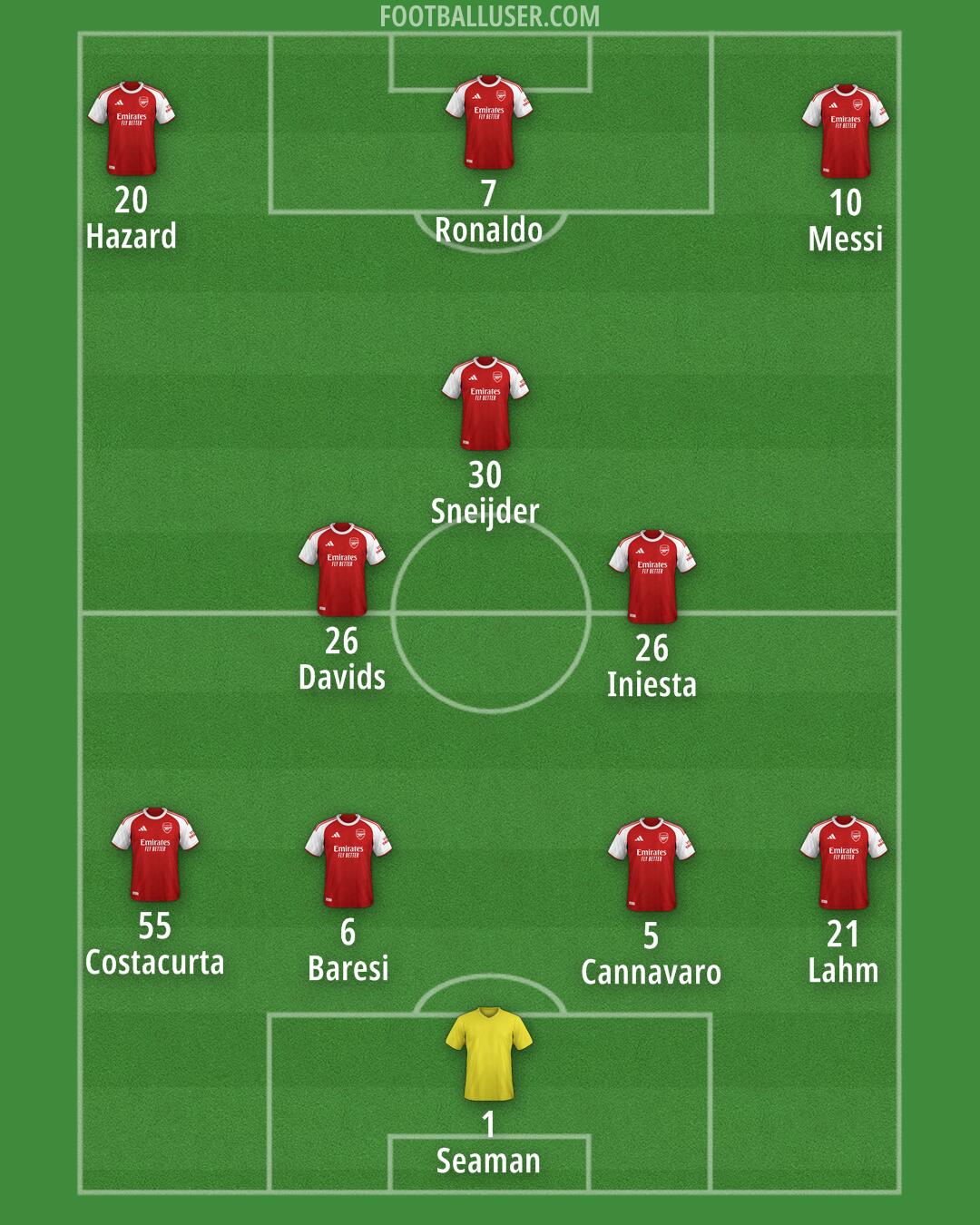
1 (Seaman)7 (Ronaldo)
55 (Costacurta)
6 (Baresi)
5 (Cannavaro)
21 (Lahm)
26 (Davids)
26 (Iniesta)
30 (Sneijder)
10 (Messi)
20 (Hazard)
Arsenal play a high press game using a 4-3-3 formation. This lineup is built to dominate the ball and control the tempo of the match through constant pressure. The Gunners want to use their ability to move the ball through short passes to dictate how the game is played.
Player 1 stays between the posts to start the buildup from the back. The defense works in a flat back four with 5 and 6 as the central defenders. 5 is a ball playing defender who can step up to intercept, while 6 is there to cover and hold the line. On the flanks, 21 and 55 act as full backs to provide width. 21 can push forward to overlap the winger, while 55 can also move into the half-spaces to help the midfield. The unit works to keep a high line to squeeze the space and prevent the opposition from playing through the middle.
The midfield is a three-man unit built to control the center of the pitch. Player 26 operates in the central midfield roles to drive the ball forward and connects the defense to the attack. Player 30 works as an attacking ten behind the striker to find space between the lines. This midfield works to win the second ball and recycle possession quickly to keep the pressure on. By moving the ball through the thirds, the midfield can break the line and create chances for the forwards.
The attack uses three players across the front to stretch the defense. 10 plays as an inverted winger on the right, cutting inside to create space for others. 20 acts as a wide winger on the left who can pull wide to spread the play. 7 plays as a lone striker to hold up the ball and lay it off to teammates to create combinations. This formation is designed to create runs in behind and allows for cutbacks from the byline. The forwards press the opposition back line to win the ball back high up the pitch.
One major advantage for Arsenal is the ability to create numerical superiority in the midfield. With player 30 and player 26 working in those central zones, the team can overwhelm the opposition. Another strength is the speed of transition when the ball is won. The team can quickly switch play to 10 or 20 to isolate wide players in one on one situations.
This 4-3-3 formation is ideal for a team that wants to control the game with possession. It is best suited for matches against opponents that drop into a low block and require constant movement to break them down.