Arsenal Football Formation
 September 1, 2025


Starting Lineup
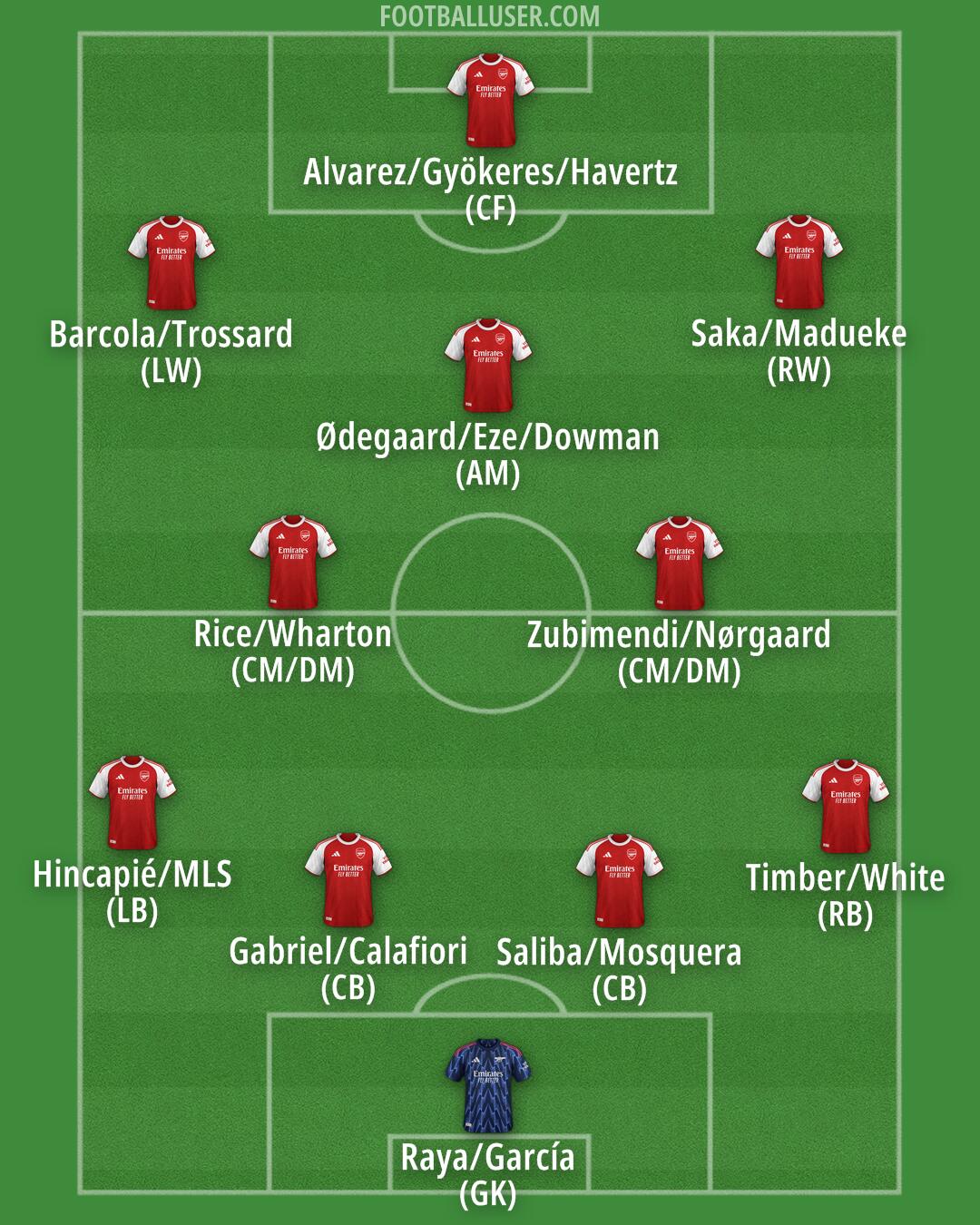
Alvarez/Gyökeres/Havertz (CF) · Barcola/Trossard (LW) · Saka/Madueke (RW) · Ødegaard/Eze/Dowman (AM) · Rice/Wharton (CM/DM) · Zubimendi/Nørgaard (CM/DM) · Hincapié/MLS (LB) · Gabriel/Calafiori (CB) · Saliba/Mosquera (CB) · Timber/White (RB) · Raya/García (GK)Arsenal looks to control the game through high pressing and heavy possession with a 4-3-3 formation. This lineup is built to squeeze the space in the opponent half and dominate through technical ability. The Gunners aim to win it back high up the pitch and use quick passing to move through the thirds.
Raya/García starts between the posts to play out from the back. The back line functions as a flat back four where Saliba/Mosquera and Gabriel/Calafiori act as the central defenders. Saliba/Mosquera provides great recovery speed and dominance in the air to cover the space behind. Gabriel/Calafiori is strong in duels and stays close to the line to defend zonally. Timber/White and Hincapié/MLS act as full backs who can push high to provide width. The defensive unit stays compact to prevent passes through the middle.
In the center of the pitch, Arsenal uses a three-man midfield to link the defence and attack. Zubimendi/Nørgaard acts as the single pivot to shield the defence and recycle possession. Rice/Wharton works as an inverted eight who carries the ball forward and presses aggressively to win the ball. Ødegaard/Eze/Dowman plays as an attacking ten behind the striker to create chances in the half spaces. This midfield trio works to control the tempo and find the feet of the striker.
The attacking unit features three players across the front to stretch the defence. Barcola/Trossard and Saka/Madueke operate as wide wingers who can cut inside or stay wide to cross. Saka/Madueke often looks to isolate a one on one wide to beat his marker. Alvarez/Gyökeres/Havertz leads the line as a pressing centre forward who can hold up the ball. The forwards work to pin the last defender and make runs in behind to exploit gaps in the back line.
This formation offers several tactical advantages for Arsenal. The team can create numerical superiority in midfield when the full backs move high. They also use the ability to press high in coordinated waves to force a long ball from the opposition. This creates many chances to win the second ball in advanced areas.
The 4-3-3 formation relies on high intensity to dominate the ball and control the game. It is best suited for games where Arsenal needs to break down a low block through heavy possession and wide overloads.