Southampton Football Formation
 September 1, 2025


Starting Lineup
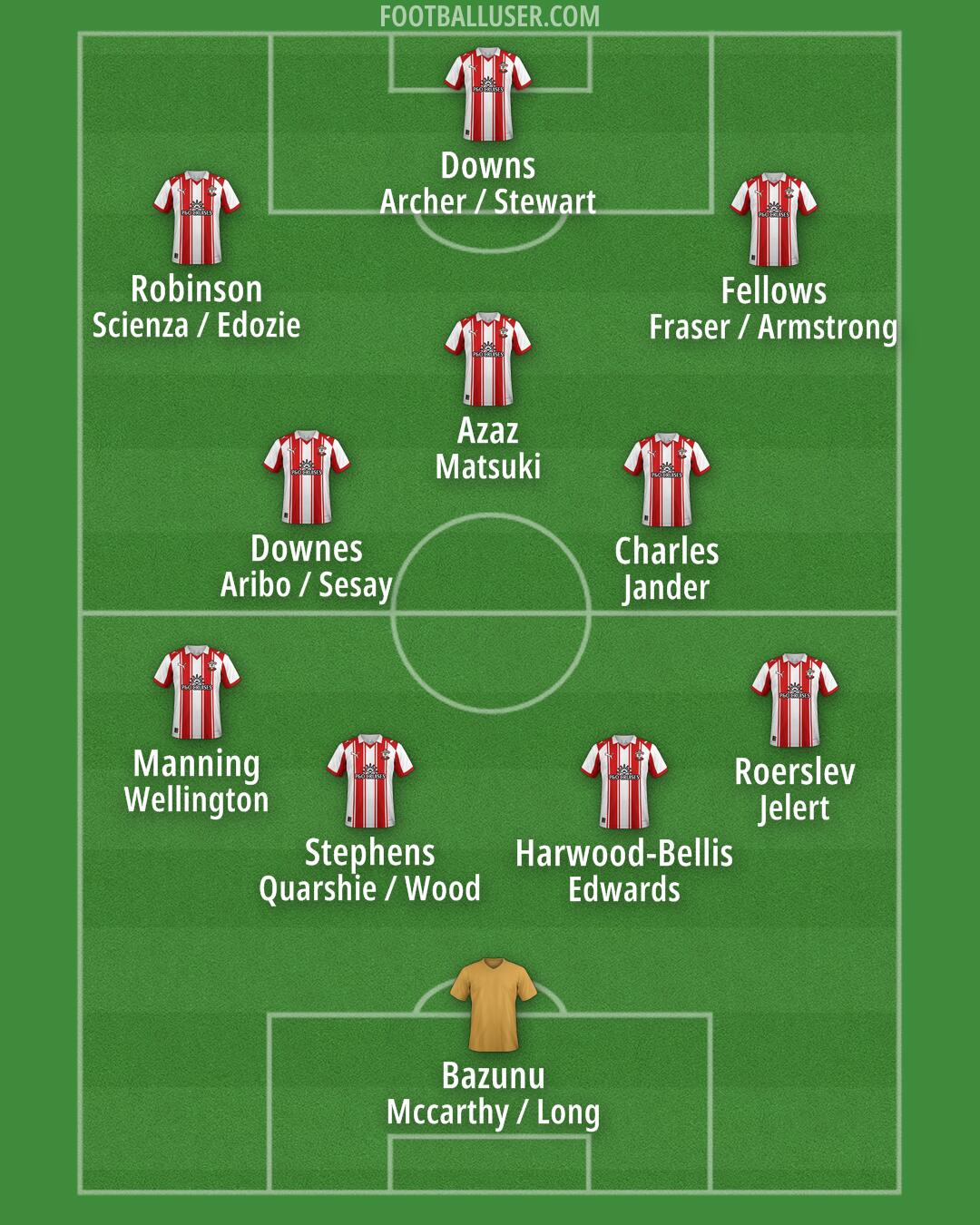
Bazunu (Mccarthy / Long) · Stephens (Quarshie / Wood) · Roerslev (Jelert) · Harwood-Bellis (Edwards) · Manning (Wellington) · Downes (Aribo / Sesay) · Charles (Jander) · Azaz (Matsuki) · Fellows (Fraser / Armstrong) · Robinson (Scienza / Edozie) · Downs (Archer / Stewart)Southampton rely on a high press and verticality to unsettle opponents using a 4-3-3. This formation is built to win the ball high up the pitch and quickly move it into the final third. The Saints look to control games by squeezing the space in the middle and forcing turnovers near the opposition goal.
Bazunu operates between the posts to start the build up. In front of him, a flat back four maintains a high line to keep the team compact. Harwood-Bellis and Stephens act as the central duo, with Harwood-Bellis playing as a ball playing defender to progress through the thirds. Stephens provides aerial strength and covers the space behind when the line steps up. Roerslev and Manning act as wide defenders, with Roerslev looking to overlap the winger while Manning stays wider to provide width. The defensive unit works together to hold the line and trigger a press when the ball enters their zone.
The midfield operates as a three man midfield with a carrier and an attacking ten. Downes and Charles sit in the middle to control the tempo and shield the defense. Downes acts to win the second ball and intercept passes, while Charles looks to carry the ball forward to connect the lines. Azaz plays in the hole as an attacking ten behind the striker to find pockets of space. Azaz is tasked to press aggressively to win the ball high and create chances by playing through the lines. This trio ensures the team can transition from a mid-block to an attacking position quickly.
Southampton use three attackers across the front to stretch the defence. Robinson and Fellows play as wide wingers, with Robinson cutting inside to find shooting lanes and Fellows looking to get to the byline. Downs acts as a pressing centre-forward to pin the last defender and fight for long balls. The attack relies on quick combinations to split the defence with a through ball. When the wingers pull wide, it creates space for Azaz to arrive late into the box or for the full backs to provide extra passing options.
This lineup offers several tactical advantages, including the ability to press high in coordinated waves. By using a high line and an aggressive midfield, Southampton can win the ball back high up the pitch. They also create wide overloads when Roerslev and Manning push up to support the wingers. This pressure often forces the opposition into making mistakes in their own half.
The 4-3-3 formation makes Southampton a dangerous side for teams that struggle to play out from the back. This setup is best suited for games where the team can exploit space behind a high defensive line.