
Germany National Football Team Formation
 September 2, 2025


Starting Lineup
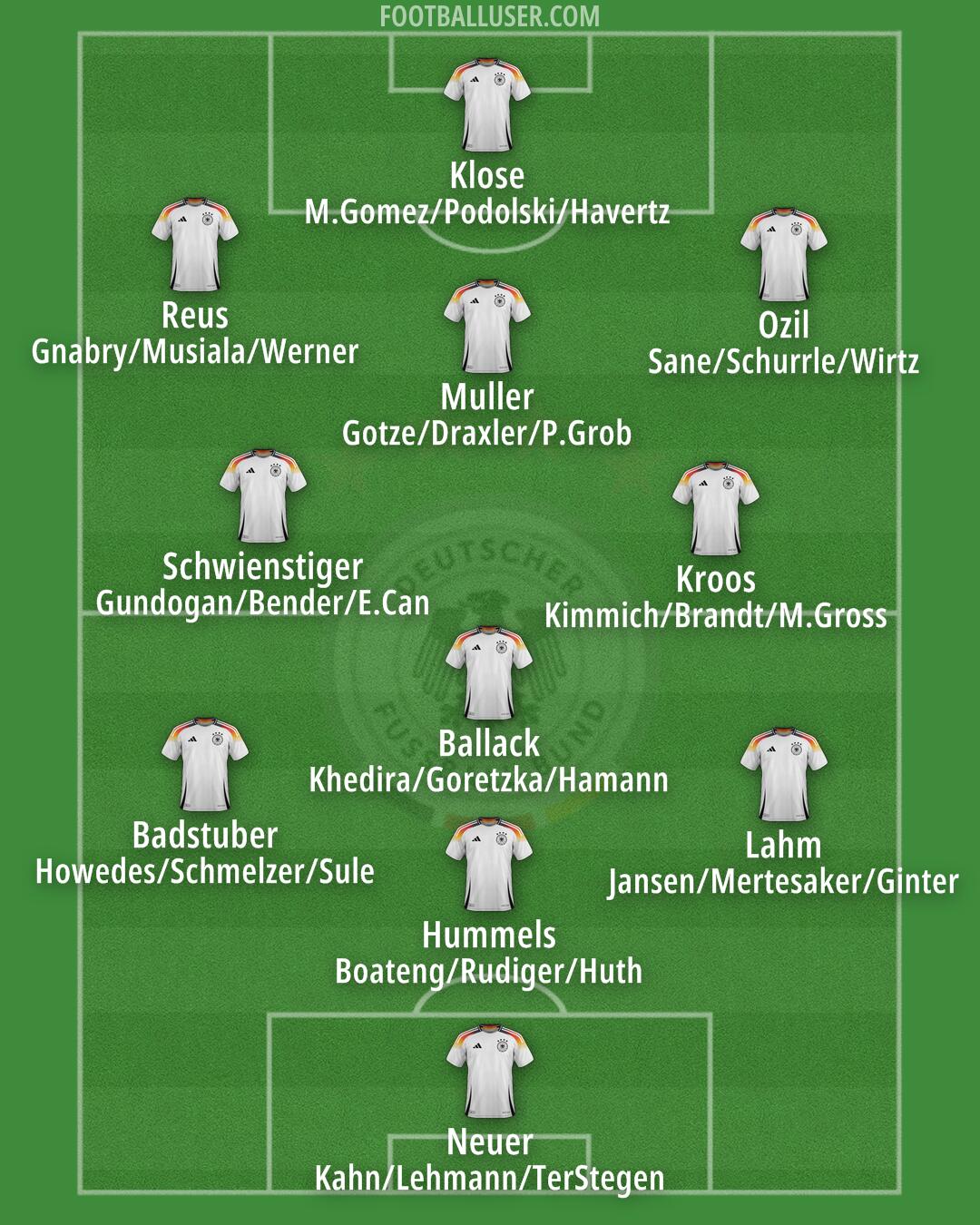
Neuer (Kahn/Lehmann/TerStegen) · Klose (M.Gomez/Podolski/Havertz) · Muller (Gotze/Draxler/P.Grob) · Ozil (Sane/Schurrle/Wirtz) · Reus (Gnabry/Musiala/Werner) · Lahm (Jansen/Mertesaker/Ginter) · Hummels (Boateng/Rudiger/Huth) · Ballack (Khedira/Goretzka/Hamann) · Schwienstiger (Gundogan/Bender/E.Can) · Kroos (Kimmich/Brandt/M.Gross) · Badstuber (Howedes/Schmelzer/Sule)Germany plays a high intensity brand of football built to overwhelm opponents with a heavy vertical press and rapid transitions using a 4-2-4. This formation focuses on pinning the opposition in their own half and utilizing wide areas to stretch the defence. The goal is to win the ball high up the pitch and strike quickly before the opposition can settle.
Manuel Neuer operates between the posts, often acting as a sweeper to cover the high line. The back line functions as a flat back four where Lahm acts as an attacking full back to provide width on the right. Badstuber sits on the left to balance the defensive line, while Hummels and Ballack form the central pairing. Hummels is dominant in the air and serves as a ball playing defender to start attacks, while Ballack provides physical presence and strength to win the second ball. The unit works to squeeze the space and push up to support the high press.
A double pivot controls the center of the pitch to bridge the gap between the defence and the front four. Kroos acts as the deep lying playmaker, using his passing range to switch play and find teammates in advanced positions. Beside him, Schweinsteiger works to connect the lines, often carrying the ball forward to drive the team into the final third. This pairing is tasked to shield the defence and recycle possession when the attack stalls. They must be ready to intercept passes and quickly move the ball to the attackers.
The front line is composed of four attackers designed to pin the opposition back line. Klose serves as the primary target man to hold up the ball and finish chances, while Muller operates as a second striker in the hole to find pockets of space. On the flanks, Reus and Ozil act as wide wingers who cut inside to create goalscoring opportunities. Reus uses his pace to run in behind, while Ozil looks to play through the lines with precise passing. This attacking group focuses on combinations in tight spaces and quick movement to isolate defenders.
Germany offers several tactical advantages with this lineup. The formation allows for a high press in coordinated waves to force a long ball from the opponent. By using two central midfielders and four attackers, the team can create numerical superiority in certain zones during the transition. The ability to spread wide with Lahm and the wingers also creates wide overloads that pull the defensive block apart.
This 4-2-4 formation is a high risk, high reward system built on aggressive pressing and direct attacking. It is best suited for games where Germany needs to dominate possession and break down a team that sits deep in a low block.