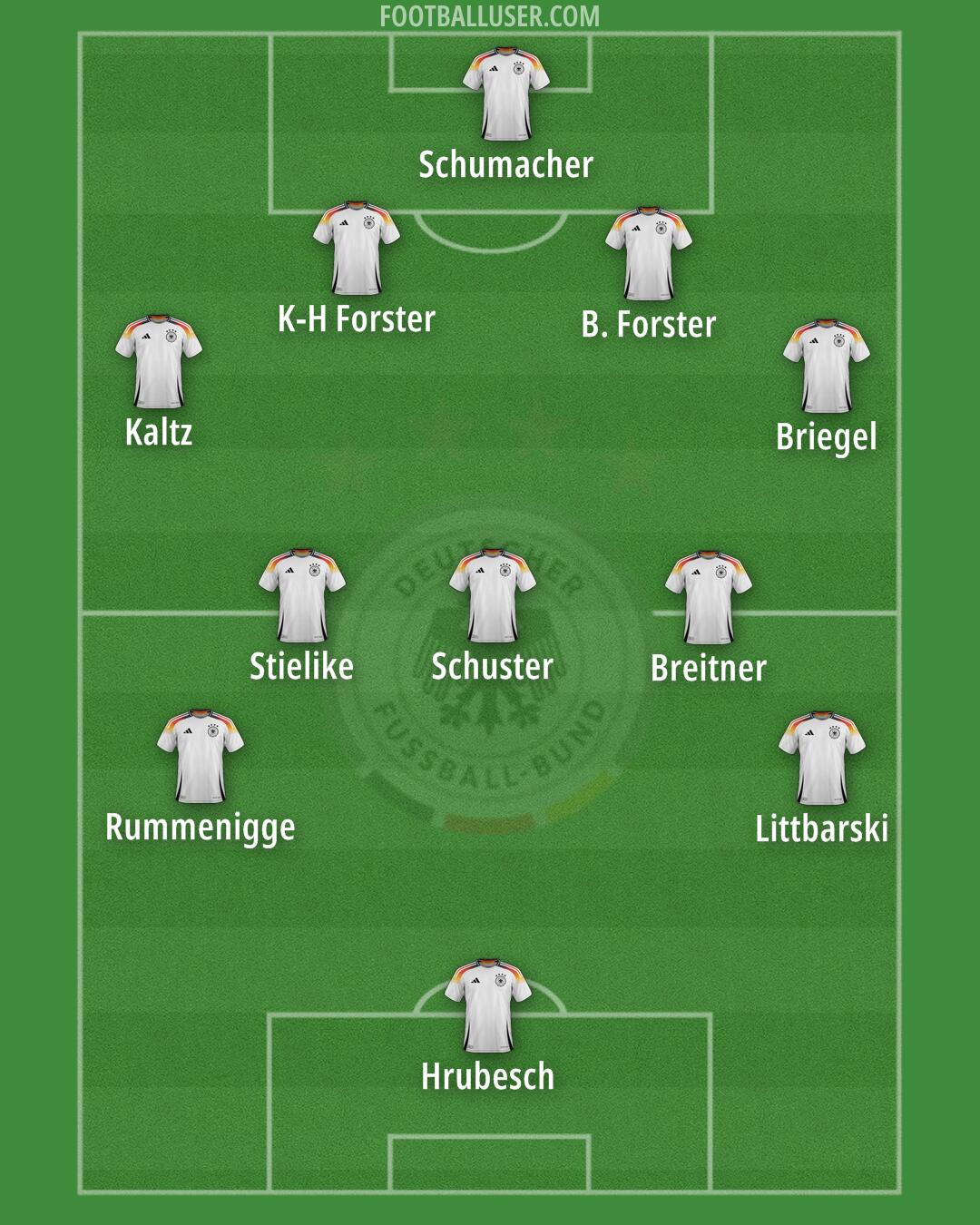

Germany National Football Team Formation
 September 4, 2025


Starting Lineup
Schumacher · Kaltz · K-H Forster · B. Forster · Briegel · Stielike · Schuster · Breitner · Rummenigge · Littbarski · HrubeschGermany aims to control the game through a compact midfield and high intensity, utilizing a 4-5-1 formation. This lineup is built to maintain control in the middle of the pitch while staying ready to strike with speed. The team focuses on winning the ball in central areas and quickly feeding the attackers to exploit gaps in the opposition.
Schumacher starts in goal to organize the defensive unit. The back line functions as a flat back four, with Kaltz acting as the right back and Briegel playing as the left back. In the center, K-H Forster and B. Forster operate as the central defenders. K-H Forster uses his strength to win headers, while B. Forster provides cover to sweep behind the line. The defensive unit works to stay close together, making it difficult for opponents to find space between the lines.
The midfield is a five man unit that provides both cover and service. Schuster sits in the center to shield the defense and recycle possession. Stielike and Breitner work as the engine, with Breitner often driving forward to connect the lines and Stielike staying deeper to intercept play. On the flanks, Rummenigge and Littbarski occupy the half spaces. Rummenigge uses his immense power and clinical finishing to act almost as a second striker, while Littbarski uses his dribbling to push up the wing.
In the attacking phase, Germany relies on a lone striker, Hrubesch, who acts as a target man. Hrubesch stays central to hold up the ball and provide an outlet for long passes. The attack is built through the wide players, Littbarski and Rummenigge, who look to cut inside or cross into the box. This setup encourages runs in behind from the midfielders, creating combinations that catch the defense off guard. The forwards press from the front to force the opposition into mistakes.
This formation offers significant tactical advantages, specifically the ability to create numerical superiority in the midfield. By packing the center with Schuster, Stielike, and Breitner, Germany can dominate the ball and win the second ball. Another strength is the ability to shift quickly from a mid-block to a counter at pace once the ball is won. The presence of Rummenigge in the attacking midfield role allows the team to pin the last defender and create chaos in the final third.
Germany uses this 4-5-1 to dominate the central zones and transition with lethal speed. This formation is best suited for games against teams that play with a single pivot or those that struggle to cope with high pressing in the middle.