QPR Football Formation
 September 4, 2025


Starting Lineup
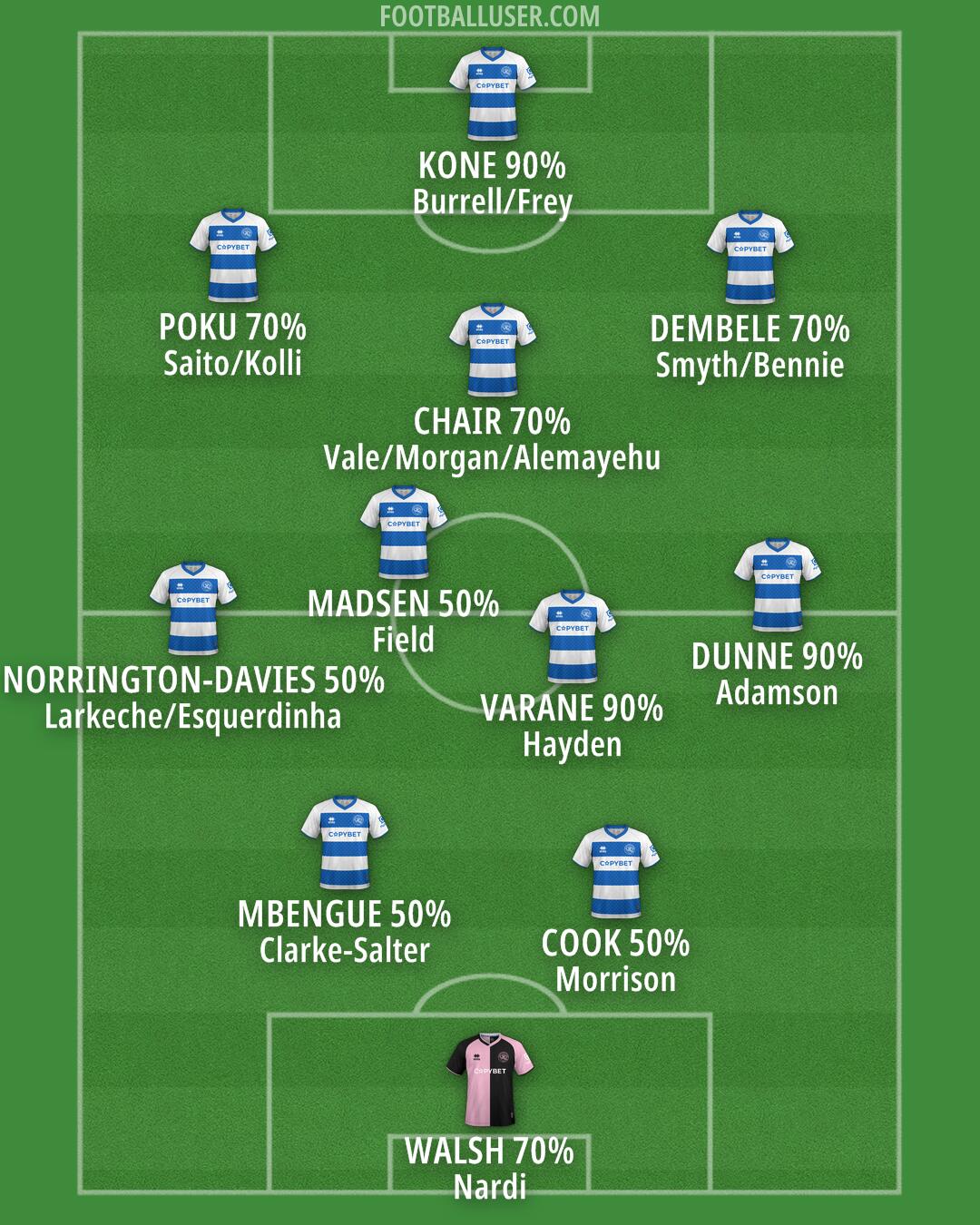
WALSH 70% (Nardi) · NORRINGTON-DAVIES 50% (Larkeche/Esquerdinha) · DUNNE 90% (Adamson) · MBENGUE 50% (Clarke-Salter) · COOK 50% (Morrison) · MADSEN 50% (Field) · VARANE 90% (Hayden) · CHAIR 70% (Vale/Morgan/Alemayehu) · POKU 70% (Saito/Kolli) · DEMBELE 70% (Smyth/Bennie) · KONE 90% (Burrell/Frey)QPR look to play a vertical game built around quick transitions and high energy in a 2-5-3 formation. This lineup aims to overwhelm the opponent in the final third by pushing a large number of players forward to create chaos. The intent is to win the ball high up the pitch and move toward the goal with speed rather than keeping possession for long periods.
In goal, WALSH acts as the last line of defense. The defensive unit relies on a narrow back two consisting of COOK and MBENGUE. These central defenders must be ready to cover large amounts of space behind them as the team pushes up. COOK and MBENGUE operate in a high line to squeeze the space in the middle, requiring them to be alert to any runners moving in behind. They must win the second ball and clear the lines quickly when the opposition attempts to bypass the midfield.
The midfield is heavily populated to control the central areas and provide width. VARANE and MADSEN work as a central pairing to protect the two defenders, while CHAIR operates as an attacking ten to link the lines. The width comes from DUNNE on the right and NORRINGTON-DAVIES on the left. DUNNE and NORRINGTON-DAVIES must track back to support the two defenders when the team loses the ball. CHAIR looks to play through the lines to find the attackers, while VARANE and MADSEN provide the grit to win the ball back in a mid-block.
The attacking front three is designed to pin the opposition back. KONE leads the line as a lone striker, tasked to hold up the ball and wait for support. POKU and DEMBELE act as wide attackers, with POKU on the left and DEMBELE on the right. They look to cut inside to create central threats or spread wide to stretch the defence. These three forwards must press from the front to force a long ball and disrupt the opposition build up. They often work in combinations to find gaps in the defensive line.
QPR possess several tactical advantages with this setup. The formation allows for massive numerical superiority in the attacking zones, making it hard for opponents to mark every runner. The wide players and the attacking ten create many passing lanes, which helps the team transition from defense to attack in seconds. Additionally, the heavy presence in midfield allows the team to compress the midfield and win the ball back quickly after a turnover.
This aggressive formation is designed to catch opponents off guard through sheer numbers in the attacking third. It is best suited for games where QPR can exploit a high line or punish teams that struggle to defend wide areas in transition.