
Japan National Football Team Formation
 September 5, 2025
 NK_Leonardoburst


Starting Lineup
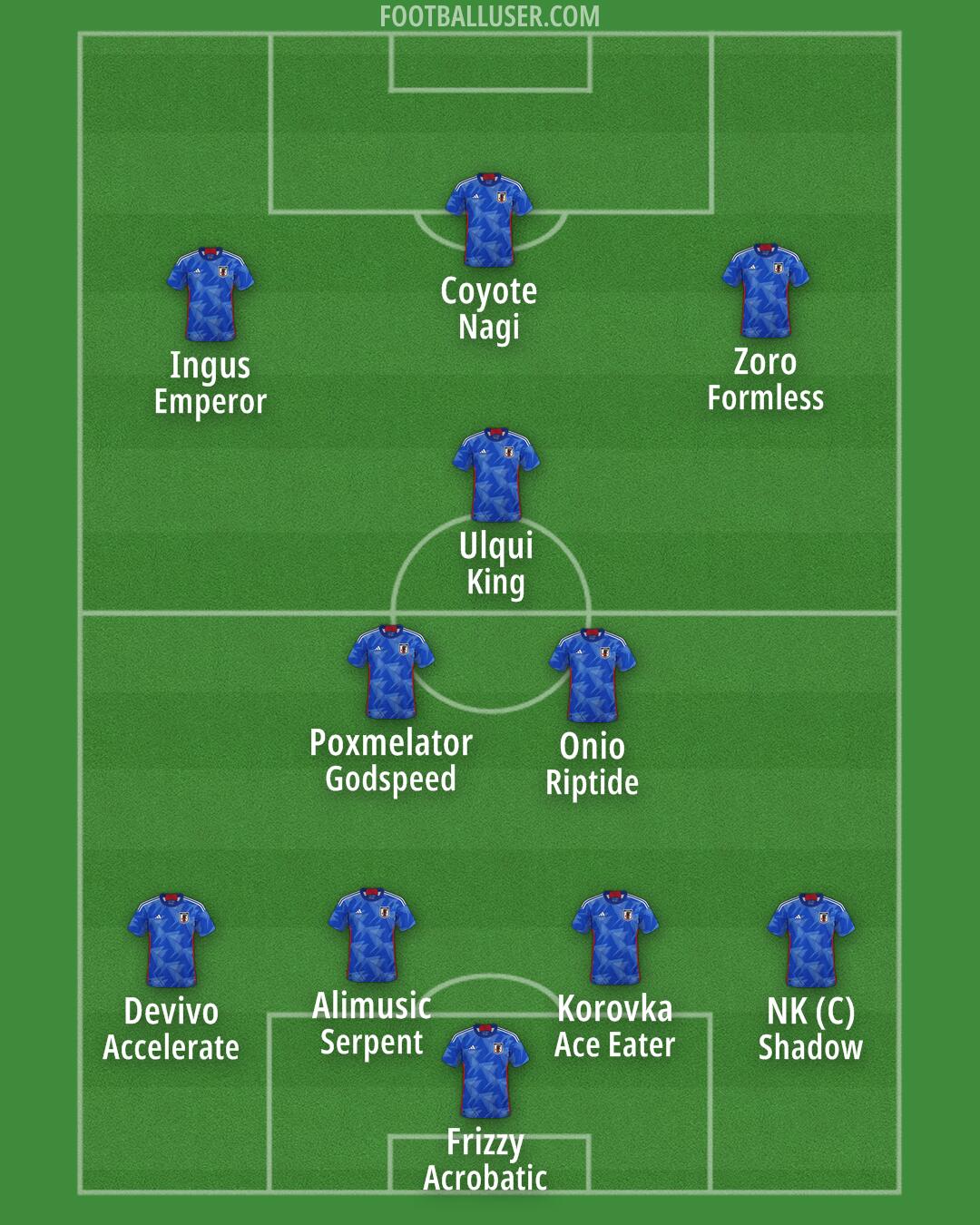
Frizzy (Acrobatic) · Alimusic (Serpent) · Korovka (Ace Eater) · Poxmelator (Godspeed) · NK (C) (Shadow) · Onio (Riptide) · Coyote (Nagi) · Zoro (Formless) · Ingus (Emperor) · Devivo (Accelerate) · Ulqui (King)Japan focuses on high intensity and verticality through a 4-3-3 formation. This lineup is built to win the ball back high up the pitch and break quickly to exploit any gaps in the opposition. Maintaining constant pressure allows the team to force a long ball and win the second ball in advanced areas.
Frizzy operates as the goalkeeper to anchor the defensive unit. A flat back four features NK (C), Devivo, Korovka, and Alimusic. NK (C) acts as a right back who can step up to support the midfield, while Devivo provides balance on the left. Korovka and Alimusic act as the central pair, defending zonally to set the offside trap and squeeze the space. Holding a high line helps the unit stay compact when defending.
The midfield uses a three-man unit to connect the defense and attack. Onio and Poxmelator sit in the central areas to shield the defense and recycle possession. Ulqui plays as the advanced midfielder to link the lines and find the feet of the striker. Both players work to win the second ball and carry the ball forward, while Ulqui looks to play through the lines to progress through the thirds.
Three attackers make up the front line to stretch the defense. Ingus plays on the left as an inverted winger to cut inside, whereas Zoro stays wide on the right to spread the play. Coyote leads the line as a lone striker, tasked to hold up the ball and pin the last defender. These forwards look to create runs in behind and get to the byline to cut it back for teammates.
This formation provides Japan with the ability to press high in coordinated waves. The presence of Ulqui allows the team to find numerical superiority in the final third to create chances. Furthermore, movement from the wide players helps to stretch the defense, creating space for the central attackers to combine in tight spaces and arrive late into the box.
The tactical identity of Japan is defined by aggression and rapid transitions. This formation is best suited for games against opponents that struggle to play short from the back or leave space behind their defensive line.