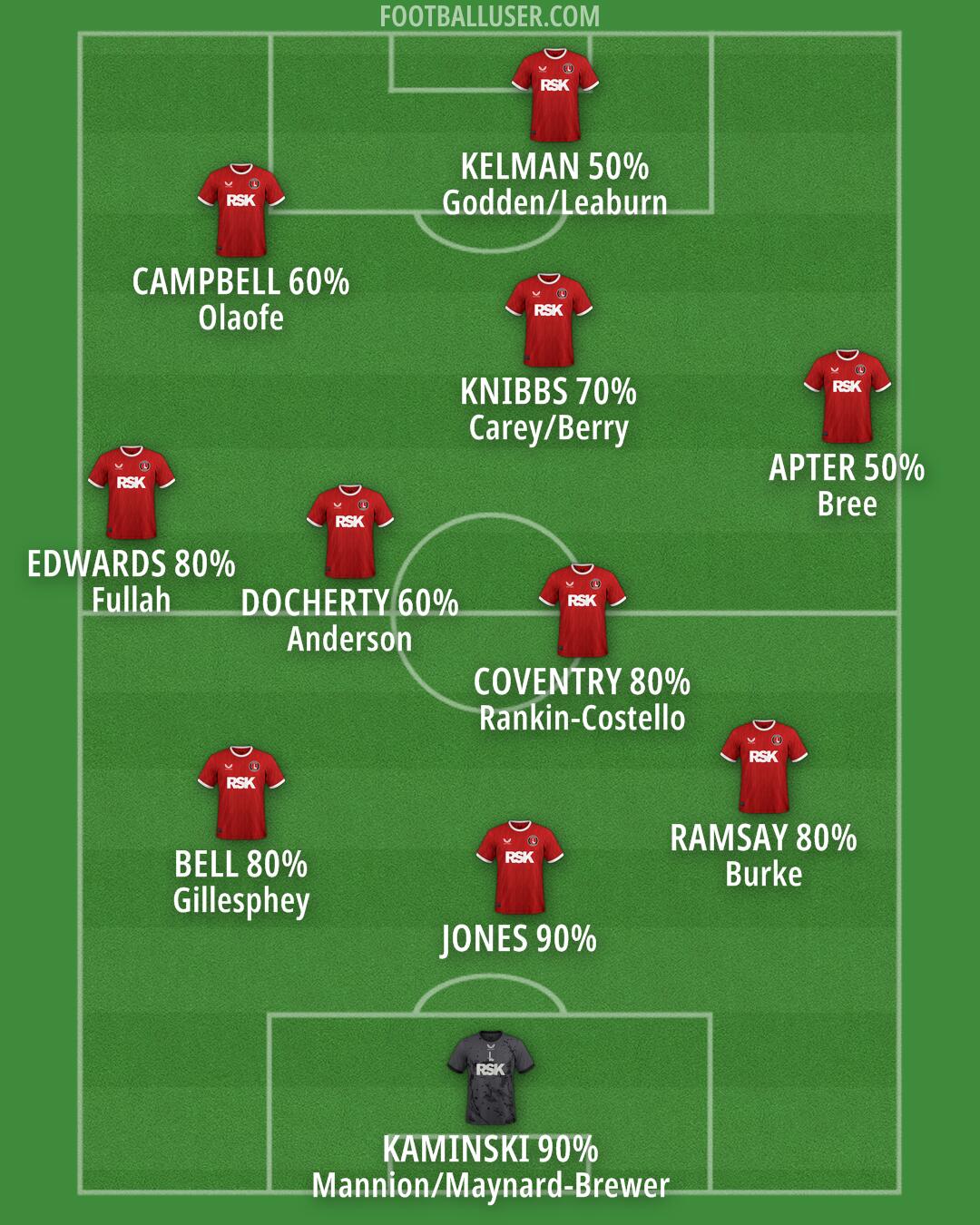
Charlton Football Formation
 September 6, 2025


Starting Lineup
KAMINSKI 90% (Mannion/Maynard-Brewer) · BELL 80% (Gillesphey) · JONES 90% · RAMSAY 80% (Burke) · EDWARDS 80% (Fullah) · APTER 50% (Bree) · COVENTRY 80% (Rankin-Costello) · DOCHERTY 60% (Anderson) · KELMAN 50% (Godden/Leaburn) · CAMPBELL 60% (Olaofe) · KNIBBS 70% (Carey/Berry)Charlton aims to control the middle of the pitch through a heavy concentration of players in the center using a 3-6-1. This formation is built to win the second ball and dominate through high pressing in the middle thirds. By packing the central areas, Charlton intends to suffocate the opposition and recycle possession quickly to maintain pressure.
Kaminski sits between the posts to organize the defensive line. The back three consists of BELL, JONES, and RAMSAY, who operate as a narrow defensive block. JONES acts as the central anchor, while BELL and RAMSAY cover the spaces to the sides. This unit focuses on staying compact to deny the turn to attackers and will step up to catch opponents offside.
The midfield is a massive engine room that connects the defense to the front line. COVENTRY and DOCHERTY form a double pivot to shield the back three, while EDWARDS and APTER play as inverted eights to move between the lines. KNIBBS and CAMPBELL operate in the half spaces to create overloads. This group is tasked to press aggressively to win the ball high up the pitch and drive forward to support the attack.
In the attacking phase, KELMAN operates as a lone striker to pin the last defender. The movement of KNIBBS and CAMPBELL is vital as they make runs into the box to support the lone frontman. The width comes from the midfield players pushing high to stretch the defence. This allows the team to combine in tight spaces and deliver early crosses into the area to create chances.
A major tactical advantage for Charlton is the numerical superiority in midfield which makes it difficult for opponents to find passing lanes. The coordinated waves of players allow them to press in a mid-block or high up the pitch effectively. Additionally, the density of the lineup provides great compactness when defending deep, forcing the opposition to play long balls that the back three can win.
This 3-6-1 formation is designed to overwhelm opponents through central dominance and relentless pressing. It is best suited for games against teams that try to build play through the middle of the pitch.