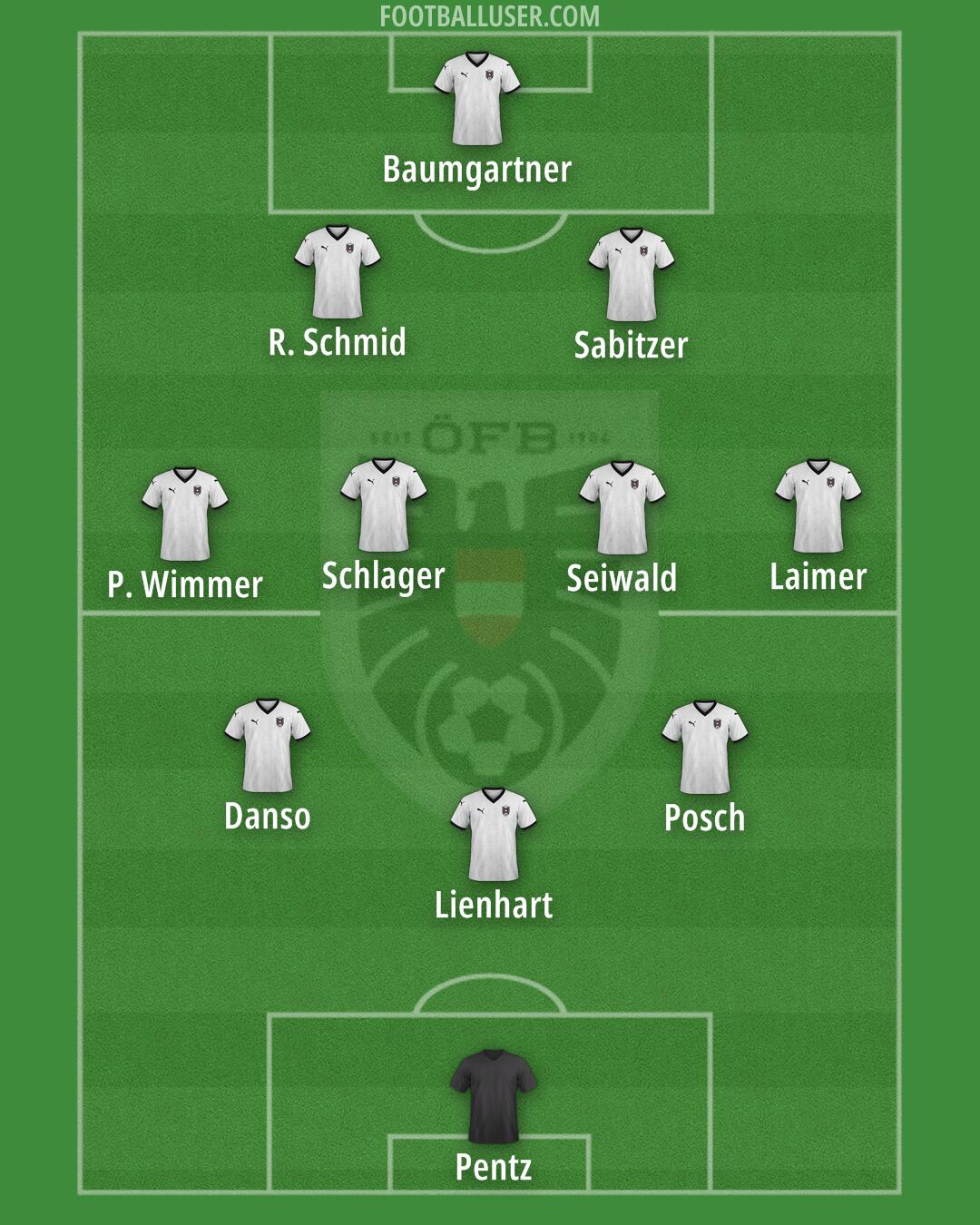

Austria National Football Team Formation
 September 6, 2025


Starting Lineup
Danso · Laimer · Posch · Lienhart · Schlager · Seiwald · Baumgartner · R. Schmid · P. Wimmer · Sabitzer · PentzAustria looks to win the ball back high up the pitch and play with high intensity through a 3-4-3 formation. The team focuses on verticality and immediate pressure to disrupt the opponent before they can settle. This lineup is built to play a direct style of football where they press from the front and look to break quickly once possession is regained in the final third.
Pentz guards the goal while a back three forms the foundation of the defensive unit. Danso and Lienhart sit in the center to win headers and cover space, while Posch plays on the right side of the central trio. When the team plays a high line, these defenders must step up to catch opponents offside. The unit works to hold a compact block to prevent through balls and force the opposition to play wide.
The midfield consists of a four-man line where Seiwald and Schlager occupy the central spaces. Seiwald works to shield the defence and win the second ball, while Schlager helps to recycle possession and connect the defensive and attacking lines. Laimer and P. Wimmer provide the width, acting as wide midfielders who push high to support the attack or drop back to assist the defenders. This group works to squeeze the space in the middle and win the ball back high up the pitch.
Up front, Baumgartner acts as the central striker to lead the press against the opposition back line. He looks to find the feet of his teammates or make runs in behind the defenders to exploit gaps. Sabitzer and R. Schmid operate from wide areas, with Sabitzer often looking to cut inside to create chances in the half spaces. The front three aim to stretch the defence and create combinations through quick passing and movement in tight spaces.
The main advantages of this Austria formation are the ability to press high in coordinated waves and the speed of transition. By using Seiwald and Schlager to control the center, the team can often create numerical superiority in the middle of the pitch. This allows them to win the ball and immediately look to hit in behind on the transition with the movement of the wide players and the central striker.
This 3-4-3 formation is built on aggressive pressing and quick vertical attacks. It is best suited for matches against opponents that try to play short from the back and can be pressured into making mistakes.