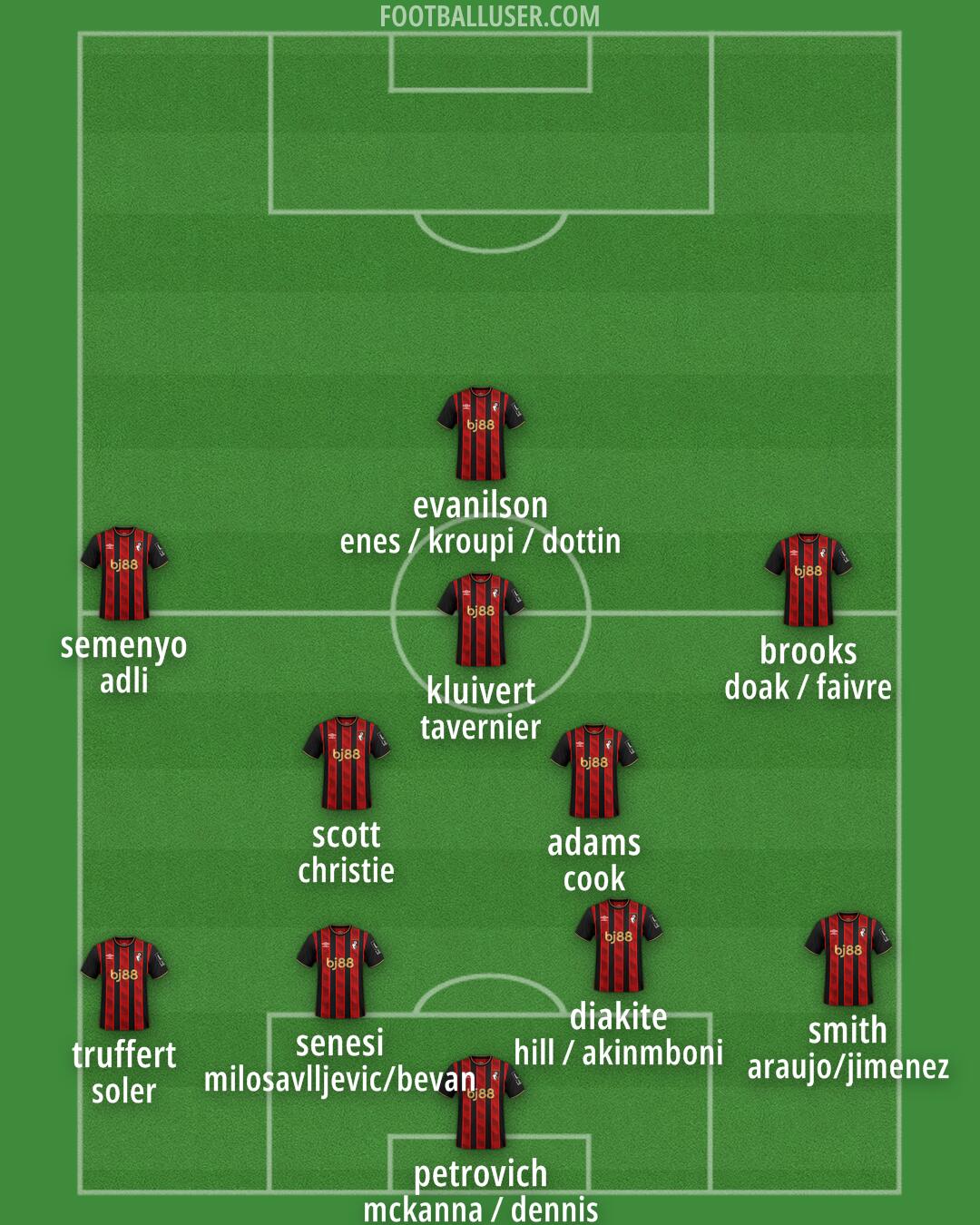
Bournemouth Football Formation
 September 10, 2025
 liderstoper


Starting Lineup
petrovich (mckanna / dennis) · smith (araujo/jimenez) · diakite (hill / akinmboni) · senesi (milosavlljevic/bevan) · truffert (soler) · adams (cook) · scott (christie) · kluivert (tavernier) · brooks (doak / faivre) · semenyo (adli) · evanilson (enes / kroupi / dottin)Bournemouth aims to play a high tempo, vertical game with a 4-2-4 formation. This lineup focuses on heavy attacking pressure and rapid transitions to catch the opposition out of position. The team looks to push high up the pitch to win the ball back quickly and strike direct through the center or out wide.
Petrovich stays between the posts to manage the defensive line. The back four operates as a flat line with Smith at right back and Truffert at left back. Senesi and Diakite act as the central defenders, where Senesi uses his aerial strength and Diakite covers the space behind. The full backs are expected to push up to provide width, while the center backs hold the line to protect against long balls played into the channels.
The midfield functions as a double pivot to bridge the gap between defense and attack. Adams and Scott sit in front of the back four to shield the defense and recycle possession. Scott works to break the line with his passing, while Adams focuses on winning the second ball and protecting the center. This pair must stay compact to prevent the opposition from playing through the middle, ensuring the team stays solid when the full backs move forward.
Attacking dominance is the main goal for Bournemouth with four players positioned high. Semenyo and Brooks operate as wide attackers, where Semenyo often looks to cut inside and Brooks stretches the defense by hugging the touchline. Kluivert and Evanilson lead the line as a striking partnership, using their movement to pin the last defender. The front four press from the front to force a long ball, creating chances through quick combinations and runs in behind.
A major advantage of this formation is the ability to create wide overloads when the full backs join the wingers. This creates a massive presence in the final third that is hard to track. The team also benefits from the speed of transition, as the four attackers can immediately spring forward to exploit space once the midfield wins possession. This allows the club to punish teams that play with a high line.
This 4-2-4 formation is built for aggressive, direct football that looks to overwhelm the opponent. It is best suited for matches where the team wants to dominate the final third and exploit high defensive lines.