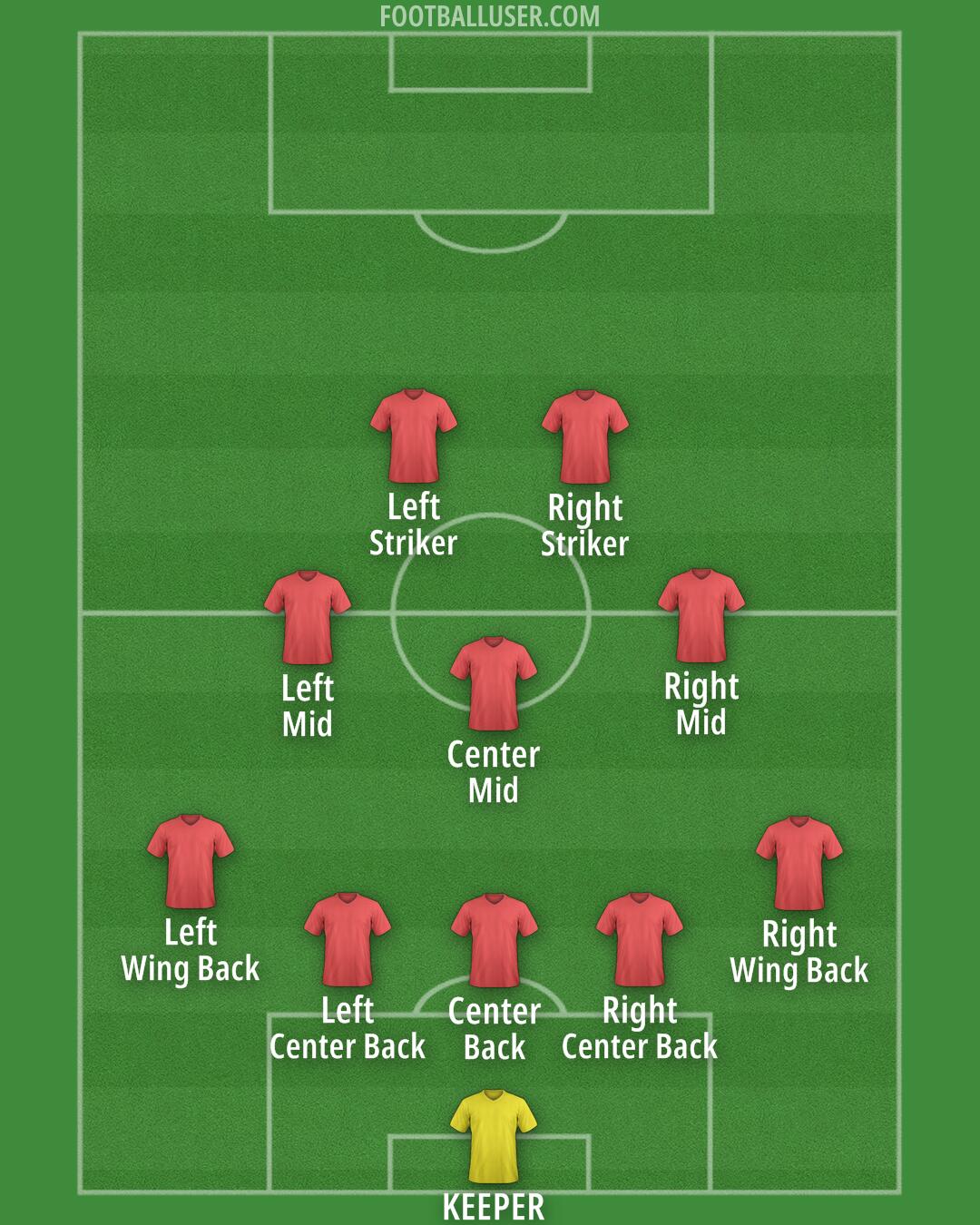
United States National Soccer Team Formation
 September 11, 2025


Starting Lineup
Center (Back) · Left (Center Back) · Right (Striker) · KEEPER · Left (Striker) · Right (Wing Back) · Center (Mid) · Right (Center Back) · Right (Mid) · Left (Wing Back) · Left (Mid)United States aims to remain defensively solid while looking to hit opponents on the break through a 5-3-2 formation. This lineup is built to sit deep and squeeze the space between the lines, making it hard for opponents to find any room to play. The team relies on a compact defensive block to absorb pressure before launching quick transitions through the middle and wide areas.
The KEEPER acts as the last line of defense while the back five provides a wide and deep defensive layer. A flat back three consisting of the LCB, Center CB, and RCB provides a strong central presence, with the RCB and LCB often tasked with defending the wide channels. The RWB and LWB act as attacking wing backs who provide the necessary width in possession, but they must track back quickly to form a five man line when the team loses the ball. The central defenders must be dominant in the air to clear crosses and capable of covering for one another to maintain a strong zonal line.
In the middle of the pitch, United States employs a three man midfield with a carrier to connect the phases of play. The LCM and RCM work to win the second ball and cover the space left by the wing backs, while the CM holds the position to shield the defense. This central trio works to compress the midfield and prevent opponents from playing through the lines. When the team wins the ball, the midfielders look to find the forwards quickly or carry the ball forward to break the first line of the opposition press.
The attacking unit uses two forwards in a partnership to stretch the opposition defense. The LS and RS operate as a duo, often working in combination to pull defenders out of position. One forward may act as a target man to hold up the ball, while the other looks to make runs in behind the defense. By using two attackers, the formation creates constant pressure on the opposition center backs, especially when the RS and LS use quick one-two combinations to create space for themselves.
One major advantage of this formation is the ability to create wide overloads when the RWB and LWB push high up the pitch to support the attack. The team also benefits from extreme compactness when defending in a low block, which makes it very difficult for opponents to penetrate the central areas. This ability to shift between a five man defense and a more attacking setup allows United States to control the tempo of the game based on the match situation.
This 5-3-2 formation provides a reliable platform for teams that want to defend with numbers and strike with speed. It is best suited for matches against teams that dominate possession, allowing United States to sit deep and counter at pace.