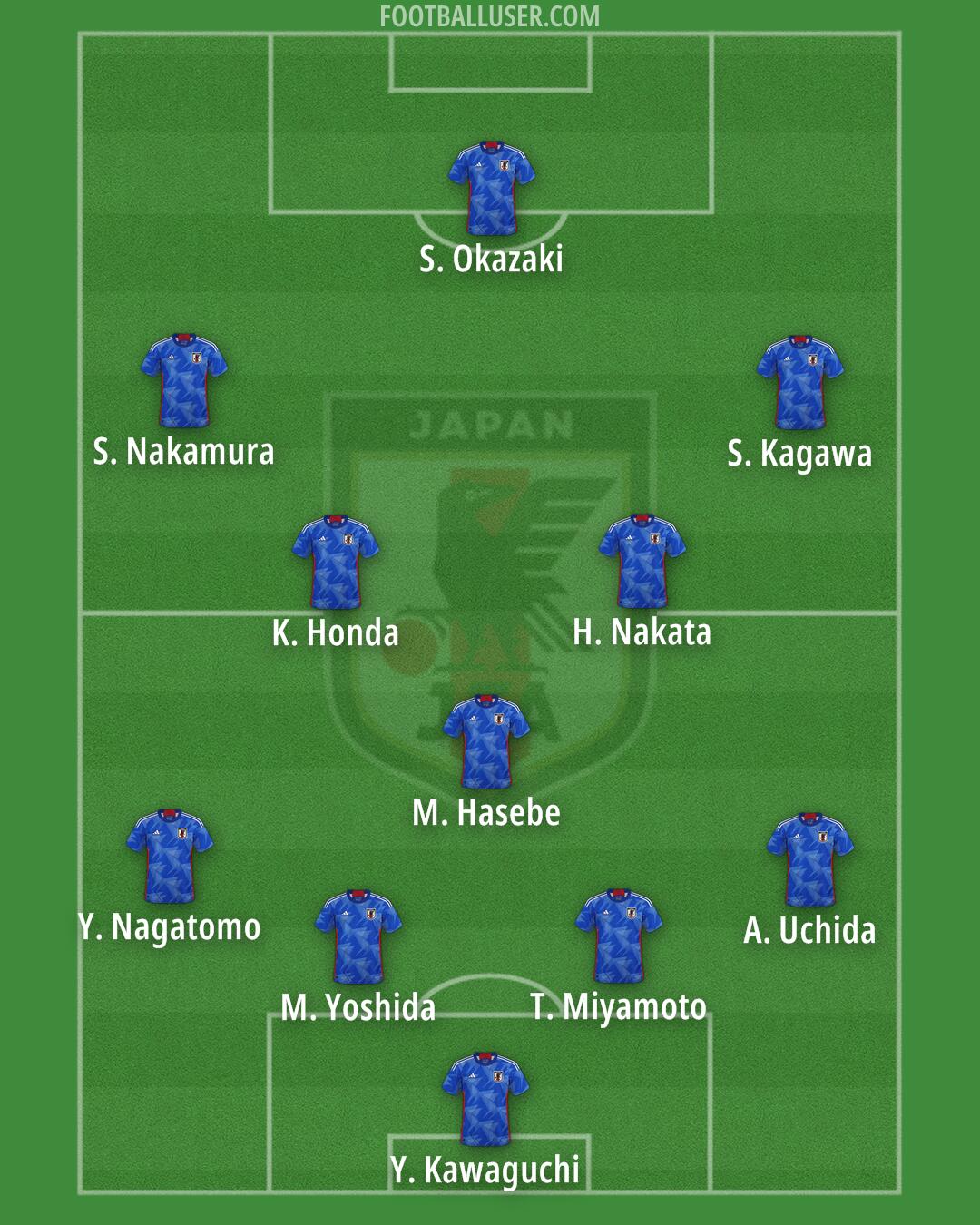

Japan National Football Team Formation
 September 12, 2025


Starting Lineup
Y. Kawaguchi · A. Uchida · Y. Nagatomo · T. Miyamoto · M. Yoshida · M. Hasebe · K. Honda · S. Nakamura · H. Nakata · S. Kagawa · S. OkazakiJapan focuses on a defensively solid identity through a 5-4-1 formation. This lineup is built to absorb pressure and hit opponents with quick transitions. The team works to stay compact and wait for the right moment to exploit gaps in the opposition defensive lines.
Y. Kawaguchi stays between the posts to manage the defensive line. The back five consists of a central trio where M. Hasebe acts as the anchor to win the header and clear the lines. M. Yoshida and T. Miyamoto operate as the side centre-backs to cover the space behind the wing backs. Y. Nagatomo and A. Uchida play as attacking wing backs who push high up the pitch to provide width. This unit defends zonally to keep the space narrow and force the opposition to the flanks.
The midfield operates in a flat four to protect the central areas. H. Nakata and K. Honda form a double pivot where they shield the defence and recycle possession. H. Nakata uses his passing range to find teammates, while K. Honda works to break the line with vertical passes. S. Nakamura and S. Kagawa play in the half-spaces as attacking midfielders. They look to connect the defensive and attacking lines by finding pockets of space between the opposition midfield and defence.
A lone striker leads the front line. S. Okazaki acts as a pressing centre-forward to harass the opposition back line and win the second ball. He holds up the ball to allow the wide midfielders to join the attack. When the team moves forward, S. Nakamura and S. Kagawa make runs into the box to support him. The attack relies on rapid transitions to catch the opponent out of position.
Japan offers significant advantages through their defensive compactness when defending in a low block. The team can create wide overloads when A. Uchida and Y. Nagatomo overlap the midfielders. This formation also allows the side to catch opponents on the break by hitting in behind on the transition using the speed of the wide players.
The 5-4-1 formation provides a reliable way for Japan to sit deep and deny space. It is a setup best suited for matches against teams that dominate possession and require a disciplined defensive unit.