Man City Football Formation
 September 14, 2025


Starting Lineup
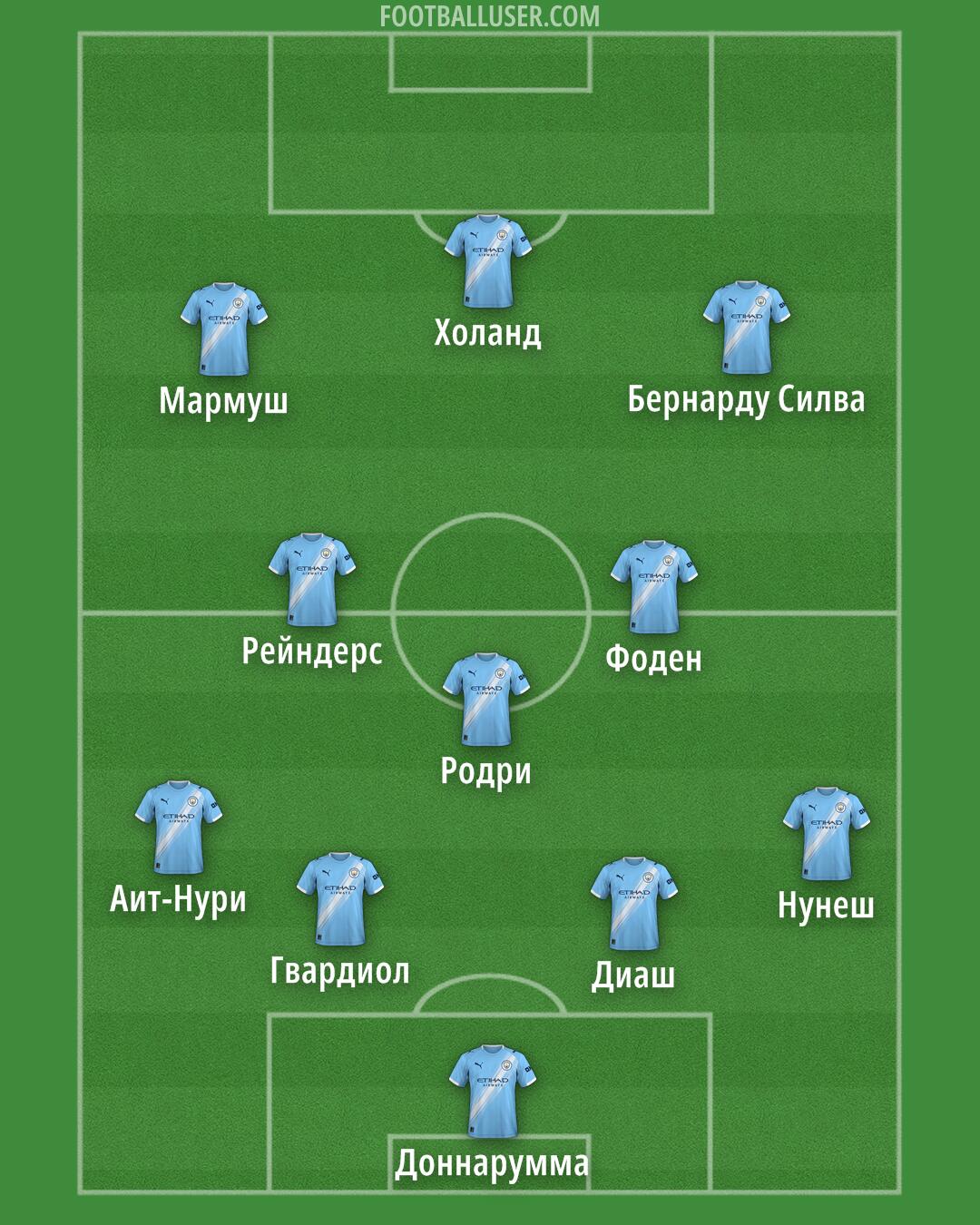
Доннарумма · Аит-Нури · Гвардиол · Диаш · Нунеш · Родри · Рейндерс · Бернарду Силва · Мармуш · Фоден · ХоландMan City prioritizes possession based football to control the tempo and squeeze the space of the opposition. This 4-3-3 formation is built to dominate the ball and pin the opponent in their own half. By keeping the ball moving through various lines, the team seeks to create passing lanes that eventually split the defence.
Donnarumma starts in goal to act as the first line of ball distribution. The back line operates as a flat back four where Nuñez acts as an attacking full back to provide width. Gvardiol and Dias form the central pairing, with Dias using his aerial strength to defend set pieces and Gvardiol acting as a ball playing defender to play out from the back. Ait-Nouri plays as an attacking left back to overlap the winger, while the unit works together to hold a high line and trigger a press when the ball is lost.
The midfield functions as a three-man midfield with a single pivot. Rodri sits in front of the defence to shield the back four and recycle possession. Reijnders connects the defensive and attacking lines by carrying the ball forward, while Foden operates in the half-spaces to create chances. This trio works to compress the midfield and ensure the team can always find a way to progress through the thirds.
The attacking line uses three attackers across the front to stretch the defence. Marmush plays as an inverted winger on the left to cut inside and threaten the goal. Bernardo Silva occupies the right wing to help build play and find the feet of the striker. Haaland acts as the main target man, using his physicality to hold up the ball and make runs in behind the last defender. The forwards press from the front to force a long ball from the opposition.
This lineup offers significant advantages through its ability to create numerical superiority in midfield. Man City can also use wide overloads from the overlapping runs of Nuñez and Ait-Nuri to overwhelm the flanks. The speed of transition allows the team to hit in behind on the transition when the opposition is caught out of position.
This 4-3-3 formation is designed to control matches through heavy ball retention and territorial dominance. It is best suited for games against teams that sit deep in a low block and require constant pressure to break down.