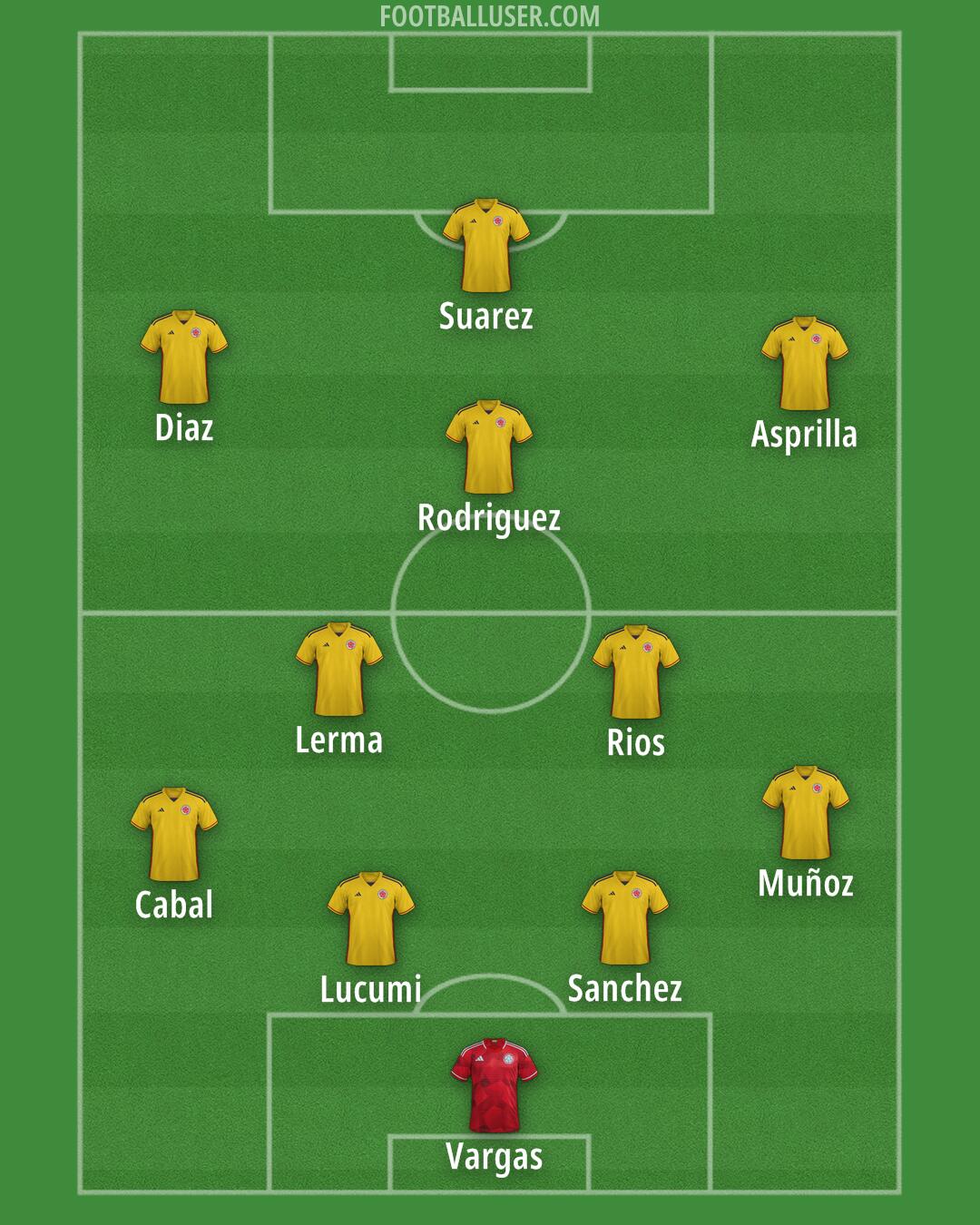

Colombia National Football Team Formation
 September 15, 2025


Starting Lineup
Suarez · Diaz · Asprilla · Rodriguez · Lerma · Rios · Cabal · Lucumi · Sanchez · Muñoz · VargasColombia looks to dominate through high intensity and quick transitions in this 4-3-3. This formation is built to play a vertical game, hunting for the ball high up the pitch and moving forward with speed once it is won. The lineup aims to stretch the opposition and use the natural pace of the front three to create scoring chances through direct play.
Vargas acts as the last line of defense in goal. The back line functions as a flat back four where the defenders must stay compact to avoid leaving gaps behind. Sanchez and Lucumi work as the central pair, with Sanchez often using his strength to win headers and Lucumi covering the space behind him. On the flanks, Cabal and Muñoz act as full backs that provide width, with Muñoz looking to overlap when the ball moves wide and Cabal helping to squeeze the space in the midfield.
The midfield works as a three-man unit with a focus on energy and ball retention. Lerma and Rios play as the engine room, with Lerma providing a physical presence to win the second ball and Rios helping to carry the ball forward. Rodriguez operates as the attacking ten behind the striker, looking to find pockets of space between the lines to play through the lines. This trio connects the defense to the attack, with the two central midfielders often dropping to help build play from the back.
A heavy emphasis is placed on the front three to pin the last defender. Diaz and Asprilla operate as wide wingers who look to cut inside and challenge the opposition defense centrally. Diaz uses his dribbling style to beat his man on the flank, while Asprilla looks to make runs in behind. Suarez plays as the lone striker, acting as the focal point to hold up the ball and allow the wingers to join the attack. The forwards press from the front to force a long ball from the opposition.
Colombia finds success through the speed of transition when the ball is recovered in the middle third. The ability to hit in behind on the transition allows the team to punish opponents who play a high line. Wide overloads are created when the full backs push up to support the wingers, creating numerical superiority in the final third. This allows the team to spread wide and then quickly combine in tight spaces.
This 4-3-3 formation relies on high pressing and rapid movement to overwhelm the opponent. It is best suited for games against teams that struggle to play out from the back under pressure.