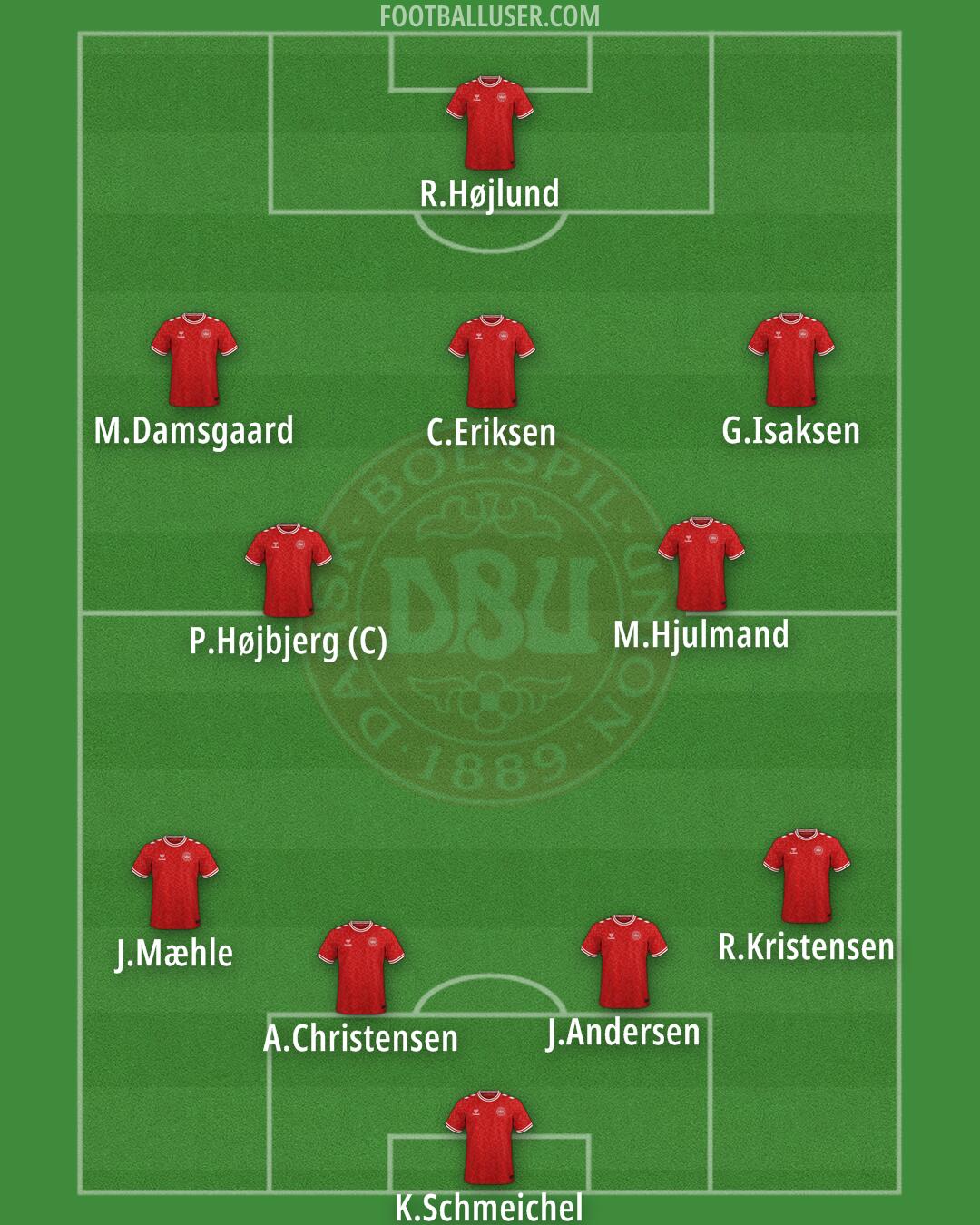

Denmark National Football Team Formation
 September 15, 2025
 bosan
bosan


Starting Lineup
K.Schmeichel · J.Andersen · A.Christensen · J.Mæhle · R.Kristensen · P.Højbjerg (C) · M.Hjulmand · C.Eriksen · M.Damsgaard · R.Højlund · G.IsaksenDenmark prefers to play a direct and vertical style of football with a 4-5-1 formation. This lineup is built to absorb pressure and strike with speed. The team aims to use the physical presence of their lone forward to hold up the ball while the midfield unit works to win the second ball.
Kasper Schmeichel guards the goal and organizes the defensive unit. The back four consists of a flat line where Jannes Andersen and Andreas Christensen act as central defenders. Andersen provides aerial strength while Christensen works to cover space and intercept passes. On the flanks, Joakim Mæhle operates as an attacking full back to provide width, while Rasmus Kristensen plays a more defensive role to help secure the back line. The unit stays compact to deny the turn to opposition attackers.
A five man midfield provides the engine for Denmark. The captain, Pierre-Emile Højbjerg, sits in a single pivot role to shield the defence and recycle possession. Beside him, Morten Hjulmand acts as a carrier to drive the ball forward. Christian Eriksen operates as the main creator, looking to play through the lines with his passing range. Alongside him, Morten Damsgaard and Gustav Isaksen occupy the half spaces to connect the defensive and attacking lines. This group works to squeeze the space in a mid block.
The attacking plan relies on Rasmus Højlund acting as a lone striker. He is tasked to pin the last defender and find the feet of the striker when the team moves up the pitch. When the team breaks quickly, Højlund works to hold up the ball to allow Isaksen and Damsgaard to join the attack. The wingers often pull wide to stretch the defence before cutting inside to create numerical superiority in central areas. This movement creates runs in behind for the midfielders to exploit.
This formation offers great compactness when defending deep. By using a five man midfield, Denmark can easily shift between shapes to cover wide areas or pack the center. The team also benefits from the speed of transition, using the passing range of Eriksen to hit in behind on the transition.
Denmark uses this 4-5-1 formation to remain hard to beat against technically superior sides. It is best suited for games where the team needs to sit deep and counter at pace.