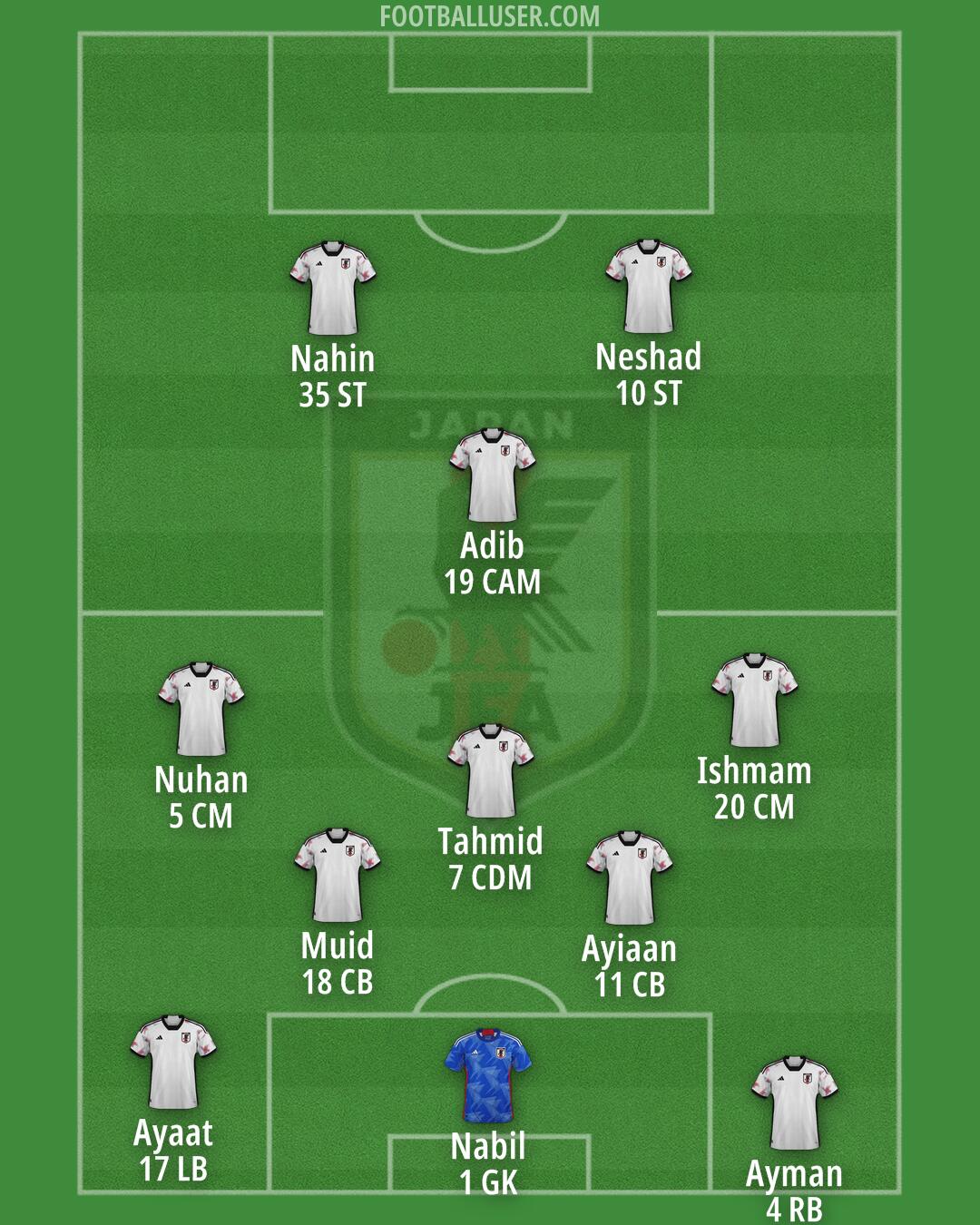

Japan National Football Team Formation
 September 16, 2025
 Ayiaan


Starting Lineup
Nabil (1 GK) · Ayman (4 RB) · Ayaat (17 LB) · Muid (18 CB) · Ayiaan (11 CB) · Tahmid (7 CDM) · Ishmam (20 CM) · Nuhan (5 CM) · Adib (19 CAM) · Nahin (35 ST) · Neshad (10 ST)Japan looks to dominate through central density and overwhelming numbers in the middle of the pitch using a 2-6-2 formation. This lineup is built to squeeze the space in the center and force opponents into wide areas where they can be trapped. The team aims to control the rhythm by packing the midfield, making it very difficult for any opponent to play through the center.
Nabil sits between the posts to guard the goal while the defensive unit remains extremely compact. Ayman and Ayaat operate as a narrow duo of central defenders, sitting deep to protect the goal. Since there are no full backs, these two must stay disciplined and cover the large amount of space behind them. They act as the last line of defense, focusing on winning the second ball and clearing the lines when the high press is bypassed.
The midfield is the engine of Japan, consisting of a massive six man block designed to win possession high up the pitch. Ayiaan and Muid act as a double pivot to shield the defense, while Tahmid occupies the central space to recycle possession. Nuhan and Ishmam operate in the half spaces to link the play, and Adib plays as an attacking ten behind the forwards. This group is tasked to press aggressively to win the ball high up the pitch and quickly find the feet of the striker.
The attacking unit relies on a partnership of two forwards to occupy the opposition back line. Nahin and Neshad play as a front two, working together to create chaos in the box. They often combine in tight spaces to break the line with quick passes. While the midfielders push forward to support, Nahin and Neshad must be ready to run in behind or hold up the ball to allow the massive midfield group to join the attack.
A major advantage of this formation is the ability to create massive numerical superiority in midfield, making it almost impossible for teams to retain the ball. The compactness when defending in a mid-block allows Japan to squeeze the space and force long balls. This setup also allows for quick transitions where the large midfield group can suddenly swarm the opponent.
This formation relies on a massive central presence to choke the game and dominate possession. It is best suited for matches against teams that struggle to play through heavy pressure in the center.