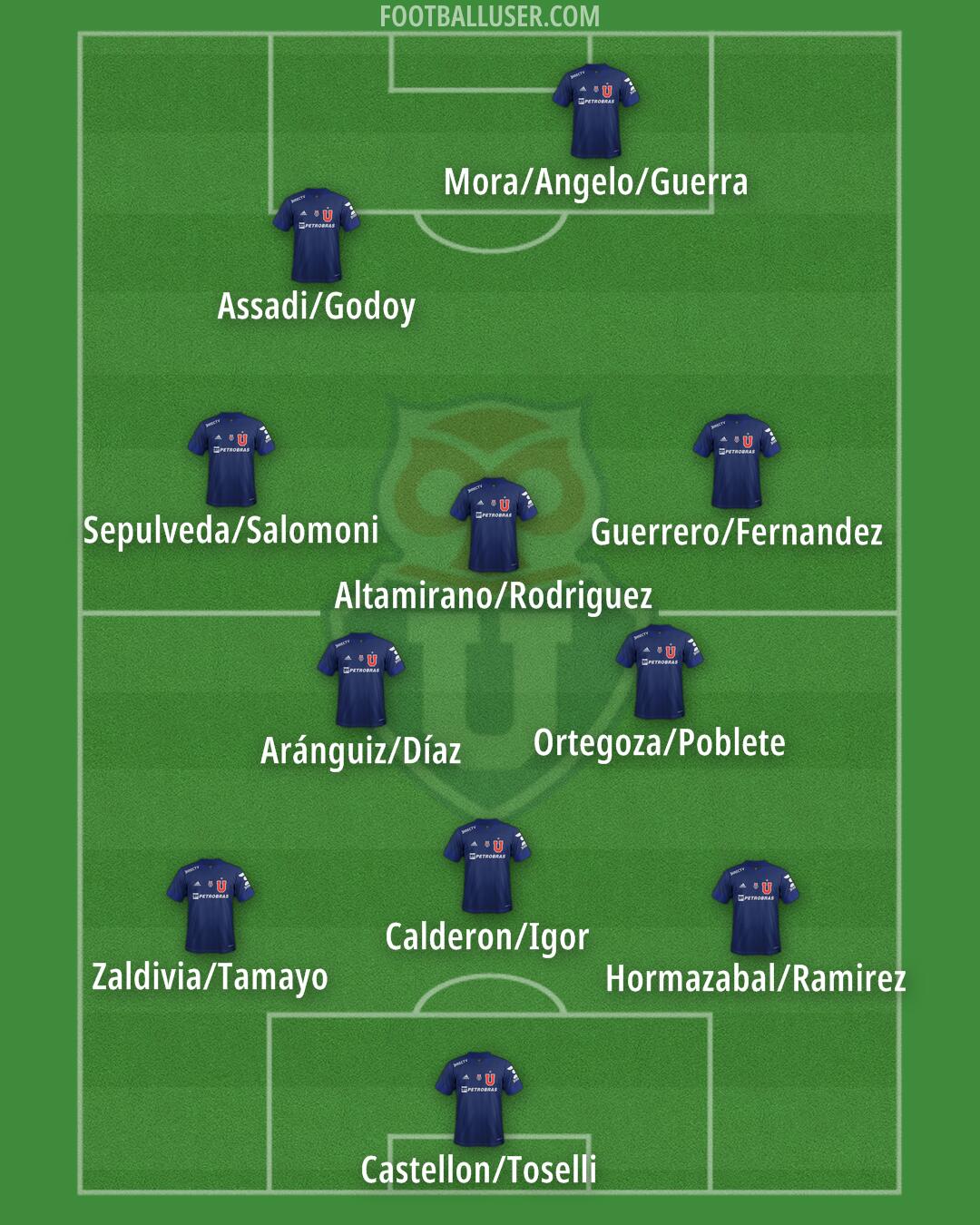

Univ. de Chile Football Formation
 September 17, 2025


Starting Lineup
Castellon/Toselli · Zaldivia/Tamayo · Calderon/Igor · Hormazabal/Ramirez · Guerrero/Fernandez · Sepulveda/Salomoni · Aránguiz/Díaz · Ortegoza/Poblete · Altamirano/Rodriguez · Mora/Angelo/Guerra · Assadi/GodoyUniv. de Chile plays with a heavy focus on controlling the middle of the pitch through a 3-6-1 formation. This lineup is built to dominate through high volume passing and constant pressure in the central zones. The team aims to pin the opposition back and use a crowded midfield to dictate the tempo of the game.
Castellon or Toselli acts as the last line of defense in goal. The defensive unit sits in a back three with Calderon or Igor acting as the central anchor to protect the middle. Hormazabal or Ramirez covers the right side while Zaldivia or Tamayo holds the left. These players must remain compact to prevent through balls and are tasked to defend zonally while managing the space behind them.
The midfield is the engine room for Univ. de Chile and functions as a massive block of six players. Aránguiz or Díaz and Ortegoza or Poblete work as a double pivot to shield the defense and win the second ball. Moving forward, Altamirano or Rodriguez and Guerrero or Fernandez occupy the central spaces to drive the ball forward. Sepulveda or Salomoni provides extra cover while Assadi or Godoy operates in the hole as an attacking ten to link the midfield to the front line.
In the final third, the team relies on a lone striker in Mora, Angelo, or Guerra to lead the line. This forward must hold up the ball and wait for the midfielders to arrive late into the box. The attack is built through quick combinations in tight spaces rather than long balls. Assadi or Godoy searches for pockets of space to play through the lines, while the wide midfielders can push up to create overloads.
A major strength of this formation is the numerical superiority in the center of the park. By crowding the middle, the team can easily recycle possession and squeeze the space available to the opponent. This setup also allows for a coordinated high press, making it difficult for the opposition to build play from the back.
This 3-6-1 formation is designed for teams that want to starve the opponent of the ball. It is most effective against sides that struggle to cope with heavy central pressure and high intensity.