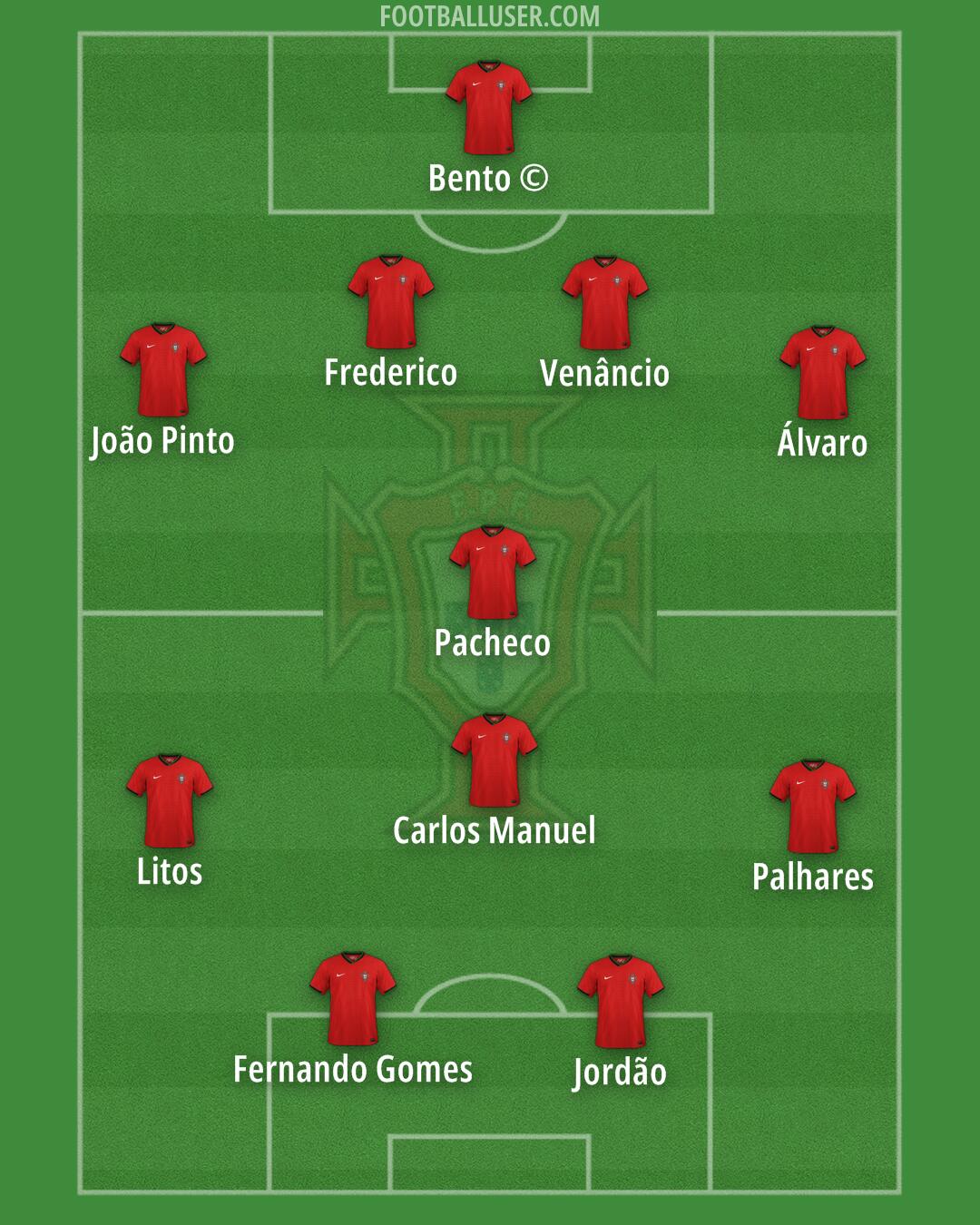

Portugal National Football Team Formation
 September 18, 2025


Starting Lineup
Bento © · Frederico · Venâncio · João Pinto · Álvaro · Pacheco · Carlos Manuel · Fernando Gomes · Jordão · Litos · PalharesPrioritizing defensive stability and direct movement, Portugal employs a 4-4-2 formation. This lineup is designed to be hard to break down by keeping the units close together. The team focuses on staying compact to deny the opposition space in the middle and force them into wide areas.
Bento © stays in goal to direct the players and organize the defensive unit. The back four stays in a flat line to maintain a clear defensive block. João Pinto acts as the right back to cover the flank and support the wide areas, while Álvaro operates as the left back. Frederico and Venâncio form the central defensive pair. Frederico relies on his positioning to intercept play, and Venâncio stays deep to cover and win the header during aerial duels.
The midfield works as a bank of four to congest the central areas. Pacheco acts as the single pivot to shield the defense and protect the center. Carlos Manuel and Palhares work to carry the ball forward, while Litos joins the rotation to connect the defensive and attacking lines. This group works to win the second ball and quickly switch play to the wide areas to stretch the defense.
Up front, Portugal uses two forwards to lead the attack. Jordão plays as the mobile striker, looking to make runs in behind the defense and exploit space. He is paired with Fernando Gomes, who acts as the target man to hold up the ball and provide a central presence. The duo works to stretch the defense, with Jordão making diagonal runs while Fernando Gomes works to pin the last defender and create space for others to arrive late into the box.
One major advantage is the compactness when defending in a mid-block. By staying close together, the players can easily double up on wide players and cut off the passing lane. Another strength is the speed of transition, as the team can hit the opposition at pace once the ball is recovered in the middle third.
This formation provides a sturdy platform for a team that wants to remain difficult to beat. It is best suited for games against ball-dominant opponents where Portugal can sit deep and counter at pace.