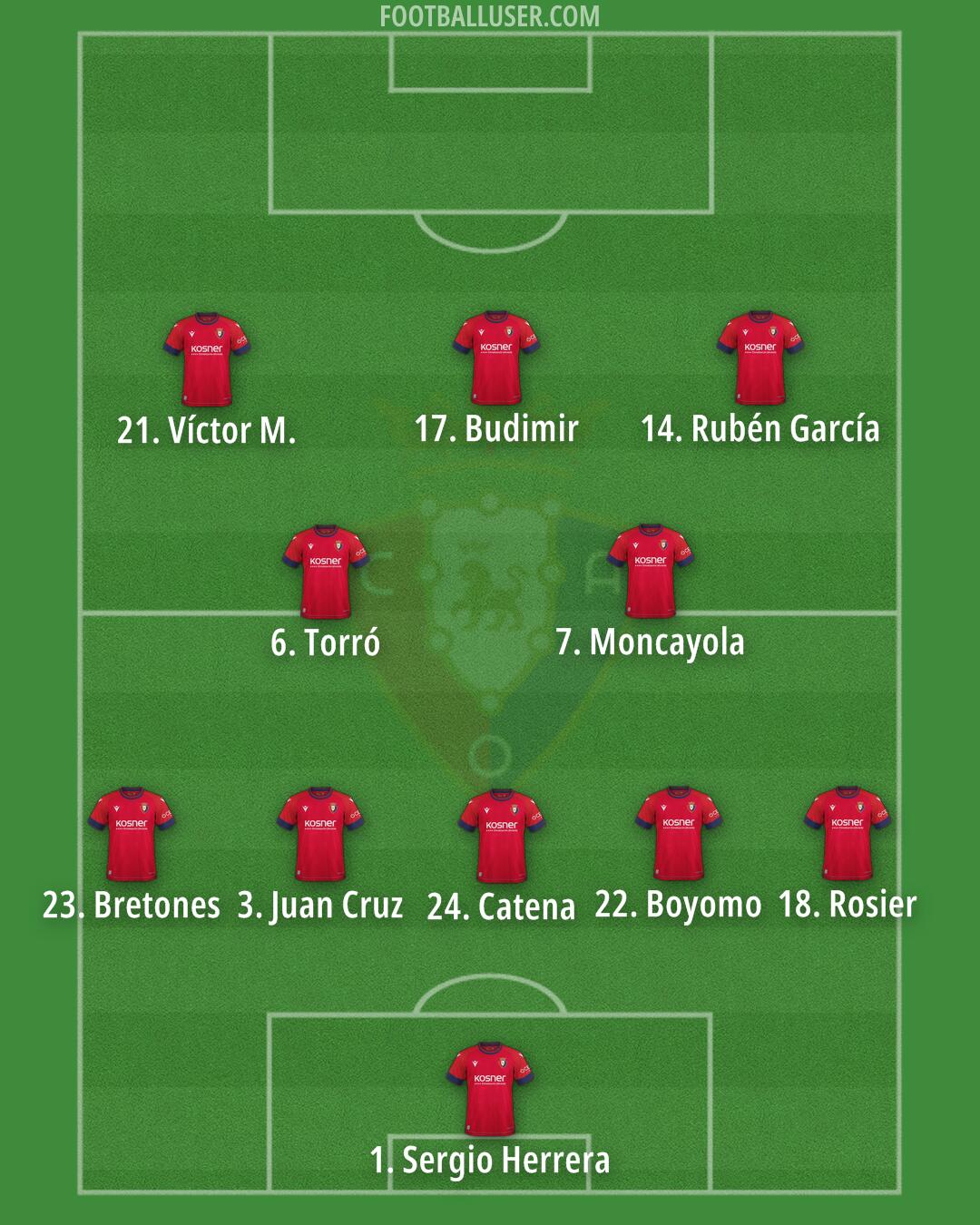

Osasuna Football Formation
 September 20, 2025


Starting Lineup
1. Sergio Herrera18. Rosier
22. Boyomo
24. Catena
3. Juan Cruz
23. Bretones
7. Moncayola
6. Torró
14. Rubén García
17. Budimir
21. Víctor M.
Osasuna plays with a focus on being defensively solid, utilizing a 5-2-3 formation. This lineup is built to play a vertical style of football that relies on quick transitions. The goal is to win the ball back and immediately target the forward line to catch the opponent off balance. This allows the team to play through the lines quickly once possession is regained.
Sergio Herrera operates between the posts to organize the unit. The back five consists of Boyomo and Catena in the middle with Juan Cruz acting as the left centre-back. Rosier and Bretones work as attacking wing backs who provide width but drop deep to maintain a narrow defensive block. They are dominant in the air to clear the lines during crosses. Juan Cruz can cover the space if the wing backs push high to support the attack. The entire unit defends zonally to stay compact.
In the middle, Torró and Moncayola operate as a double pivot. Torró works to shield the defence and press in a mid-block to win the ball high up the pitch. Moncayola acts as the carrier to move the ball from the defensive third into the attacking third. They work together to compress the midfield and deny the turn for the opposition. This duo helps to connect the defensive and attacking lines.
The attacking unit features Budimir as a target man. He is tasked to hold up the ball and win the header to set off the attack. Rubén García and Víctor M. act as inverted wingers who cut inside to occupy the half spaces. This movement allows the team to attack in transition and create runs in behind. The forwards press the opposition back line to force a long ball. They look to deliver early crosses or cut it back from the byline.
The formation offers great compactness when defending. By using a back five, Osasuna can squeeze the space in the final third. Another strength is the ability to use the width of Rosier and Bretones to stretch the defence during the break. This creates space for the central players to arrive late into the box and win the second ball.
The 5-2-3 formation is best suited for matches where the team needs to defend against high possession sides. It is a formation designed to punish opponents through speed on the counter.