
Russia National Football Team Formation
 September 21, 2025


Starting Lineup
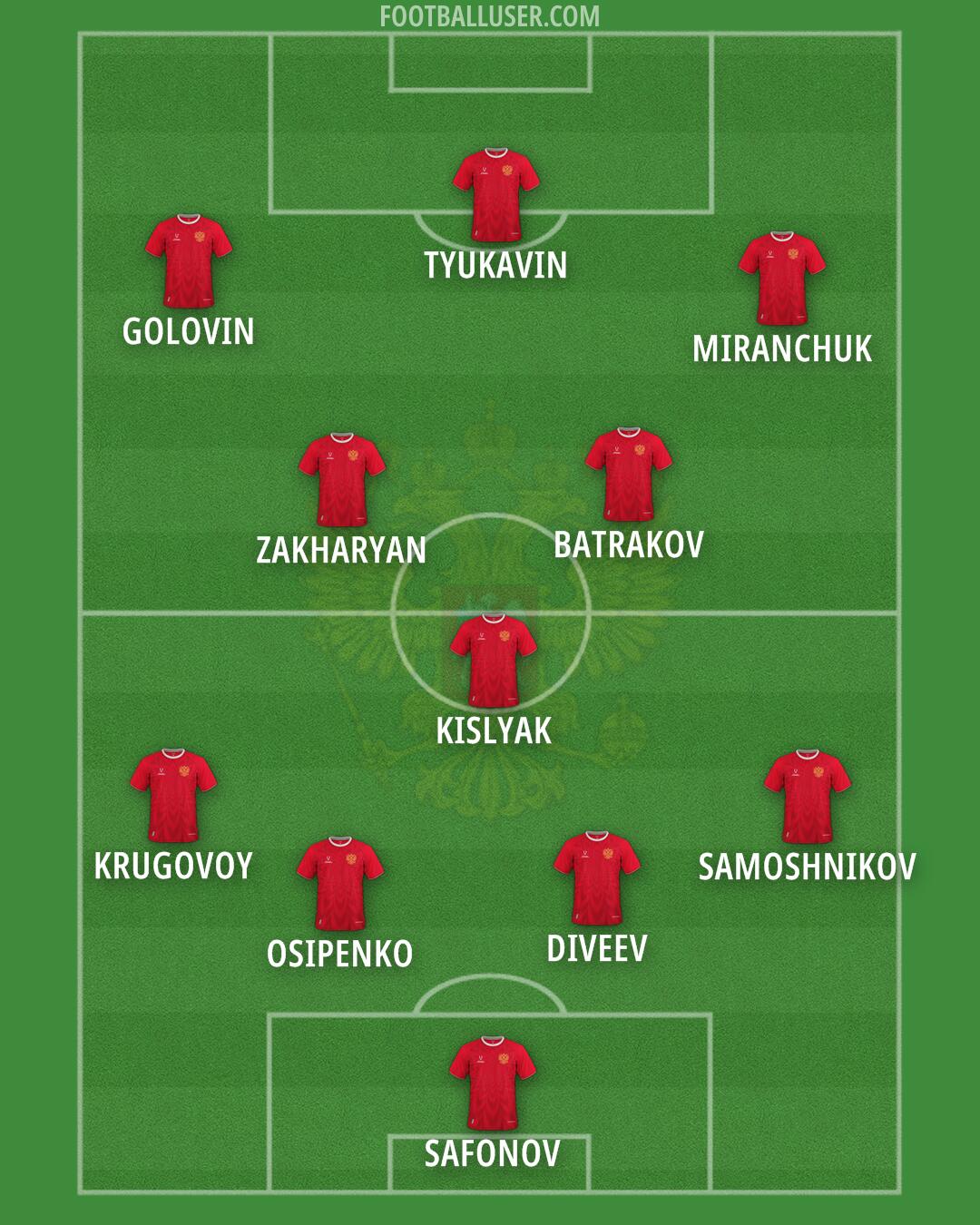
SAFONOV · TYUKAVIN · KISLYAK · GOLOVIN · MIRANCHUK · BATRAKOV · ZAKHARYAN · KRUGOVOY · SAMOSHNIKOV · DIVEEV · OSIPENKORussia focuses on a defensive shell and quick transitions using a 5-2-3 formation. This lineup is built to sit deep and absorb pressure before hitting teams on the break. The team seeks to maintain a compact defensive unit and use the width provided by wing backs to stretch the opposition once they win the ball back.
Matvei Safonov operates between the posts as the goalkeeper. The defensive line uses a back five where KISLYAK acts as the central defender to anchor the unit. OSIPENKO plays as the left centre back and DIVEEV occupies the right centre back position. SAMOSHNIKOV acts as the right wing back to provide width, while KRUGOY covers the left flank as the left wing back. This group works together to defend zonally and ensure the space between the lines remains closed.
A double pivot forms the heart of the midfield. ZAKHARYAN and BATRAKOV are the two central midfielders tasked with controlling the middle of the pitch. BATRAKOV works to drive forward with the ball to help the attack, while ZAKHARYAN focuses on winning the second ball and connecting the defense to the front line. This pairing must stay disciplined to avoid leaving the central defenders exposed when the team loses possession.
The attacking front three utilizes wide players to create chances. GOLOVIN plays on the left wing and MIRANCHUK operates on the right, with both players looking to cut inside to find space. TYUKAVIN acts as the lone striker, acting as a focal point to hold up the ball and bring the wingers into play. The forwards press the opposition back line to force mistakes and allow the wing backs to join the attack in transition.
Russia gains a significant advantage through the width offered by SAMOSHNIKOV and KRUGOY. These wing backs create wide overloads that force the opposition to pull defenders out of position. The team also benefits from its compactness when defending, making it very difficult for opponents to find gaps in the central areas. The speed of transition allows the front three to exploit spaces as soon as the midfield regains control.
This formation provides a solid foundation for teams that prefer to react to their opponents rather than dictate play. It is best suited for matches against dominant sides where sitting deep and hitting on the break is necessary.