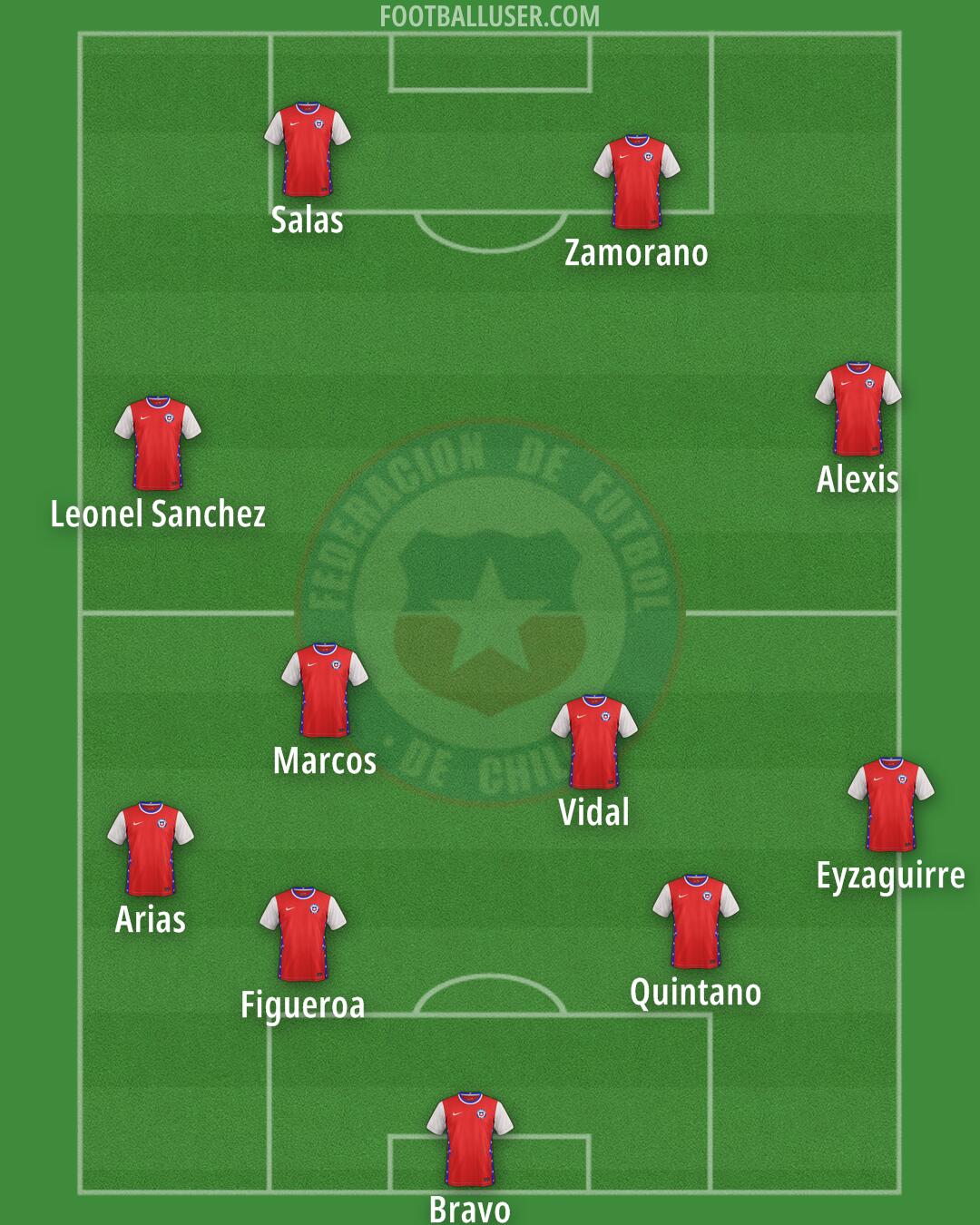

Chile National Football Team Formation
 September 22, 2025


Starting Lineup
Bravo · Eyzaguirre · Quintano · Figueroa · Arias · Marcos · Vidal · Alexis · Leonel Sanchez · Salas · ZamoranoChile aims to play a high tempo, vertical game built to overwhelm opponents with numbers in the final third through a 2-4-4 formation. This lineup focuses on getting the ball into the box as quickly as possible to force errors. By pushing so many players forward, the team looks to dominate the pitch and sustain heavy pressure in the opponent's half.
Bravo operates as the lone goalkeeper behind a very narrow defensive unit. Figueroa and Quintano form the two central defenders, and they must play with a high line to keep the team compact. Because there are only two men in the back, Figueroa and Quintano have to be ready to step up and intercept long balls while covering the huge space left behind. They must defend zonally and be ready to clear the lines if the high press fails.
The midfield functions as a block of four to connect the defence to the attack. Arias sits in the single pivot role to shield the two defenders and recycle possession when things get tight. Eyzaguirre and Vidal act as the central engine, with Vidal using his known tenacity and driving runs to carry the ball forward. Marcos plays as the attacking ten, positioned to find space between the lines and play through the lines to the front four. This group must work hard to win the second ball and prevent central counters.
The attacking front four uses extreme width and central power to stretch the defence. Leonel Sanchez and Alexis act as wide wingers who hug the touchline to spread the opposition. Alexis often looks to cut inside to create more central presence. In the middle, Zamorano and Salas operate as two forwards in a partnership. Zamorano uses his aerial strength to win the header, while Salas looks to make runs in behind the last defender. The team builds attacks through quick combinations to find the feet of the striker.
This formation offers Chile a significant advantage in terms of numerical superiority in the attacking third. By playing four attackers, they can pin the last defender and create constant chaos in the box. The wide overloads from the wingers combined with the central runs of the two strikers make it hard for opponents to track every runner. When the team wins it back high up the pitch, they can transition with immense speed.
Chile utilizes a high risk, high reward system to dominate matches through offensive pressure. This lineup is best suited for games where they need to break down a parked bus or outscore an opponent in an open game.