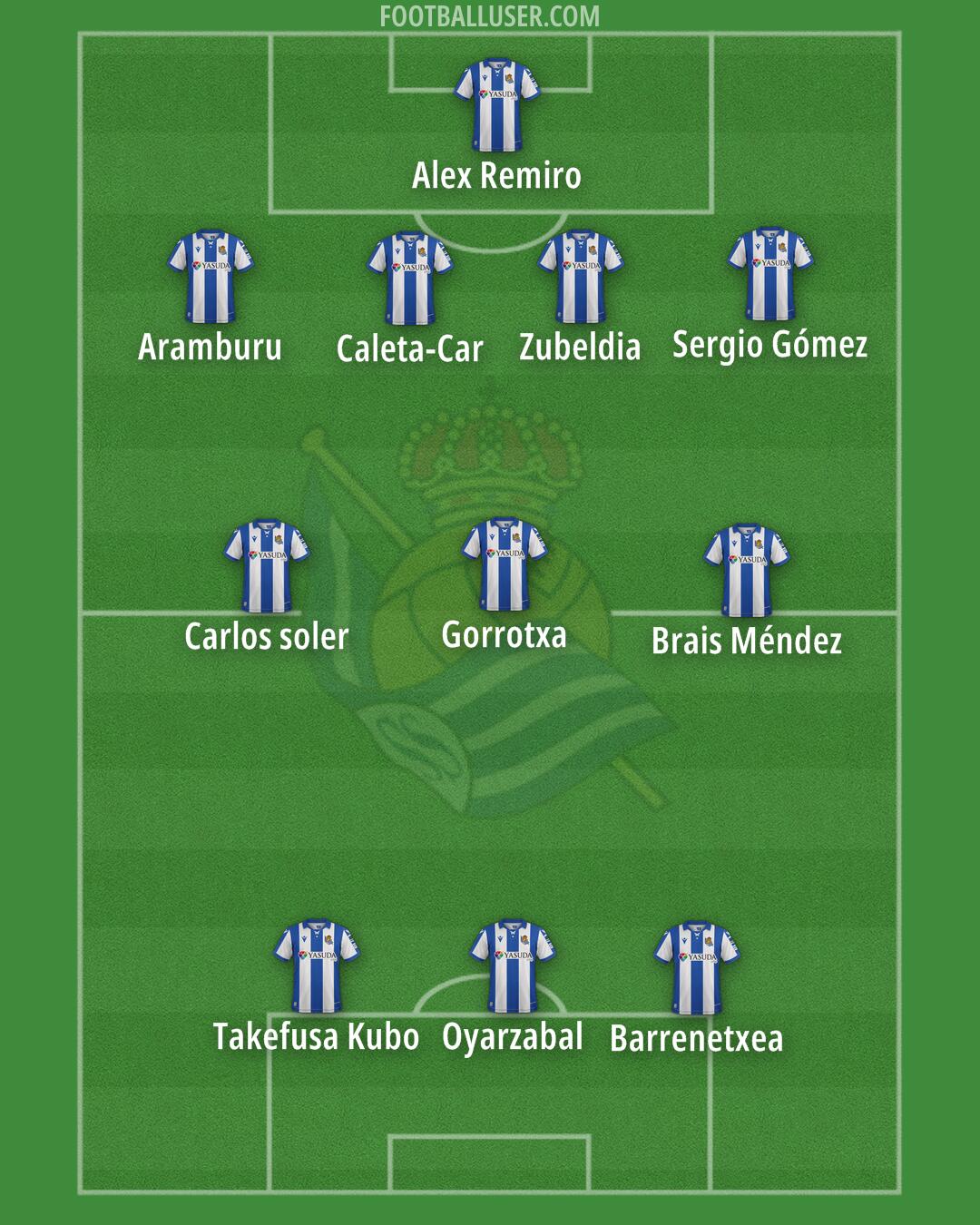

Real Sociedad Football Formation
 September 25, 2025


Starting Lineup
Alex Remiro · Aramburu · Caleta-Car · Zubeldia · Sergio Gómez · Carlos soler · Gorrotxa · Brais Méndez · Takefusa Kubo · Oyarzabal · BarrenetxeaReal Sociedad look to control games through high pressing and quick ball movement in a 4-3-3. This formation is built to press from the front and use narrow passing to progress through the thirds. The lineup aims to squeeze the space in the middle of the pitch to win it back high up the pitch.
Alex Remiro plays behind a flat back four that holds a high line to keep the team compact. Zubeldia acts as a ball playing defender who can play short from the back to start attacks, while Caleta-Car provides aerial strength to defend against long balls. Sergio Gómez works as an attacking full back to provide width, whereas Aramburu stays more tucked in to cover the space if the team loses possession. The whole defensive unit works to set the offside trap and keep the distance between the lines small.
The midfield uses a three-man midfield with a carrier to link the defense and attack. Brais Méndez plays as the creative engine to find the feet of the striker and play through the lines with his passing range. Carlos Soler operates in the half-spaces to connect play, while Gorrotxa provides the energy to press aggressively and win the second ball. This group works to compress the midfield and deny the pivot of the opposition.
Real Sociedad use three attackers across the front to stretch the defence. Oyarzabal acts as the central presence, often playing as a pressing centre-forward to force a long ball from the opposition. Takefusa Kubo plays as an inverted winger on the right to cut inside and create, while Barrenetxea stays wide on the left to cross on the run. The forwards look to play one-two combinations to split the defence with a through ball.
This lineup offers significant advantages through its ability to press high in coordinated waves. Real Sociedad can create wide overloads when Sergio Gómez overlaps the winger to send crosses into the box. The midfield unit provides numerical superiority in the center, allowing the team to recycle possession and switch play rapidly to the flanks.
The 4-3-3 formation relies on high intensity and quick ball circulation to dominate the game. It is best suited for matches against teams that struggle to play out from the back under pressure.