
Stade Reims Football Formation
 September 26, 2025


Starting Lineup
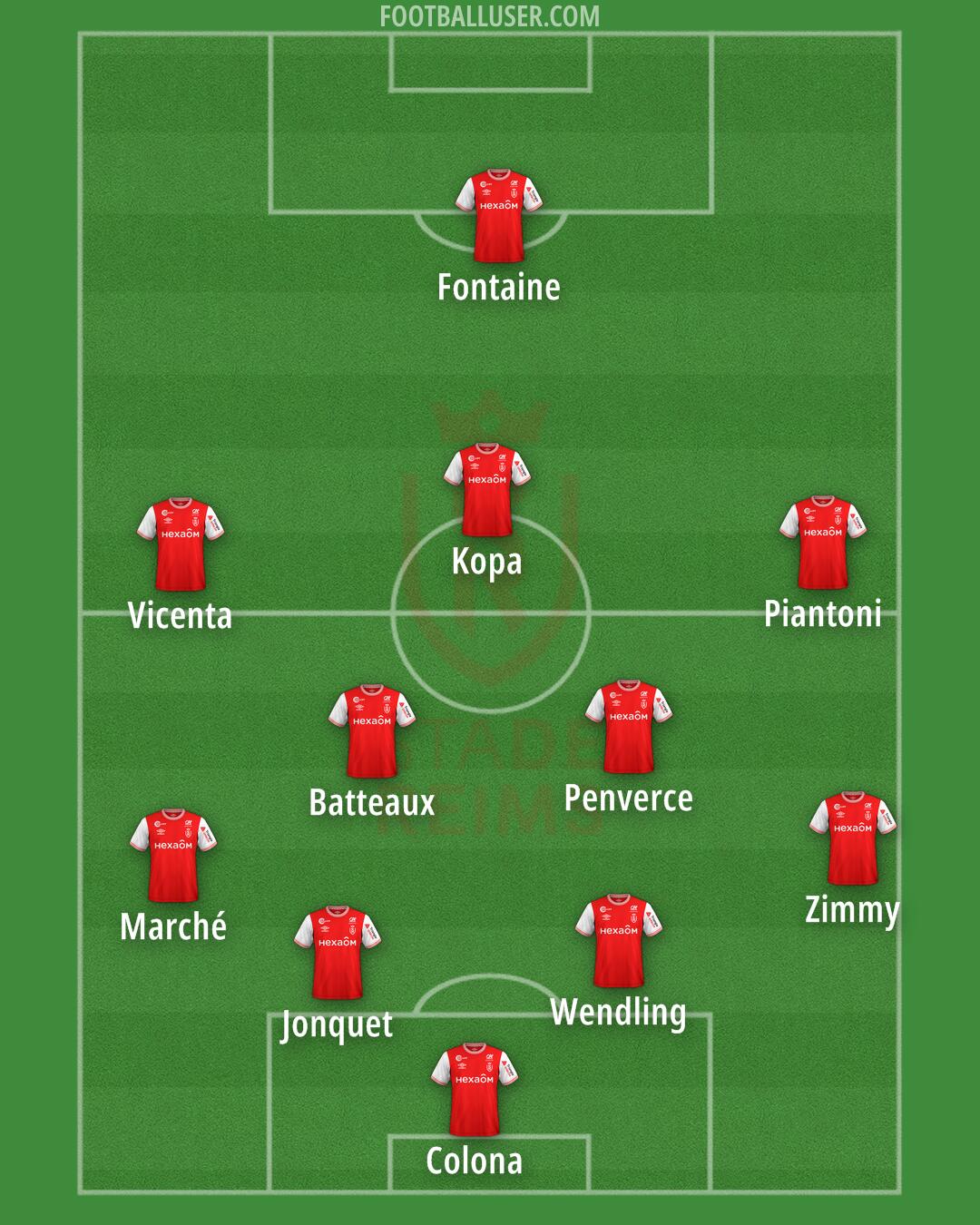
Colona · Zimmy · Wendling · Jonquet · Marché · Batteaux · Penverce · Kopa · Piantoni · Vicenta · FontaineTo control the middle of the pitch and stay compact, Stade Reims uses a 4-5-1 lineup. This formation is built to play a game of control through a dense midfield, often looking to win the ball back in a mid-block before hitting quickly. By packing the central zones, the team forces the opponent to play wide and reduces the space between the lines.
In goal, Colona acts as the last line of defense. The defensive unit sits in a flat back four with Zimmy on the right and Marché on the left. Wendling and Jonquet play as the two central defenders, where they must stay close to each other to protect the center. Zimmy and Marché need to track back to help when the team is under pressure, while Wendling and Jonquet focus on winning the second ball and clearing the lines when the opposition pushes high.
The midfield is the engine of the Stade Reims formation, utilizing a double pivot alongside three central players. Batteaux and Penverce act as the defensive screen, sitting deep to deny the turn of oncoming attackers and shield the back four. Ahead of them, Vicenta, Piantoni, and Kopa work to occupy the half spaces and connect the defense to the attack. This group can shift to squeeze the space in the middle, making it difficult for the opposition to play through the lines. Kopa and Piantoni often try to carry the ball forward to support the lone striker.
Up front, the attack relies on Fontaine playing as a lone striker. Fontaine must hold up the ball to allow the midfield to push up and join the play. When the team wins the ball, the intention is to find Fontaine or use the width provided by Marché and Zimmy to stretch the defense. The midfielders move into wide areas to create chances, while Fontaine looks to run in behind the defenders to catch them on the transition.
One major advantage of this 4-5-1 is the ability to create numerical superiority in the middle of the pitch. With five players in the central zone, it is very hard for opponents to find passing lanes. This formation also allows for great compactness when defending, as the team can quickly drop into a low block or a mid-block to deny space. The speed of transition is another key factor, as the ball can move quickly from the defensive pivot to the front line.
This formation is designed to be hard to break down and relies on central dominance. It is best suited for matches against teams that rely heavily on central playmakers or when the team needs to defend a lead.