
Brazil National Football Team Formation
 September 26, 2025


Starting Lineup
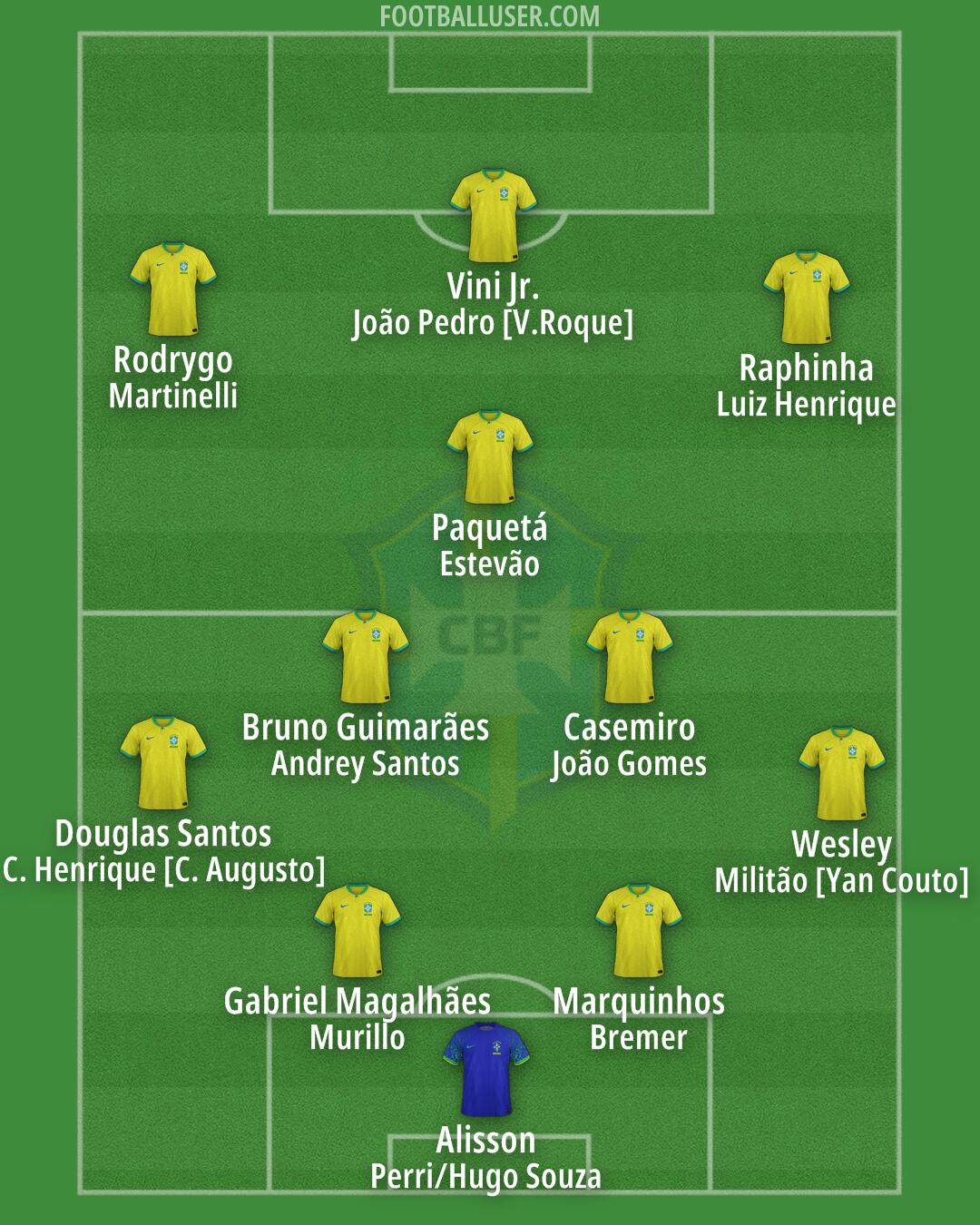
Alisson (Perri/Hugo Souza) · Gabriel Magalhães (Murillo) · Marquinhos (Bremer) · Douglas Santos (C. Henrique [C. Augusto]) · Casemiro (João Gomes) · Vini Jr. (João Pedro [V.Roque]) · Rodrygo (Martinelli) · Raphinha (Luiz Henrique) · Paquetá (Estevão) · Bruno Guimarães (Andrey Santos) · Wesley (Militão [Yan Couto])Brazil focuses on controlling the center of the pitch and winning the ball high up the pitch with a 2-5-3 formation. This lineup is built to play a heavy pressing game that uses a massive midfield block to squeeze the space in the middle. By committing many players forward, the Seleção aims to dominate possession and attack with high intensity.
Alisson acts as a sweeper keeper, sitting high to cover the space behind the two central defenders. Gabriel Magalhães and Marquinhos form a narrow defensive duo, acting as ball playing defenders who need to be comfortable playing short from the back. Because there are only two defenders, they must be ready to step up to catch opponents offside or track runners if the midfield press is bypassed. The entire defensive unit functions by relying on the midfield to prevent the opposition from getting close to the back line.
The midfield is the engine of Brazil, utilizing a five man unit to control the game. Wesley and Douglas Santos sit in a double pivot to shield the defense, while Casemiro and Bruno Guimarães operate as two much more advanced central midfielders. Casemiro uses his passing range and strength to control the tempo, while Bruno Guimarães drives forward with the ball to link the lines. Paquetá plays as an attacking ten behind the striker, operating in the pockets to find ways to split the defense with a through ball. This heavy midfield presence allows the team to recycle possession and constantly threaten through the middle.
In the final third, the attack is built around a front three that stretches the pitch. Vini Jr. plays as a pressing centre forward, using his dribbling style and speed to cause problems for the last defender. Rodrygo and Raphinha act as wide attackers who cut inside to create central overloads. Rather than hugging the touchline, these players look to combine in tight spaces and make runs in behind the defense. The movement of the front three is designed to pull the opposition back line apart, creating space for Paquetá or the midfielders to arrive late into the box.
This formation offers a massive numerical superiority in midfield, making it very hard for opponents to play through the center. The Brazil team can also use the high press to win the ball back high up the pitch and attack quickly before the defense can settle. By packing the middle, they can easily switch play to the wide players when the opposition compacts the center.
Brazil relies on an aggressive midfield to dominate possession and pin the opponent in their own half. This formation is best suited for games where the team wants to dictate the tempo against a side that sits deep.