
Portugal National Football Team Formation
 September 26, 2025


Starting Lineup
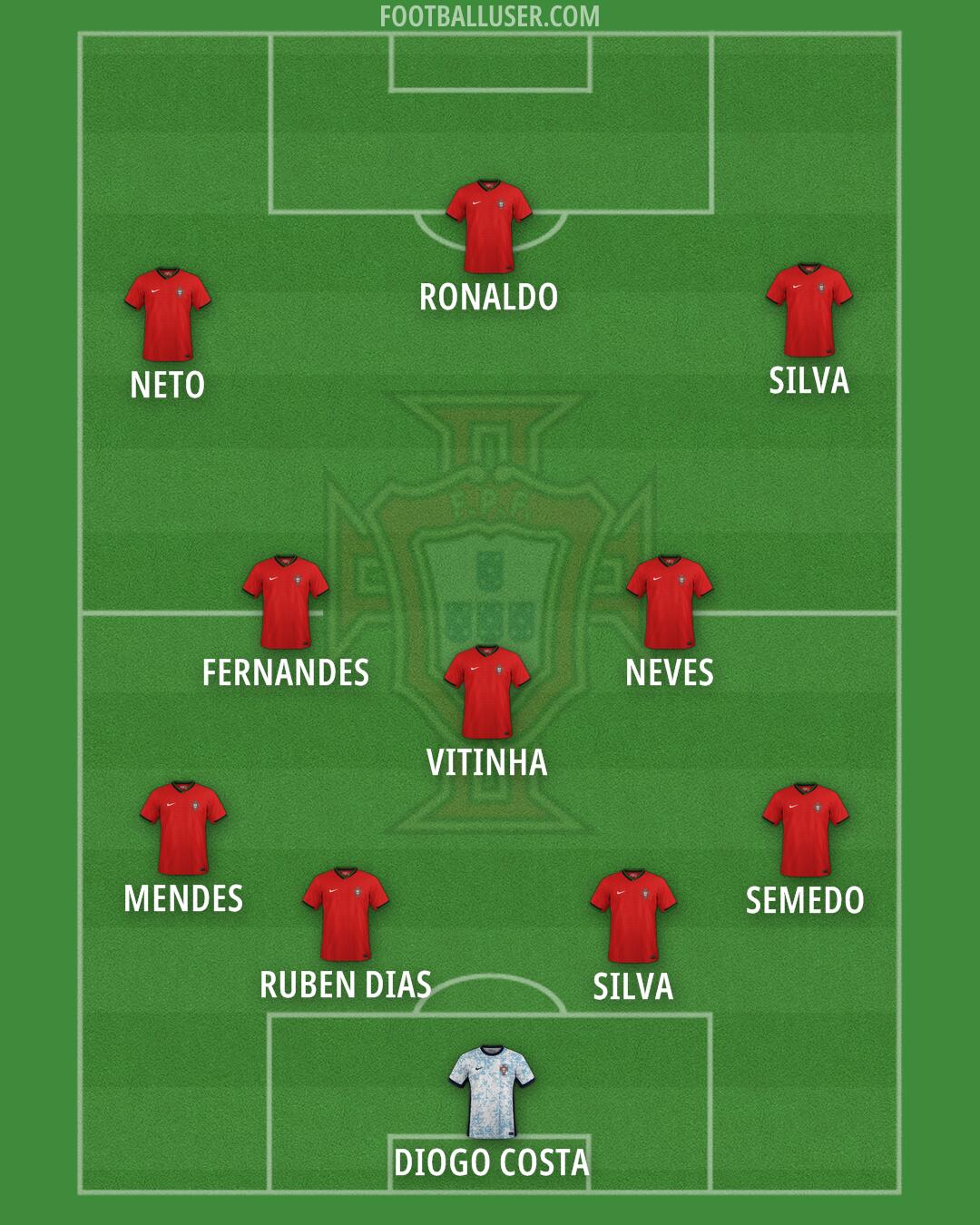
RONALDO · VITINHA · FERNANDES · NEVES · SILVA · NETO · RUBEN DIAS · SILVA · MENDES · SEMEDO · DIOGO COSTAPortugal looks to control matches through a high press and verticality using a 4-3-3. This formation is built to win the ball high up the pitch and quickly transition into attacking threats. The lineup seeks to dominate territory by squeezing the pitch and forcing mistakes from the opposition.
DIOGO COSTA starts the build up from the back as the goalkeeper. The defensive unit operates with a flat back four featuring SEMEDO at right back and MENDES at left back. SEMEDO acts as an attacking wing back to provide width, while MENDES pushes forward to overlap. RUBEN DIAS, known for his aerial strength and leadership, anchors the center alongside SILVA. RUBEN DIAS often steps up to intercept passes, while SILVA covers the space behind to maintain the line. A cohesive defensive unit works together to hold a high line and squeeze the space.
In the middle of the pitch, Portugal uses a three man midfield with a single pivot. VITINHA sits in front of the defense to shield the back four and recycle possession. To his sides, FERNANDES and NEVES operate as dual eights. NEVES helps to connect the defense to the attack with his passing range, while FERNANDES presses aggressively to win the ball back high up the pitch. These players work to control the tempo and find the feet of the striker in central areas. They also look to arrive late into the box to support the forward line.
Three forwards work in combinations to create chances. RONALDO operates as a pressing centre forward who looks to run in behind the defensive line. On the flanks, NETO and SILVA act as wide wingers who hug the touchline to stretch the defence. NETO looks to cut inside to create chances, while SILVA aims to get to the byline and deliver early crosses. Attacking in transition involves hitting in behind once the midfield wins the ball. Players use combinations to break the line and isolate wide players in one on one situations.
This 4-3-3 offers several tactical advantages for Portugal. Creating numerical superiority in midfield happens when the full backs push high, allowing the three midfielders to dominate the center. There is also a great ability to press high in coordinated waves, which forces the opponent into a low block. Speed of transition allows Portugal to exploit gaps left by advancing opponents. The lineup allows for quick ball movement to shift the opponent.
Such a lineup is a potent mix of control and direct attacking intent. This formation is best suited for matches where the team wants to dictate play against teams that sit deep.