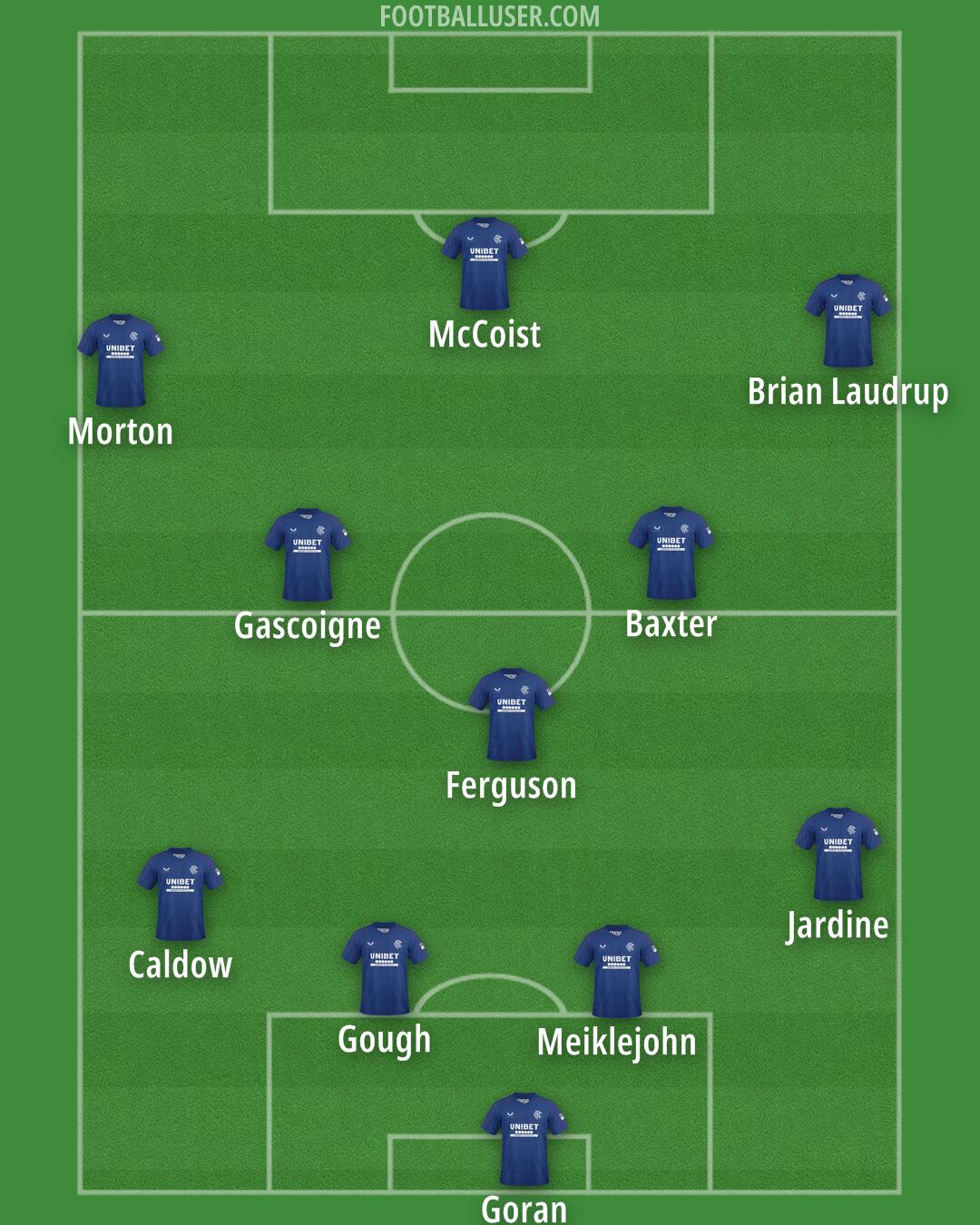
Rangers Football Formation
 September 27, 2025


Starting Lineup
Goran · Jardine · Meiklejohn · Gough · Caldow · Ferguson · Baxter · Gascoigne · Brian Laudrup · McCoist · MortonRangers play a direct and vertical style of football built on a 5-2-3 formation. This lineup aims to control transitions by quickly moving the ball from a sturdy defensive base to a potent front three. The goal is to use the width of the pitch to stretch the opposition while remaining hard to break down.
Goran sits between the posts to organize the defensive unit. The back line operates as a back five with Ferguson acting as the central anchor to win the header and clear the lines. Meiklejohn plays as the right centre-back to cover space, while Gough holds the left centre-back position. The wing backs, Jardine on the right and Caldow on the left, are tasked to push high and provide width. This allows the central defenders to stay deep and maintain a compact shape when the team does not have the ball.
The midfield consists of a two-man central pairing of Gascoigne and Baxter. Gascoigne works to drive forward with the ball and connect the defensive and attacking lines. Baxter works alongside him to help win the second ball and protect the space in front of the back five. This pair must work hard to cover the ground and ensure they do not leave the central defenders exposed during a transition.
In the attacking phase, Rangers use three attackers to pin the last defender. McCoist acts as the central striker to hold up the ball and link play. Brian Laudrup operates on the right wing as an inverted winger to cut inside and create chances, while Morton stays wide on the left to pull defenders apart. The wing backs, Jardine and Caldow, often overlap the winger to deliver crosses into the box. This creates a variety of attacking combinations to find the feet of the striker.
One major tactical strength is the ability to create wide overloads when the wing backs push up to join the attackers. Another advantage is the compactness when defending in a low block, making it very difficult for opponents to find gaps between the lines. The speed of transition from a defensive stance to an attacking one allows the team to catch opponents out of position.
Rangers utilize this formation to absorb pressure and strike with pace on the break. It is a lineup best suited for facing teams that commit many players forward and leave space behind their back line.