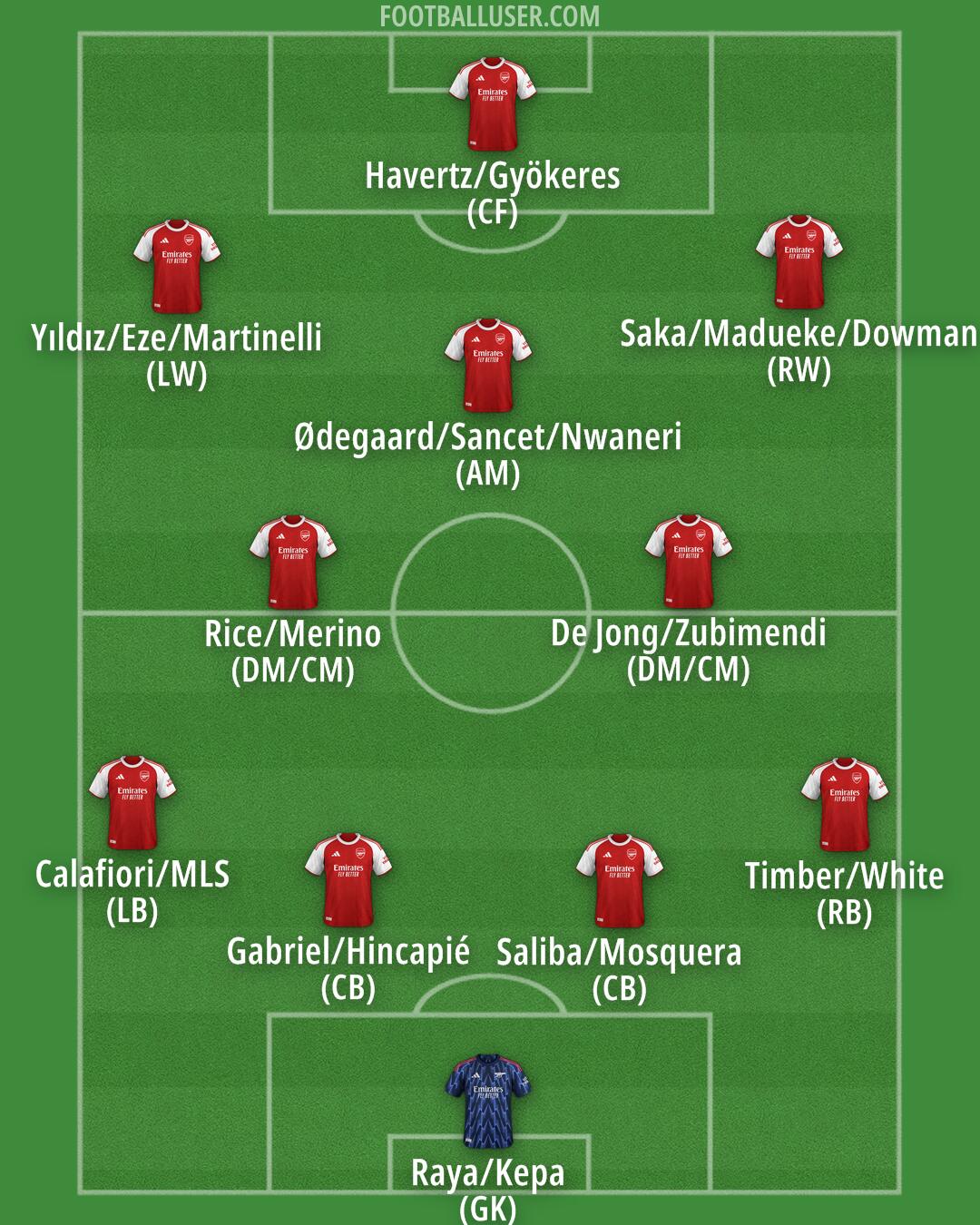
Arsenal Football Formation
 October 5, 2025


Starting Lineup
Havertz/Gyökeres (CF) · Yıldız/Eze/Martinelli (LW) · Saka/Madueke/Dowman (RW) · Ødegaard/Sancet/Nwaneri (AM) · Rice/Merino (DM/CM) · De Jong/Zubimendi (DM/CM) · Calafiori/MLS (LB) · Gabriel/Hincapié (CB) · Saliba/Mosquera (CB) · Timber/White (RB) · Raya/Kepa (GK)Arsenal play a high press game using a 4-3-3 formation. This lineup is built to win the ball high up the pitch and control the tempo through heavy possession. The team focuses on squeezing the space in the opponent half to force errors and create quick chances.
David Raya acts as the goalkeeper, starting the build up from the back. The defensive unit operates with a high line involving Saliba and Gabriel as the central defenders. Saliba provides composure when playing out from the back, while Gabriel is dominant in the air and strong in physical duels. Timber plays as the right back, often looking to overlap the winger, while Calafiori occupies the left back position to provide security and cover. This back four works together to maintain a compact block and defend zonally.
The midfield is a three-man midfield with a carrier and a creative hub. Declan Rice plays as the left central midfielder, acting as a shield for the defence and a driver to carry the ball forward. De Jong operates on the right side of the midfield to connect the defensive and attacking lines with his passing range. Martin Ødegaard plays as the attacking ten behind the striker, looking to find the feet of the forwards and play through the lines. This group works to recycle possession and ensure the team maintains control in the middle third.
Arsenal use three attackers across the front to stretch the defence. Bukayo Saka operates on the right wing, often looking to cut inside and create chances, while Martinelli provides width and pace on the left. Kai Havertz functions as a pressing centre-forward who can also drop deep to link up play. The front three work to pin the last defender and create runs in behind. They use combinations in tight spaces to bypass the midfield and get to the byline for cutbacks.
This formation offers significant tactical advantages through numerical superiority in the middle of the pitch. The team can create wide overloads when Timber pushes up to support the attack. Additionally, the coordination between the front three and the attacking midfielder allows for a high press in coordinated waves, making it very difficult for opponents to play out from the back.
This 4-3-3 formation is a high intensity system designed to dominate games through control and territorial advantage. It is best suited for matches against teams that struggle to handle a heavy press or those that sit in a deep low block.