Crystal Palace Football Formation
 October 6, 2025


Starting Lineup
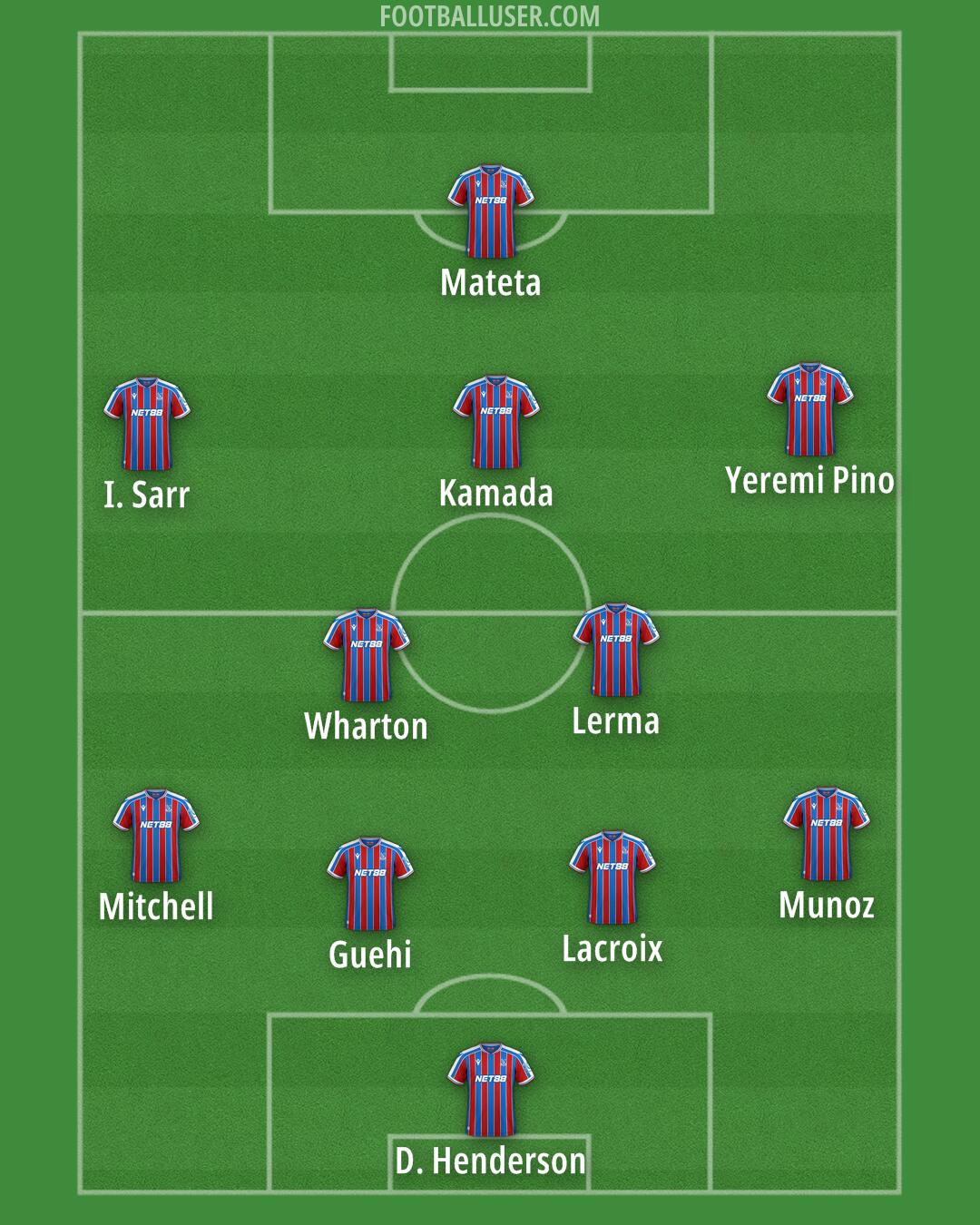
D. Henderson · Munoz · Guehi · Mitchell · Lacroix · Wharton · I. Sarr · Mateta · Kamada · Lerma · Yeremi PinoCrystal Palace looks to play with a heavy verticality and directness in this 4-2-4. The lineup is built to push the opposition back and use high intensity to win the ball in advanced areas. This formation relies on quickly moving the ball forward to exploit spaces left behind the opponent defensive line.
D. Henderson sits between the posts to organize the defensive unit. The back line functions as a flat back four that can push up to maintain a high line. Guehi acts as a ball playing defender with his composure and ability to read the game, while Lacroix provides cover and physical presence in the center. Mitchell operates as an attacking full back to provide width on the left, whereas Munoz works as an overlapping full back on the right to support the wide men.
The midfield relies on a double pivot to provide stability. Wharton connects the defense to the attack and uses his passing range to break the lines, while Lerma acts as the engine to press aggressively and win the ball back in the middle third. This duo must hold their positions to prevent counter attacks while allowing the team to transition from a mid-block into a high press. They sit just in front of the center backs to shield the defense and recycle possession.
The attacking unit is designed to overwhelm the opposition with four players. Mateta acts as a pressing centre-forward who can hold up the ball, while Kamada plays in the hole to link the midfield to the front line. On the flanks, I. Sarr stays wide to stretch the play before cutting inside, and Yeremi Pino uses his dribbling style to create chances from the right wing. This front line aims to create runs in behind and use quick combinations to isolate defenders in one on one situations.
One major advantage for Crystal Palace is the ability to press high in coordinated waves, forcing mistakes near the opponent goal. The team also creates wide overloads when the full backs push up to join the wingers. This creates a lot of pressure in the final third and forces the opposition to defend deep in their own box.
This 4-2-4 formation is built for teams that want to dominate through high pressing and rapid transitions. It is best suited for games where the opponent struggles to play out from the back under intense pressure.