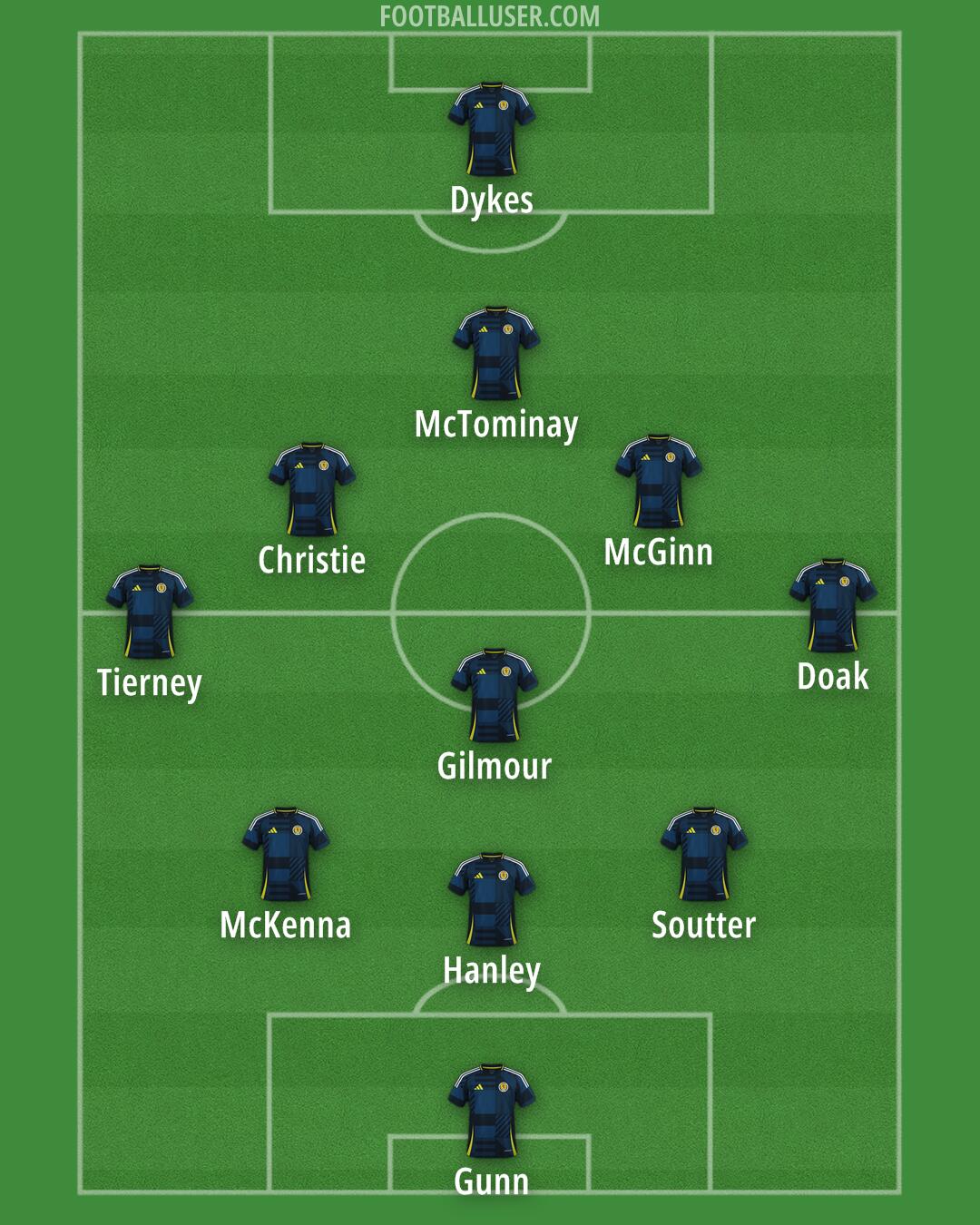
Scotland National Football Team Formation
 October 13, 2025


Starting Lineup
Gunn · Tierney · Doak · McTominay · Dykes · Soutter · Gilmour · McGinn · Hanley · McKenna · ChristieA high pressing and vertical style of play defines Scotland as they operate in a 4-5-1 formation. This lineup focuses on winning the ball back quickly and moving it forward to exploit spaces behind the opposition defense. The team looks to stay compact and use the energy of the midfield to drive the team up the pitch.
Gunn guards the goal while the defensive unit sits in a disciplined back four. Hanley and Gilmour act as the central defenders, with Hanley providing aerial strength and Gilmour working to cover space behind him. Soutter plays as the right back to hold the line, while McKenna pushes up as the left back to provide width. This defensive block works to stay tight and limit the space between the lines.
The midfield uses a combination of a double pivot and three advanced players to control the center. Tierney and Doak sit deep to shield the defense and intercept passes, allowing the team to regain possession. Christie and McGinn occupy the central spaces to connect the defense to the attack, with McGinn using his energy to press and run into channels. McTominay operates in the attacking midfield role, using his ability to make late runs into the box to create chaos.
In the attacking phase, the team relies on a lone striker, Dykes, to lead the line. Dykes works to hold up the ball and provide a focal point for long passes or crosses. The wide midfielders and McTominay push high to support him, creating a heavy presence in the final third. This movement forces the opposition defenders to drop deep and allows the wide players to cut inside or deliver crosses into the area.
One major strength for Scotland is the ability to press high in coordinated waves to force mistakes from the opponent. The combination of McTominay and McGinn allows the team to overwhelm the midfield during transitions. Furthermore, the defensive compactness makes it difficult for opponents to play through the center, often forcing them to play wide where the full backs can tackle and intercept.
This formation is built to frustrate dominant teams through hard running and defensive discipline. It is best suited for matches where the team needs to sit deep and strike quickly on the break.