
Brazil National Football Team Formation
 October 13, 2025


Starting Lineup
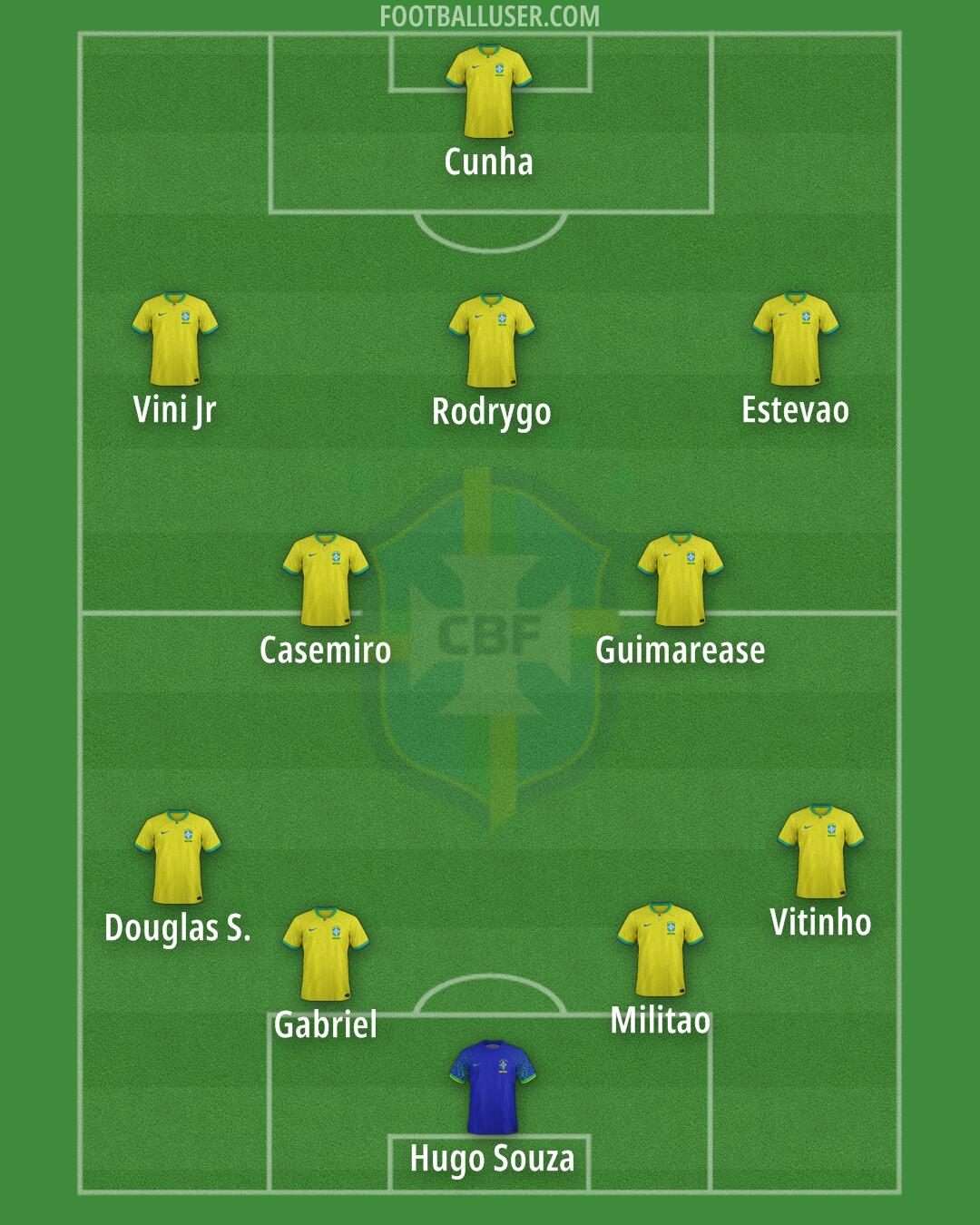
Hugo Souza · Vitinho · Militao · Gabriel · Douglas S. · Casemiro · Guimarease · Vini Jr · Rodrygo · Estevao · CunhaBrazil favors a direct and high pressing game through a 4-5-1 formation. This lineup relies on quick transitions and intense pressure to disrupt the opponent before they can build from the back. The team looks to win the ball in the middle third and launch rapid attacks to exploit spaces behind the opposition defense.
Hugo Souza stands between the posts to command the area. The back line functions as a flat four with Gabriel and Militao acting as the central pair. Militao uses his aerial strength and recovery speed to cover wide areas, while Gabriel stays compact to intercept passes. Douglas S. pushes up the left flank to provide width, whereas Vitinho holds a more conservative position to ensure the team stays solid during defensive transitions.
The midfield is built around a double pivot of Casemiro and Guimarease to provide a screen for the back four. Casemiro uses his ability to intercept play and break up attacks, which allows the other players to move higher up the pitch. Vini Jr and Estevao operate in the half spaces to connect the midfield to the attack, while Rodrygo moves between the lines to link play. This group works to control the center of the pitch and prevents the opponent from playing through the middle.
In the attacking phase, the team relies on a lone striker in Cunha to lead the line. Cunha must hold up the ball and bring the midfielders into the game. Vini Jr and Estevao act as wide creators who can cut inside to shoot or cross the ball. The attacking unit presses in coordinated waves to force mistakes, using the movement of Rodrygo to create pockets of space in the final third.
One major advantage for Brazil is the ability to press high in coordinated waves to win the ball close to the goal. The presence of Casemiro allows the more creative players like Vini Jr to push forward without fear of a counter attack. Additionally, the team can create wide overloads when Douglas S. overlaps to support the advanced midfielders, creating numerical superiority on the flanks.
This formation provides a balance of defensive stability and verticality in attack. It is best suited for matches against teams that struggle to play out from a high press.