
Germany National Football Team Formation
 October 13, 2025


Starting Lineup
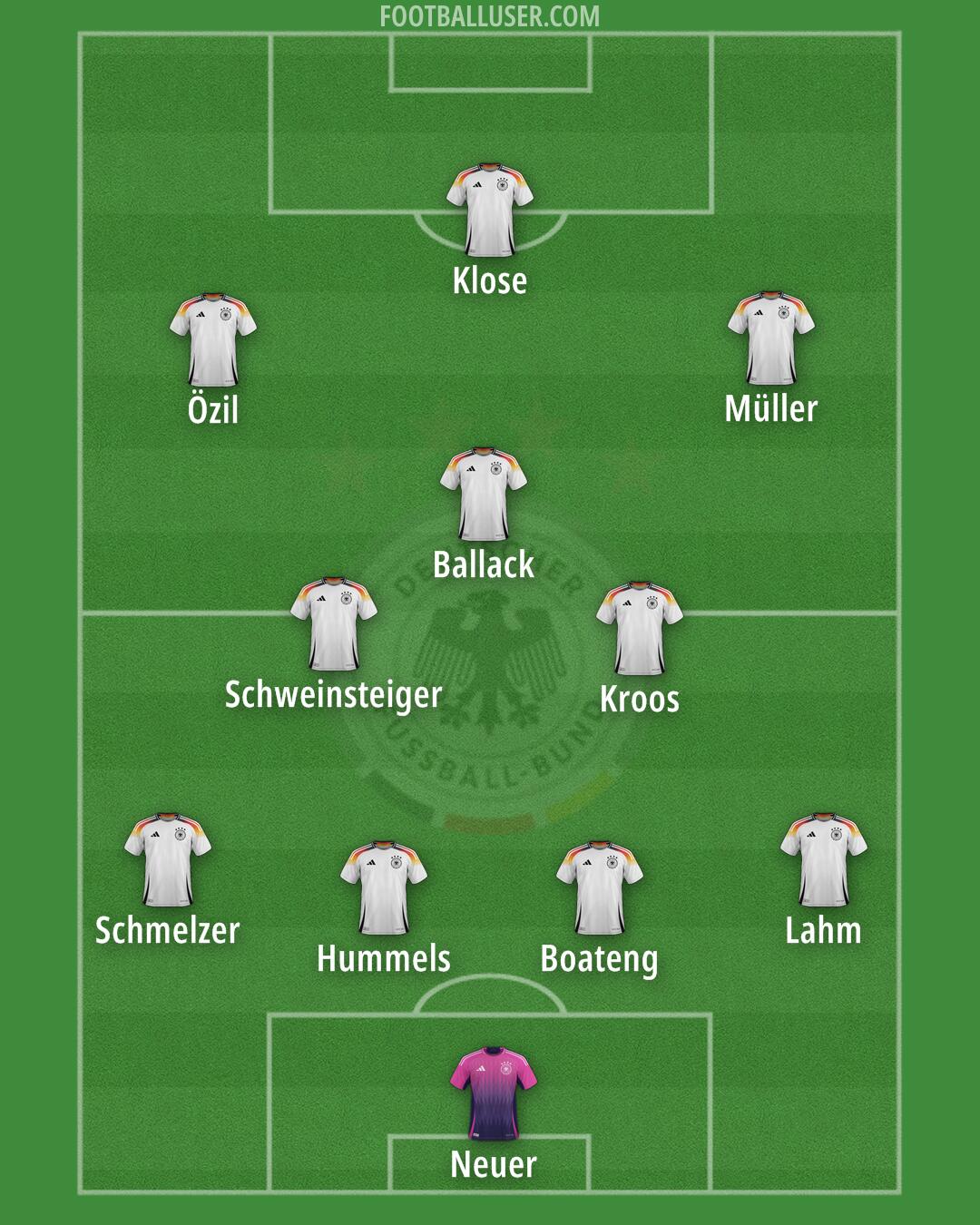
Neuer · Schmelzer · Lahm · Hummels · Boateng · Kroos · Schweinsteiger · Ballack · Özil · Müller · KloseSeeking control through high possession and intense pressing, Germany uses a 4-3-3 formation. This lineup is built to dominate the ball and pin opponents back in their own half. The team plays a vertical game that looks to break the lines quickly once the ball is won.
Manuel Neuer operates between the posts, acting as a sweeper keeper to cover the space behind the back line. The defense sits in a high line with Hummels and Boateng acting as the two central defenders. Hummels uses his long passing range to switch play, while Boateng provides strength to intercept attacks. On the flanks, Lahm and Schmelzer provide balance. Lahm often tucks inside to help control the center, while Schmelzer pushes forward to provide width and support the attack.
The midfield functions as a central engine room with a mix of roles. Schweinsteiger works in the middle to press and drive the team forward, while Kroos dictates the tempo with his precise passing. Ballack operates as the attacking midfielder, making runs into the box to support the front line. This trio connects the defense to the attackers by shifting between a deep block and a high press. The midfield unit stays compact to prevent opponents from playing through the middle.
In the attacking third, the team utilizes three forwards to stretch the opposition. Klose acts as the lone striker, using his movement to find space in the box and hold up the ball. Müller plays on the right wing but often cuts inside to create chaos, while Özil operates from the left to find pockets of space and provide through balls. This front line presses high to force mistakes and relies on quick movements to pull defenders out of position.
A major strength of this Germany lineup is the ability to create numerical superiority in the central areas. By having Kroos, Schweinsteiger, and Ballack all involved in the build up, the team can overload the midfield to dominate possession. Another advantage is the speed of transition when the ball is won, allowing Müller and Özil to immediately attack the space behind the opposition full backs. The combination of aerial strength in the center and technical skill on the wings makes them hard to mark.
This formation relies on high ball retention and aggressive pressing to dictate the rhythm of the match. It is best suited for games against teams that sit deep and struggle to handle constant pressure.