
Como Football Formation
 October 15, 2025


Starting Lineup
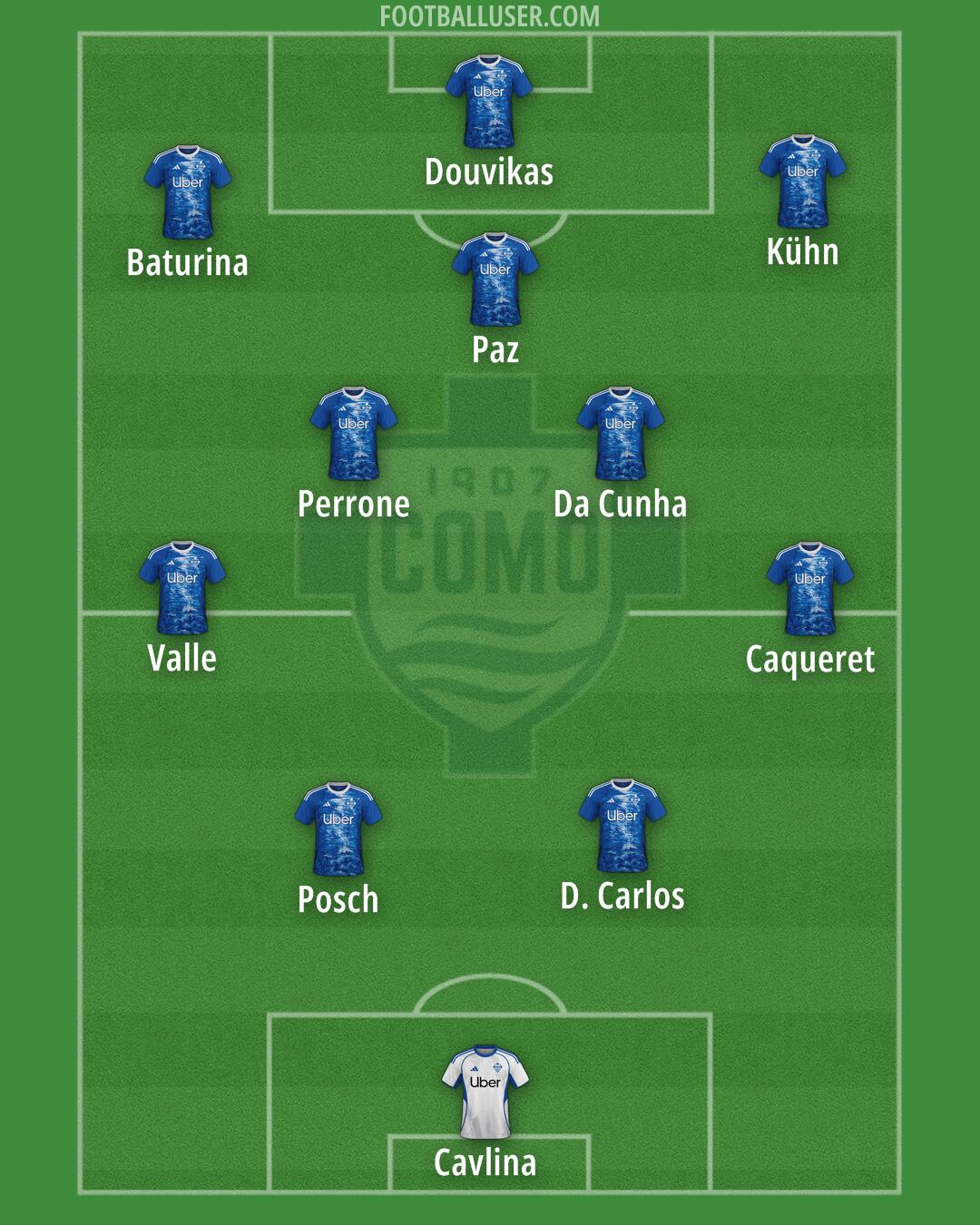
Da Cunha · Valle · Douvikas · Posch · D. Carlos · Paz · Baturina · Perrone · Caqueret · Kühn · CavlinaPrioritizing high intensity and verticality, Como employs a 2-5-3 formation to overwhelm opponents. This lineup is built to dominate the middle of the pitch and pin the opposition back through aggressive pressing and heavy numbers in the center.
Cavlina stays behind a very narrow defensive unit consisting of only two central defenders. Posch and D. Carlos operate as the primary blockers, needing to step up and intercept long balls while remaining ready to cover wide areas. Because there are no traditional full backs, these two must be mobile enough to track runners and manage the space left behind when the midfield pushes high.
The heart of the team lies in a massive five man midfield that controls the rhythm. Caqueret and Valle sit deep as a double pivot to shield the two defenders and hold the center. In front of them, Da Cunha and Perrone operate in the half spaces to drive the ball forward and break the lines. Paz plays as the attacking ten, finding pockets of space to create chances and link the midfield to the front three.
An aggressive front line features three attackers tasked with pinning the opposition defense. Douvikas acts as the lone striker to hold up the ball and occupy the center halves, while Baturina and Kühn occupy the wide channels. Baturina and Kühn often cut inside to create central overloads, leaving the wide areas open for the midfielders to exploit through late runs.
This formation offers significant tactical advantages, particularly the ability to create massive numerical superiority in the central zones. By packing the middle, Como can quickly switch play to the flanks or use the five midfielders to swarm the ball in transition. The coordinated pressing from the front three and the five midfielders makes it very difficult for opponents to build play from the back.
Como uses this lineup to dictate the tempo through central dominance and high pressing. This system works best against teams that struggle to manage congestion in the middle of the park.