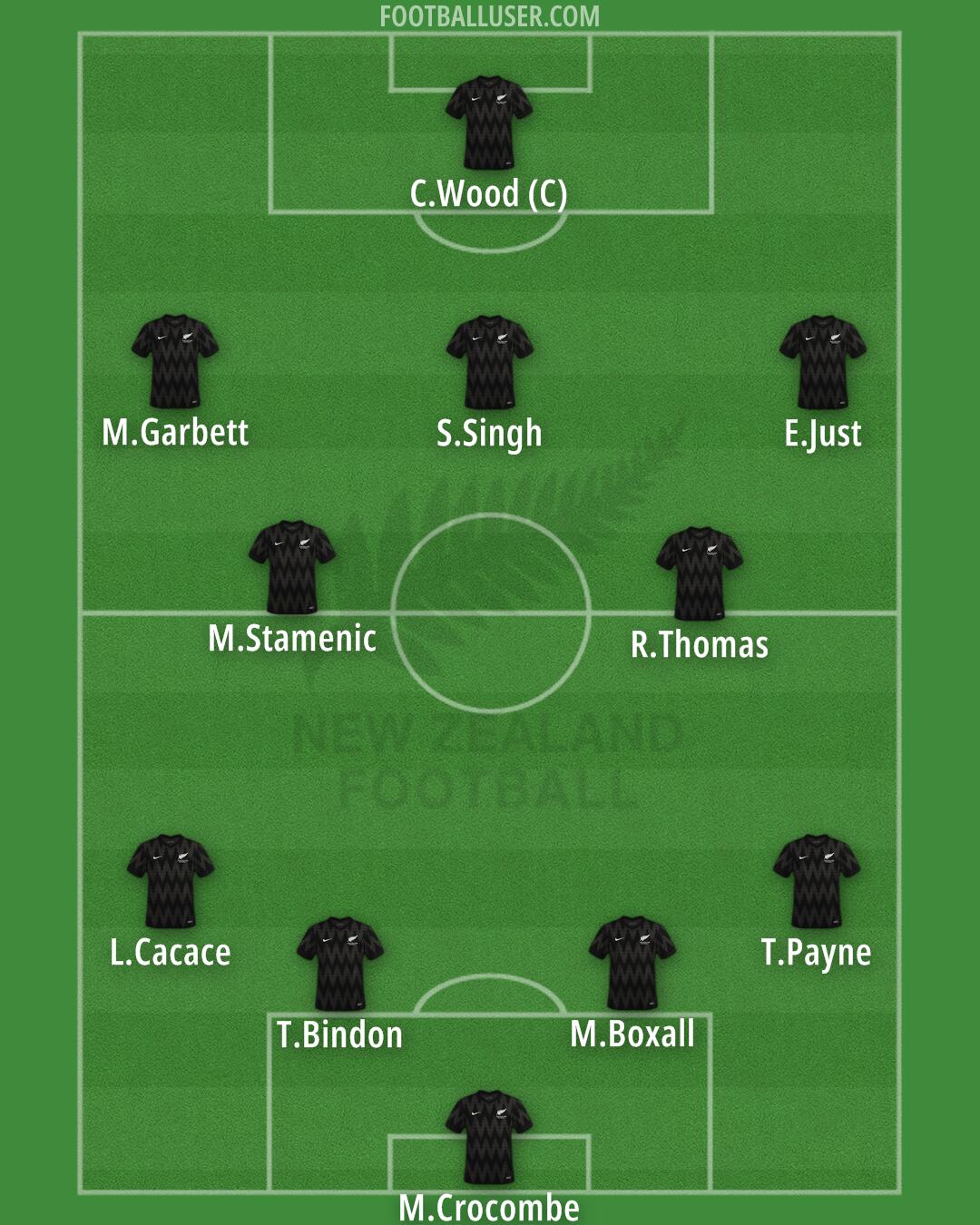

New Zealand National Football Team Formation
 October 17, 2025
 bosan
bosan


Starting Lineup
C.Wood (C) · M.Crocombe · T.Bindon · L.Cacace · M.Boxall · T.Payne · R.Thomas · M.Garbett · S.Singh · E.Just · M.StamenicNew Zealand aims to stay compact and hit teams on the break using a 5-4-1 formation. This lineup is built to sit deep and absorb pressure while waiting for the right moment to launch a vertical attack. The team relies on a low block to deny space between the lines, making them difficult to break down through the middle.
C.Wood (C) commands the penalty area from the goalkeeper position. Ahead of him, the defense operates as a back five to provide maximum coverage. S.Singh, M.Stamenic, and R.Thomas form a central trio, with Singh and Stamenic providing aerial strength and Thomas acting to cover the space behind. The wide defenders, M.Garbett and E.Just, act as wing backs who must track back to support the center backs but also push up to provide width when the team wins the ball.
The midfield operates in two banks of two to maintain a narrow and difficult block to pass through. T.Bindon and M.Boxall occupy the central roles, where they work to intercept passes and shield the defensive line. T.Payne and L.Cacace play on the flanks, tasked with tracking opposing full backs and helping the wing backs. This midfield unit works to close down gaps and ensure that New Zealand remains hard to beat in the central zones.
In the attacking phase, the team relies on a lone striker, M.Crocombe, to hold up the ball and bring others into play. The attack is built through long balls or quick transitions that find the wide players, M.Garbett and E.Just, as they move forward. M.Crocombe must press the opposing defenders to disrupt their build up and create opportunities for the oncoming midfielders. The movements are designed to stretch the opposition once the transition begins.
One major strength for New Zealand is the ability to create a low block that is incredibly hard to penetrate. By sitting deep, the team can force opponents to play around them rather than through them. Another advantage is the potential for wide overloads when the wing backs join the midfielders in the final third. This allows the team to quickly switch play and isolate defenders in one on one situations during a counter attack.
This 5-4-1 formation provides a defensively solid foundation that prioritizes stability over possession. It is best suited for matches against superior technical sides where New Zealand can absorb pressure and exploit spaces on the break.