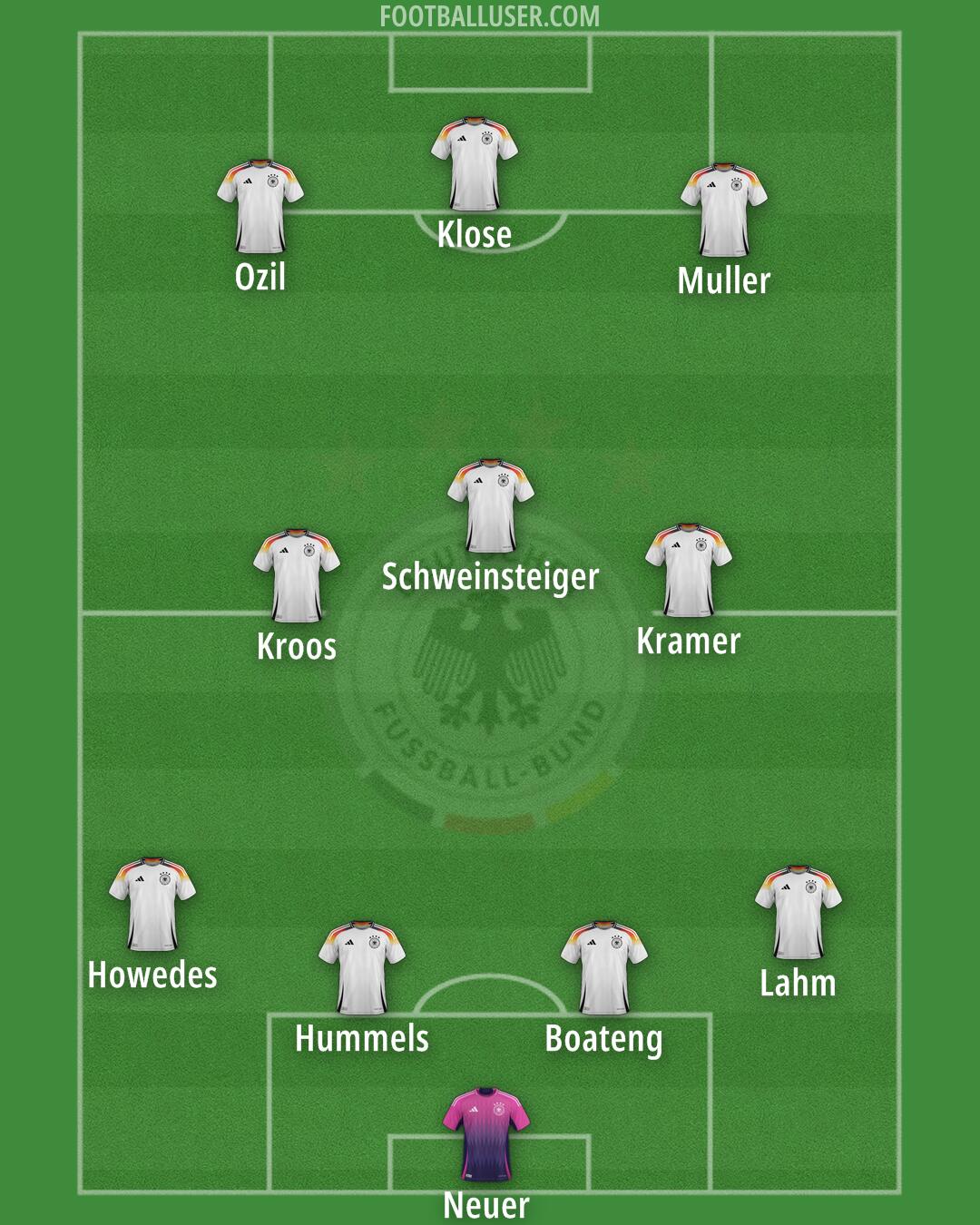

Germany National Football Team Formation
 October 17, 2025


Starting Lineup
Neuer · Boateng · Hummels · Lahm · Howedes · Kramer · Kroos · Schweinsteiger · Klose · Ozil · MullerFocusing on control and high pressing characterizes the way Germany plays in a 4-3-3. This lineup seeks to dominate the ball and move the opposition back into their own half through rapid ball movement. The team uses this formation to dictate the tempo of the match and maintain heavy pressure in the final third.
Manuel Neuer acts as the foundation in goal, often acting as a sweeper keeper to support a high line. In front of him, the back four consists of Lahm on the right and Howedes on the left. Boateng operates as the right center back with his ability to pass through lines, while Hummels sits on the left to provide aerial strength and tactical reading of the game. Lahm pushes high to overlap, while Howedes provides more defensive cover to balance the backline.
The midfield operates as a central trio that connects the defense to the attack. Schweinsteiger acts as the engine, driving forward and tracking back to support the unit. Kramer provides a presence to shield the back four and break up play, while Kroos occupies the left central role to use his famous passing range to switch play. This trio works to win the ball back quickly and feed the attackers in advanced positions.
In the attacking phase, Germany utilizes three forwards to stretch the opposition. Klose leads the line as a lone striker, using his movement to find space in the box and hold up the ball. Muller operates from the right side, constantly making intelligent runs into pockets of space, while Ozil stays on the left to cut inside and create chances with his vision. This front three works together to press high and force turnovers near the opponent's goal.
One major advantage for Germany is the ability to press high in coordinated waves, making it difficult for opponents to build from the back. The midfield unit provides numerical superiority in the center, allowing Kroos and Schweinsteiger to control the rhythm. Additionally, the movement of Muller and Ozil creates space for Klose to exploit inside the penalty area.
This 4-3-3 formation relies on high intensity and technical ball retention to break down opponents. It is best suited for matches where the team needs to dominate possession against sides that sit deep.