
Union Berlin Football Formation
 October 17, 2025


Starting Lineup
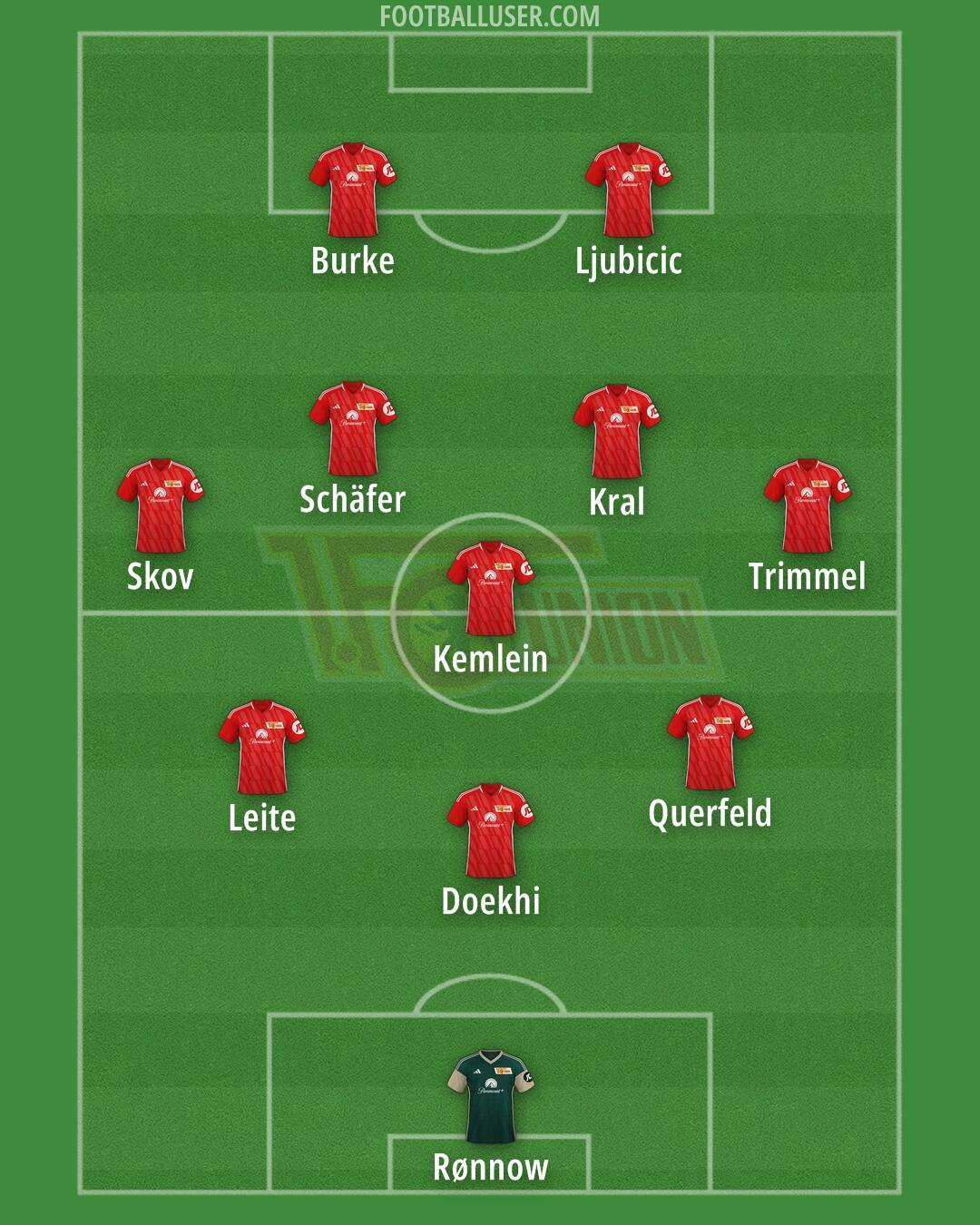
Querfeld · Leite · Doekhi · Kemlein · Skov · Schäfer · Kral · Trimmel · Ljubicic · Burke · RønnowFocusing on a high press and quick transitions, Union Berlin operates with a 3-5-2 formation. This lineup is built to play a direct style of football that relies on verticality and pressing in coordinated waves. The team aims to win the ball high up the pitch and move it quickly toward the goal to catch opponents out of position.
Rønnow acts as the last line of defense in goal. The back line consists of a back three where Leite plays as the left central defender, Doekhi sits in the middle, and Querfeld occupies the right central defender spot. This unit can step up to squeeze the space or drop into a low block when under pressure. They focus on marking tight and winning aerial duels to keep the opposition from building play through the middle.
The midfield setup uses a central trio to control the center of the pitch. Kemlein plays as the single pivot to shield the defense and intercept passes. Skov and Trimmel operate as the left and right central midfielders, driving forward to connect the defense to the attack. Kral and Schäfer act as the wide midfielders, providing the necessary width and tracking back to support the defensive line when the team loses possession.
The attack utilizes two forwards to stretch the opposition. Burke plays as the left striker while Ljubicic operates as the right striker. They work together to press the opposing center backs and hold up the ball to allow the midfield to push forward. The movements of these two players are designed to create space for the wide midfielders to cut inside and join the central attacking threat.
One major strength of this Union Berlin formation is the ability to create wide overloads. When Kral and Schäfer push high, they force the opposition wingers to track back, often leaving them outnumbered. Another advantage is the compactness of the unit when defending deep, making it difficult for opponents to find gaps between the lines. The team can also transition very fast from a defensive block to an attacking threat.
This formation provides a resilient defensive base while maintaining a high level of pressure on the ball. It is best suited for games against teams that prefer possession, allowing the side to exploit space on the break.