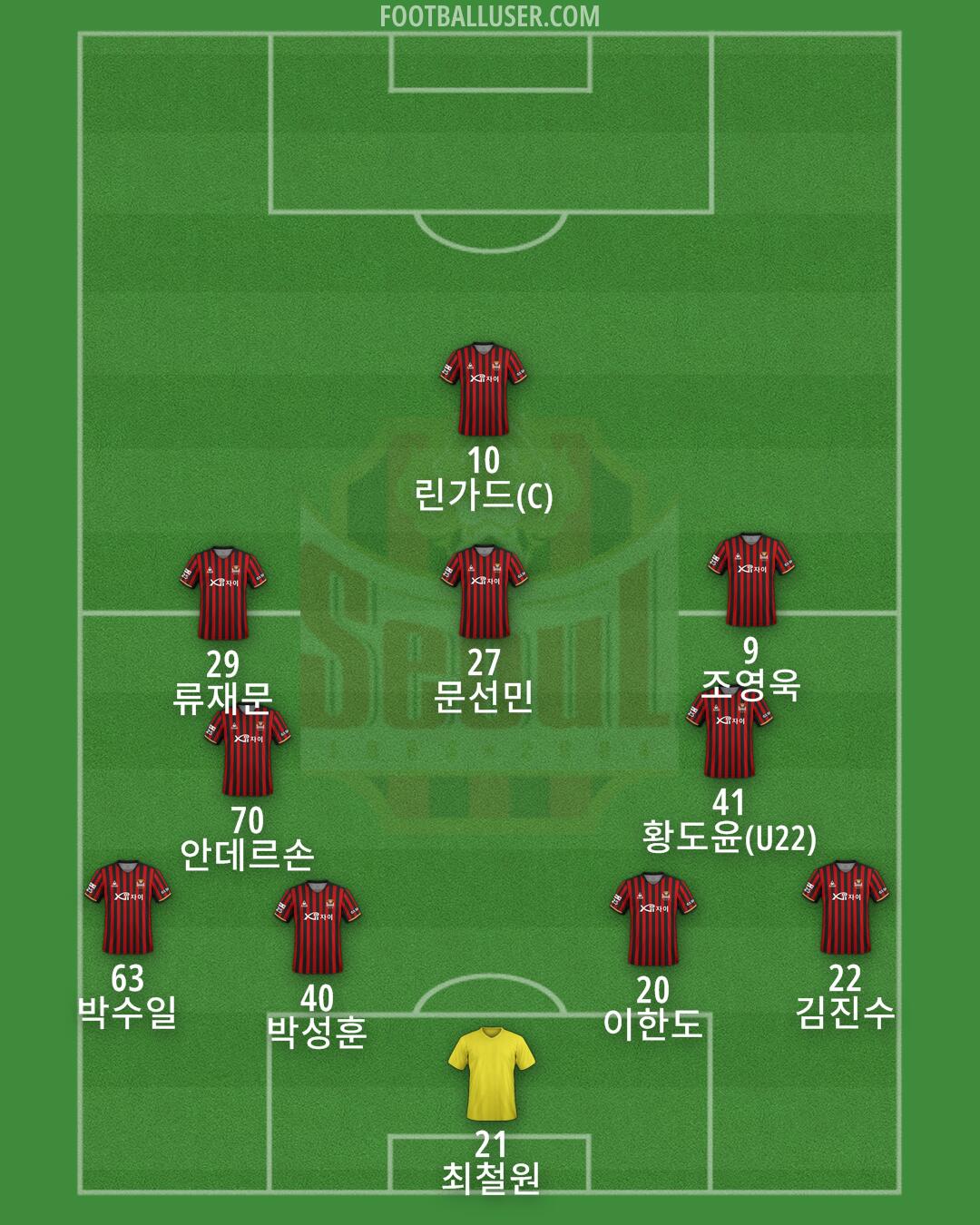

Seoul Football Formation
 October 18, 2025


Starting Lineup
21 (최철원)63 (박수일)
40 (박성훈)
20 (이한도)
22 (김진수)
70 (안데르손)
41 (황도윤(U22))
29 (류재문)
27 (문선민)
9 (조영욱)
10 (린가드(C))
Prioritizing a heavy defensive block and quick transitions, Seoul operates with a 4-5-1 formation. This lineup aims to sit deep and deny space between the lines, looking to catch opponents on the break once possession is regained. The team relies on a compact unit to frustrate opposition players and force them into wide areas or long balls.
In front of the goal, 21 stands ready to command the area. The defensive unit consists of a flat back four where 40 and 20 occupy the central roles. 40 and 20 must hold their positions to prevent through balls, while 63 and 22 provide width. 63 is expected to tuck in when the ball is on the opposite side, while 22 can push forward to provide an outlet during transitions. The entire back line works to stay connected, shifting left or right as a single unit to block passing lanes.
The midfield is the engine of this Seoul lineup, utilizing a crowded central block to control the tempo. 70 and 41 act as the double pivot, sitting in front of the defense to shield the center and intercept passes. Moving ahead, 29, 27, and 9 form a line of three that connects the defensive base to the lone striker. 27 acts as the central link, helping to move the ball from the pivots to the more advanced players. 29 and 9 look to drive forward into the half spaces to support the attack, while 70 and 41 drop back to cover any runners from deep.
The attacking phase is built around the lone striker, 10, who must work hard to hold up the ball. 10 is tasked with receiving long passes, shielding the ball, and bringing the advancing midfielders into play. Because there are no natural wingers in this formation, the width comes from 63 and 22 when they overlap. The midfielders 29 and 9 must often cut inside to create numerical superiority in the central zones, making runs to break the line and support 10 in the final third.
One major advantage of this setup is the density in the middle of the pitch, which makes it very difficult for opponents to play through the center. The presence of 70, 41, 27, 29, and 9 creates a wall of players that can quickly press the ball once it enters the middle third. Another strength is the ability to exploit wide areas through sudden transitions, using 22 and 63 to stretch the opposition once 10 or the central midfielders win possession.
This 4-5-1 formation is built to be a defensive fortress that relies on patient buildup and rapid counter attacks. It is best suited for matches against dominant sides where the team needs to sit deep and frustrate the opponent.