Rangers Football Formation
 October 18, 2025


Starting Lineup
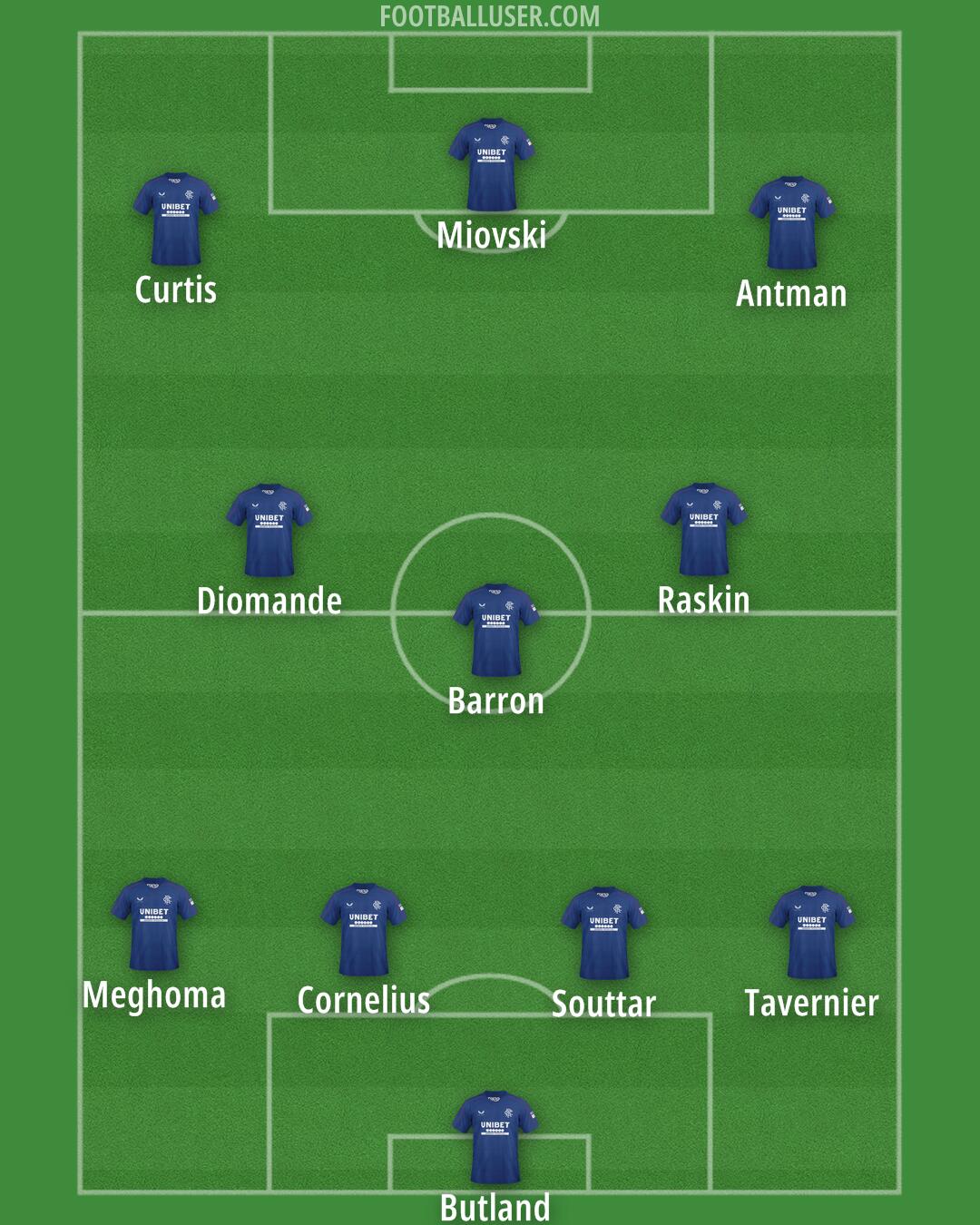
Butland · Tavernier · Souttar · Cornelius · Meghoma · Raskin · Barron · Diomande · Miovski · Antman · CurtisRangers aim to control games through a high press and rapid transitions using a 4-3-3 formation. This lineup relies on winning the ball high up the pitch to catch the opposition out of position. The team seeks to move the ball forward quickly through the middle and wide areas to create scoring chances.
Butland acts as the last line of defense in goal. The defensive unit operates with a back four where Souttar and Cornelius act as the central pair. Souttar provides aerial strength while Cornelius covers the space behind him. Tavernier pushes high as an overlapping full back to provide width and crossing ability. Meghoma holds the left side, often tucking in to support the center when the right side moves forward.
The midfield works as a trio to control the center of the pitch. Barron sits in front of the back four as a single pivot to shield the defense and intercept passes. To his sides, Diomande and Raskin occupy the central roles to drive forward and link the defense to the attack. Raskin uses his ball carrying to break the line and move the team into the final third. This trio must shift together to maintain compactness and prevent central breakthroughs.
The attacking front line is built around Miovski playing as a lone striker. He stays central to hold up the ball and provide a target for crosses. On the wings, Antman and Curtis provide width and stretch the opposition defense. Curtis looks to cut inside to create space for the overlapping runs of Meghoma. Both wingers are tasked with pressing the opposition full backs to force turnovers near the goal.
Rangers find strength in their ability to create wide overloads when Tavernier joins the attack. The midfield trio provides numerical superiority in the center, allowing the team to dominate possession. The team also benefits from a coordinated press that uses the front three to force mistakes. This allows the players to exploit transitions and catch opponents in vulnerable moments.
This 4-3-3 formation provides a balanced platform for both controlling games and attacking in waves. It is best suited for facing teams that play a high line or struggle with intense pressure in their own half.