
Real Madrid Football Formation
 October 18, 2025


Starting Lineup
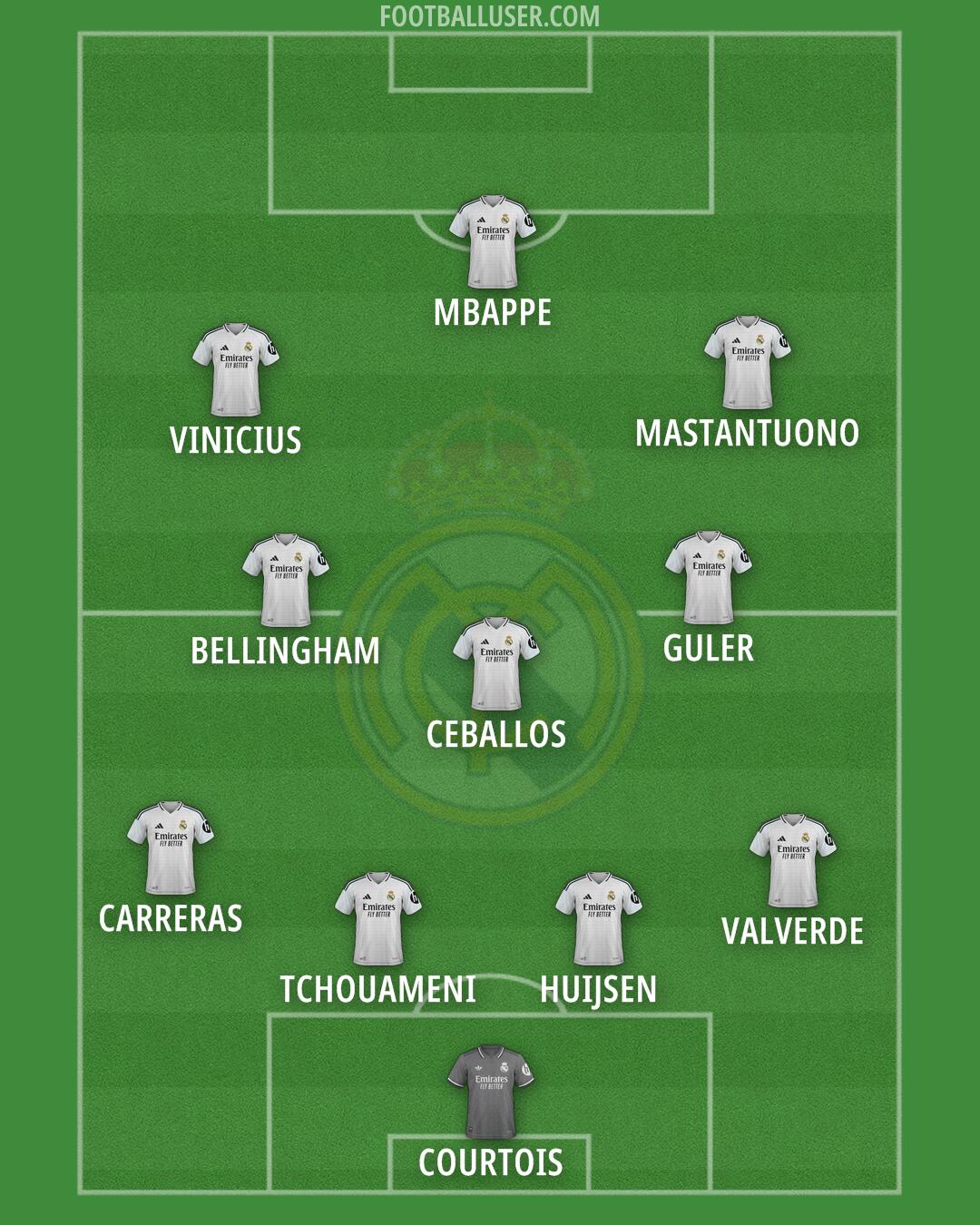
COURTOIS · VALVERDE · HUIJSEN · TCHOUAMENI · CARRERAS · GULER · MBAPPE · VINICIUS · CEBALLOS · BELLINGHAM · MASTANTUONOReal Madrid aims to control matches through heavy pressure and quick transitions in a 4-3-3. This lineup is built to play a vertical game that forces opponents to drop deep and defend their own box. By using a high press, the team seeks to win the ball in advanced areas to launch immediate attacks.
Thibaut Courtois guards the goal and provides a commanding presence during crosses. The defense operates with a flat back four where Huijsen acts as a ball playing center back. Tchouameni covers the left side of the central pairing, using his physical strength to intercept passes. On the flanks, Valverde pushes forward to overlap and provide width, while Carreras covers the left side to maintain the defensive line. The defensive unit works together to step up and squeeze the space between the lines.
The midfield functions with a single pivot system to link the play. Ceballos sits in the hole to shield the defense and recycle possession. Beside him, Bellingham drives forward into the box, using his high pressing intensity and ability to break the line with runs. Guler operates in the right central channel to connect the middle third to the attack. This midfield trio works to control the tempo and switch play quickly to the wide areas.
Real Madrid utilizes three attackers to stretch the opposition. Mbappe leads the line as a lone striker, using his explosive speed to run behind the defense. On the wings, Vinicius cuts inside from the left to take on defenders one on one, while Mastantuono stays wide on the right to provide service. The forwards press in a coordinated way to prevent the opponent from building from the back.
One major advantage is the ability to create wide overloads when Valverde pushes up the right flank. The team also benefits from the speed of transition, as Vinicius and Mbappe can exploit large spaces the moment the ball is won. This formation allows for numerical superiority in the final third during attacking phases.
This 4-3-3 formation provides a high intensity game built on directness and power. It is best suited for matches against teams that play a high line and can be caught on the break.