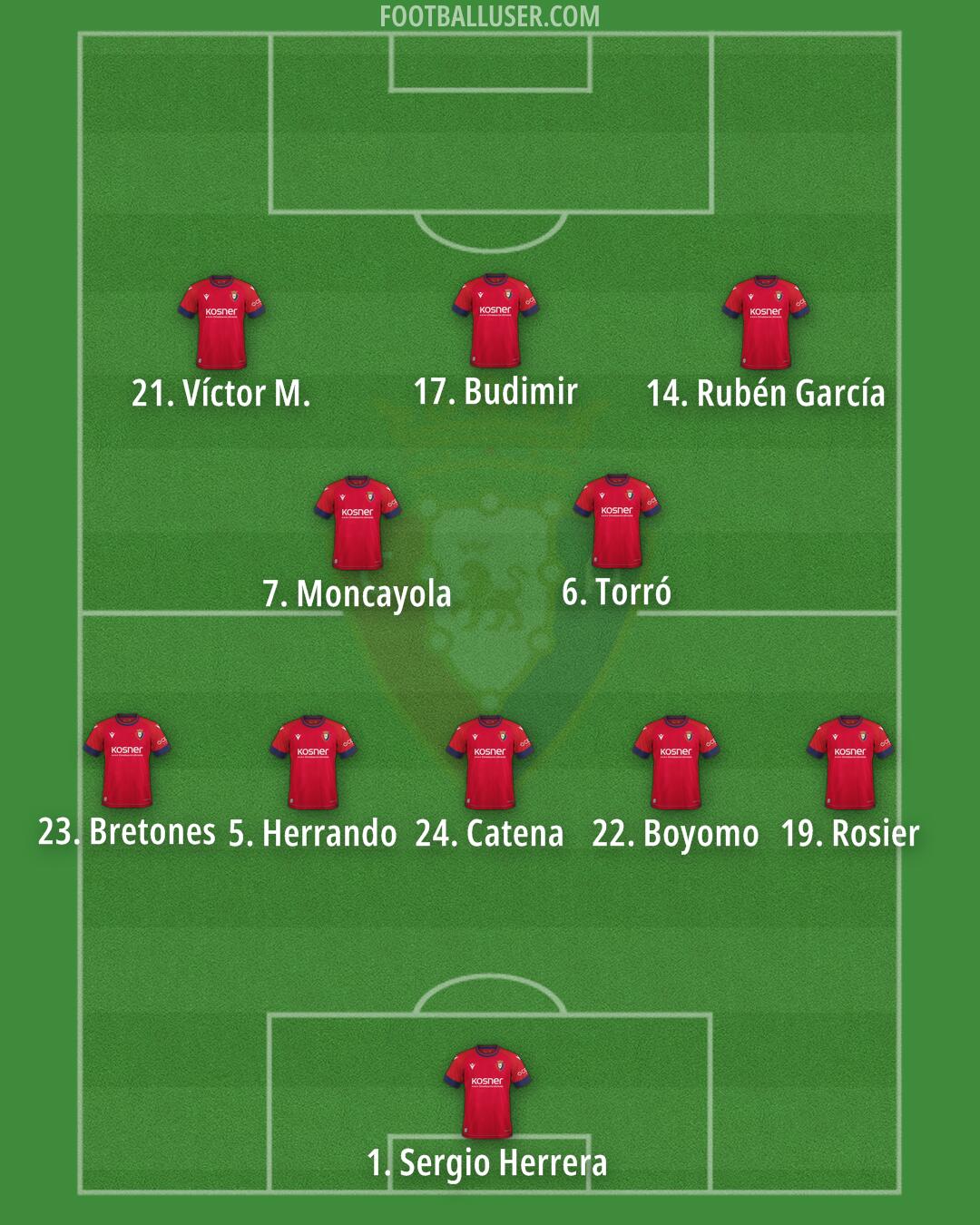

Osasuna Football Formation
 October 19, 2025


Starting Lineup
1. Sergio Herrera19. Rosier
22. Boyomo
24. Catena
5. Herrando
23. Bretones
6. Torró
7. Moncayola
14. Rubén García
17. Budimir
21. Víctor M.
Osasuna aims to stay compact and hit teams quickly on the break through a 5-2-3 formation. This lineup is built to sit deep when out of possession and use verticality to move the ball forward rapidly. The team relies on a strong defensive base to absorb pressure before launching direct attacks against the opponent.
Sergio Herrera sits between the posts to command his area and organize the defensive line. Behind a central trio of Boyomo, Catena, and Herrando, the defense maintains a low block to deny space between the lines. Rosier acts as a right wing back to provide width, while Bretones performs the same role on the left. Boyomo and Herrando focus on winning aerial duels and marking runners, with Catena providing cover in the middle. These five defenders work as a single unit to block crosses and intercept passes.
The midfield functions as a double pivot to protect the central zone. Torró and Moncayola stay close together to shield the back three and break up play. Torró works to tackle and win the ball back, while Moncayola helps connect the defense to the attacking players. This duo must track back constantly to help the wing backs when the team loses possession. They act as the engine that prevents the opposition from playing through the center of the pitch.
In the attacking third, the team uses three forwards to stretch the opposition defense. Budimir acts as a lone striker to hold up the ball and engage the center backs. Víctor M. and Rubén García play as wide attackers, ready to cut inside or run into space behind the defense. They press high when the ball is lost to force turnovers near the opponent's goal. The movement of these three is designed to create gaps in the defensive line for Budimir to exploit.
Osasuna possesses several tactical advantages with this system. The five man back line creates massive compactness when defending a lead. The team can also use wide overloads by having Rosier and Bretones push high up the pitch alongside the wingers. This allows the club to isolate wide players in one on one situations during quick transitions. The coordination between the double pivot and the back three makes it very difficult for opponents to find space in the middle.
This formation provides a defensive foundation that is hard to break down through central play. It is a setup best suited for facing possession based teams that struggle with rapid counter attacks.