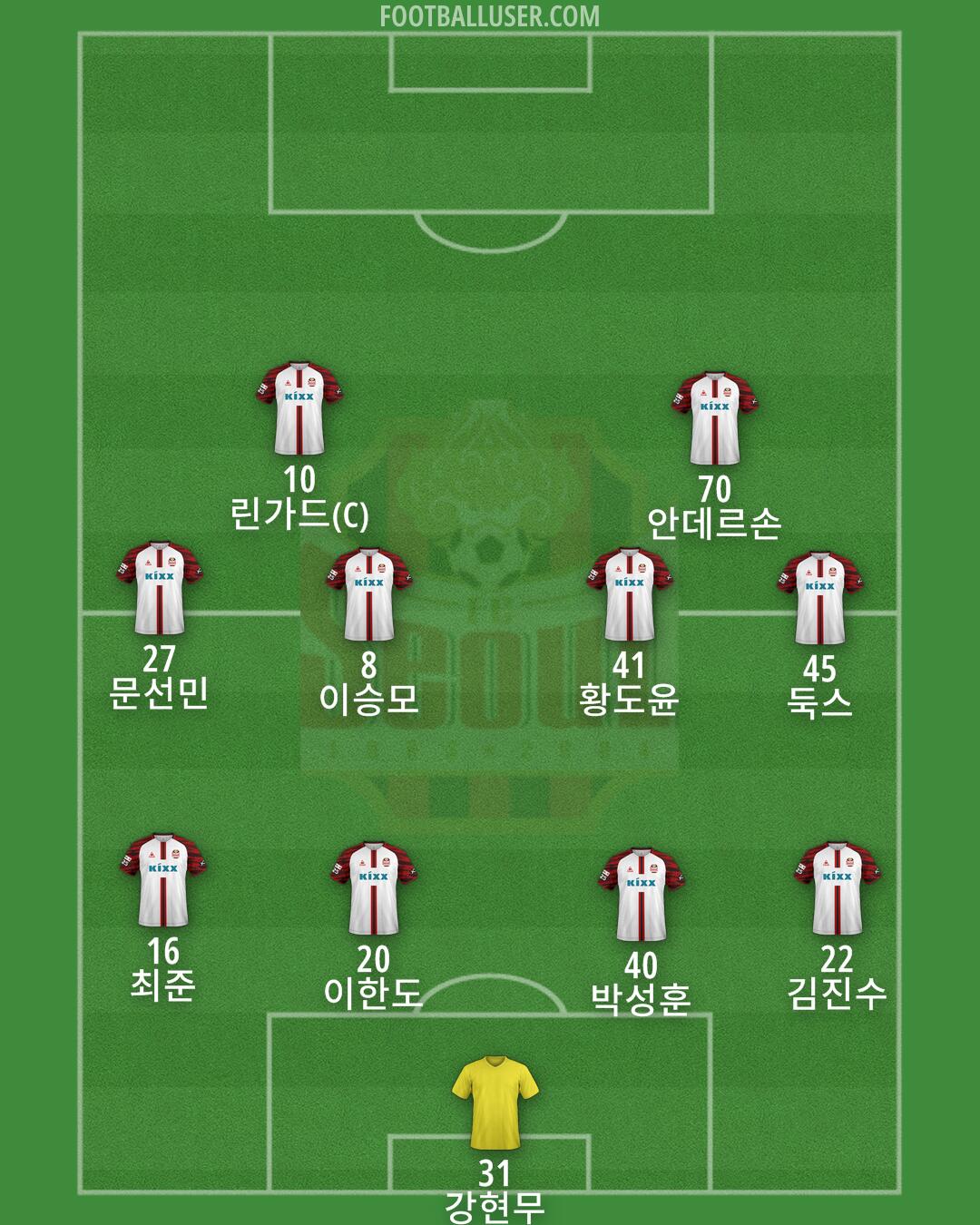

Seoul Football Formation
 October 22, 2025


Starting Lineup
31 (강현무)16 (최준)
20 (이한도)
40 (박성훈)
22 (김진수)
8 (이승모)
41 (황도윤)
45 (둑스)
27 (문선민)
70 (안데르손)
10 (린가드(C))
Seeking to control matches through a high press and quick transitions, Seoul utilizes a 4-4-2 formation. This lineup is built to play with verticality, looking to win the ball high up the pitch and push it forward immediately to the front two. The team relies on energy and compactness to force errors from the opposition in their own half.
In the defensive third, 31 acts as the last line of defense to organize the unit. The back line consists of a flat four with 22 providing width on the right and 16 covering the left. Central defenders 40 and 20 hold the line, with 40 acting as the right sided center back and 20 guarding the left. They must stay compact to prevent through balls while 22 and 16 are expected to step up to intercept passes or track back when the team loses possession.
The midfield is organized in two banks of four to ensure the team stays hard to beat. 8 and 41 operate as the central midfielders, where 8 works to shield the defense and 41 looks to drive forward or break the line with passes. On the flanks, 45 and 27 provide the width, tasking themselves to track back and support the defense before pushing up to cross the ball. This central duo of 8 and 41 must connect the back four to the attackers by moving the ball quickly through the middle.
For the attack, Seoul employs two strikers in a front two. 10 operates as the left striker while 70 plays as the right striker, creating a constant presence in the opposition box. They are tasked to press the opposing center backs to force long balls. The movement of 10 and 70 is designed to pull defenders out of position, either by dropping deep to hold up the ball or making runs behind the defense to receive through balls from the midfield.
This formation offers significant tactical advantages, such as the ability to press high in coordinated waves across two lines. By using 45 and 27 alongside 22 and 16, Seoul can create wide overloads to bypass the opposition wings. Additionally, the proximity of 10 and 70 allows for quick one two passes to bypass a low block, while the central pairing of 8 and 41 ensures stability when the team transitions into a defensive block.
Seoul relies on a disciplined defensive block and aggressive pressing to dominate territory. This 4-4-2 formation is best suited for games against teams that struggle with physical intensity or those that leave gaps behind their midfield.