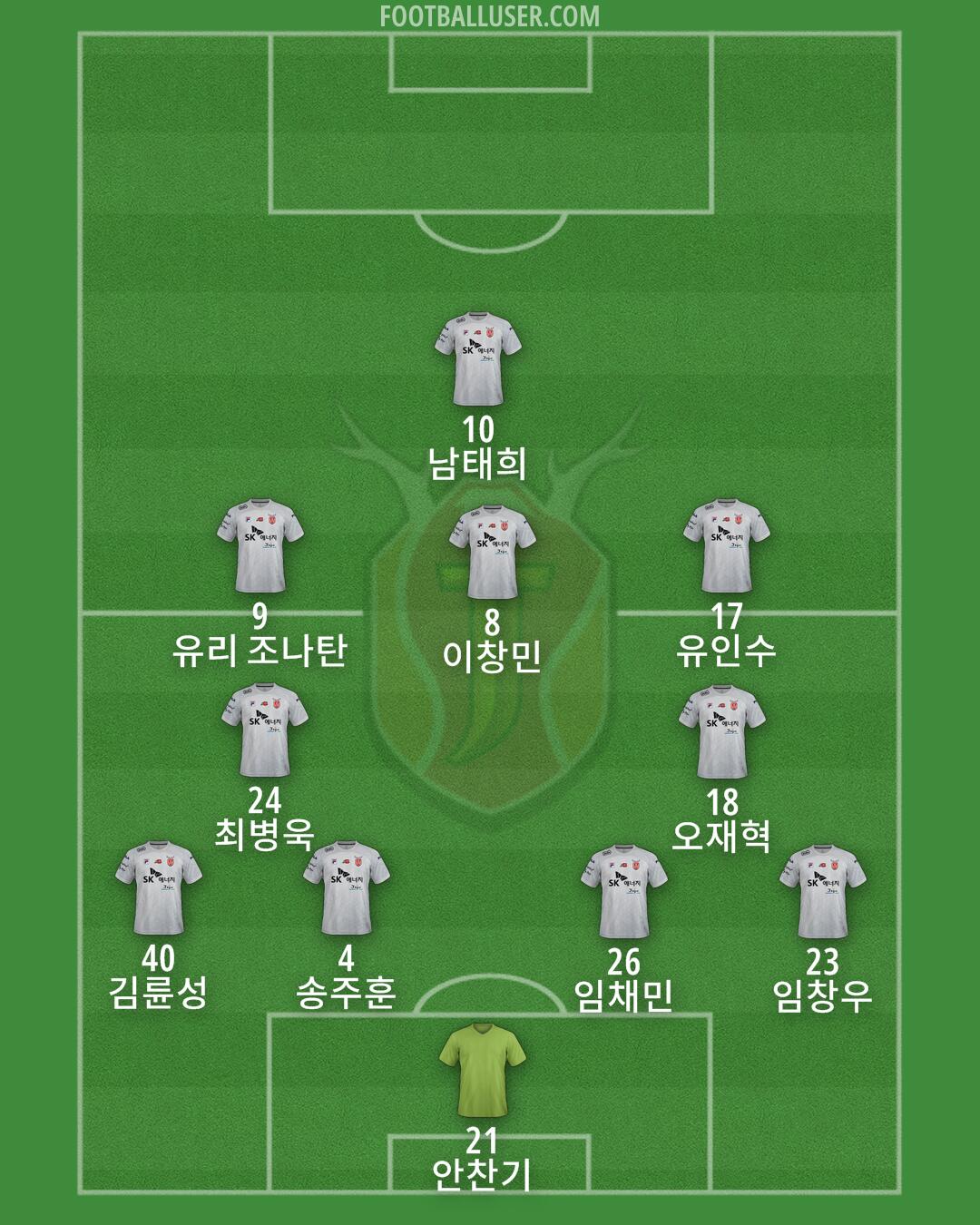

Jeju Football Formation
 October 25, 2025


Starting Lineup
21 (안찬기)40 (김륜성)
4 (송주훈)
26 (임채민)
23 (임창우)
17 (유인수)
18 (오재혁)
8 (이창민)
24 (최병욱)
9 (유리 조나탄)
10 (남태희)
Jeju focuses on a compact defensive presence and quick transitions through a 4-5-1 formation. This lineup is built to sit deep and absorb pressure before breaking the line with vertical passes. By crowding the central areas, the team looks to stifle the opponent in the middle third and launch rapid attacks when they win the ball back.
The defensive unit starts with 21 in goal. A back four provides the foundation, with 23 acting as the right back and 40 playing at left back to cover the flanks. In the heart of the defense, 4 and 26 operate as the central pairing. These two must stay close together to block passing lanes, with 26 often acting as the right sided center back to handle physical duels. The whole back line works to maintain a low block to deny space behind them.
The midfield is heavily populated to ensure control of the center of the pitch. A double pivot consisting of 18 and 24 sits in front of the defense to shield the back four and intercept passes. Ahead of them, the midfield trio of 8, 17, and 9 works to connect the play. While 8 and 17 push higher to support the attack, 9 provides more balance by dropping into pockets of space to help the pivot. This group aims to press in waves and win second balls to keep Jeju on the front foot.
In the attacking phase, the team relies on a lone striker, 10, to lead the line. Since there are no wide wingers in this specific midfield setup, 10 must be able to hold up the ball and wait for the midfielders to join the run. The attacking movements depend on the midfielders like 17 and 8 making late runs into the box to create goalscoring opportunities. The goal is to use the central presence of 10 to draw defenders away and create space for others.
One major strength of this Jeju lineup is the density in the central midfield, which makes it very difficult for opponents to play through the middle. The coordination between the double pivot of 18 and 24 and the three central midfielders creates a wall of players that can shift sideways to cover gaps. Additionally, the formation allows for quick transitions because the midfielders are already positioned to strike forward as soon as the ball is recovered.
This 4-5-1 formation creates a tough defensive block that is hard to break down through central play. It is best suited for games against dominant teams where Jeju needs to stay compact and strike on the counter.