
São Paulo Football Formation
 October 26, 2025


Starting Lineup
12- João Pedro5- R. Arboleda
29- Pablo Maia
2- R. Tolói
25- Alisson
46- Hugo L.
13- Enzo Díaz
15- Rodriguinho
49- Ryan F.
9- J. Calleri
22- Mailton
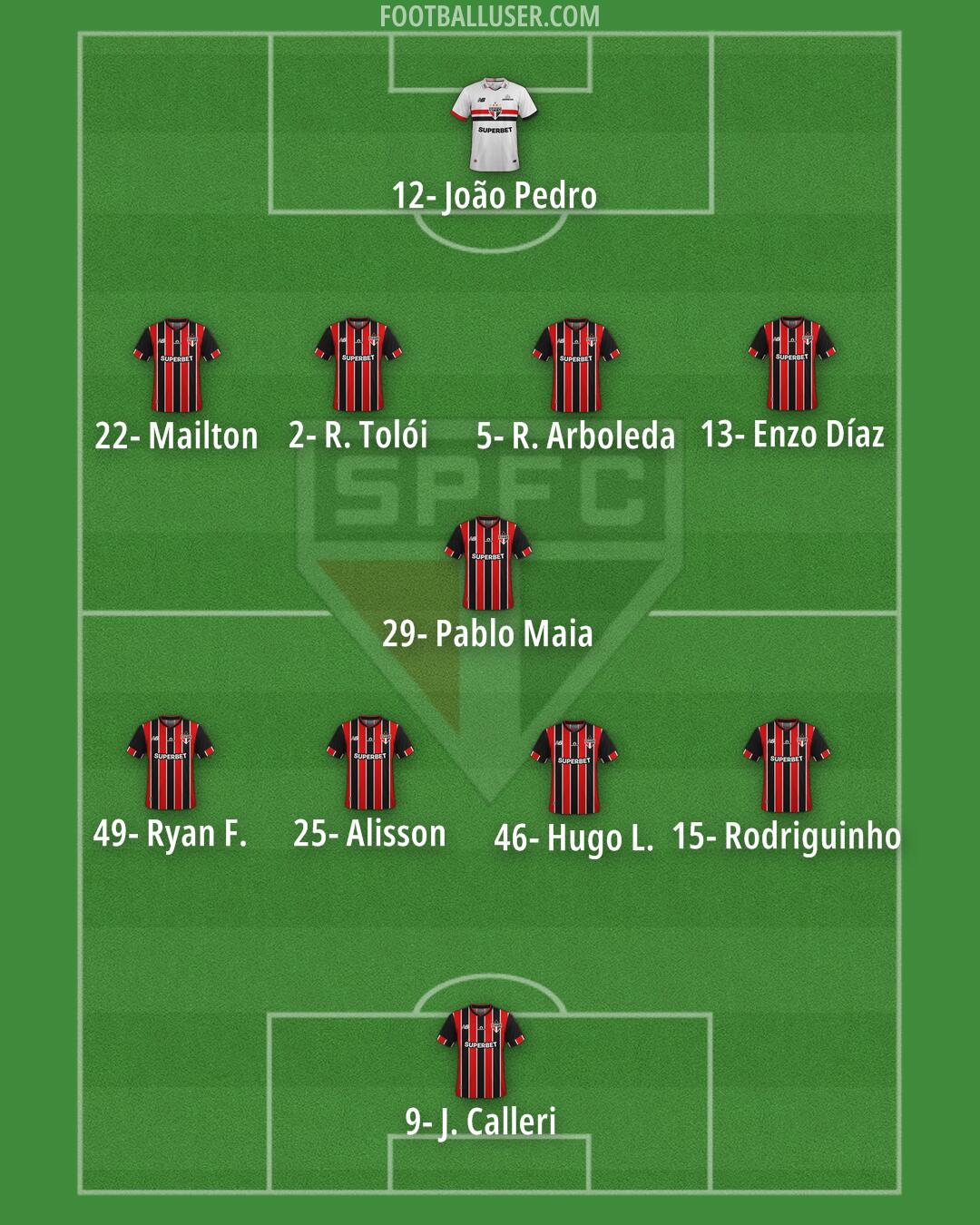
Focusing on defensive stability and direct transitions, São Paulo utilizes a 5-4-1 formation. This lineup is built to sit deep and absorb pressure before launching quick attacks. The team looks to congest the middle of the pitch, making it very hard for opponents to find space between the lines.
João Pedro stays between the posts to organize the defensive unit. The back line consists of three central defenders with Pablo Maia, R. Arboleda, and R. Tolói. Arboleda and Tolói provide aerial strength and physical presence in the box, while Pablo Maia covers the space behind them. On the flanks, Mailton and Enzo Díaz act as wing backs. They are tasked to track back and cover the wide areas, but they also push up to provide width when the team wins the ball.
The midfield works in a flat bank of four to protect the central zones. Hugo L. and Alisson occupy the central roles, with Hugo L. looking to drive forward while Alisson holds his position to shield the defense. On the wings, Ryan F. and Rodriguinho work to track back and support the wing backs. This midfield quartet aims to intercept passes and quickly switch play to the flanks to start a break.
In the attacking third, J. Calleri operates as a lone striker. He is tasked to hold up the ball and bring the midfielders into the play. The attacking movement relies on the wing backs, Mailton and Enzo Díaz, making runs to support the front line. When the team presses, J. Calleri leads the line by cutting off passing lanes to the opposition defenders.
This formation offers great compactness when defending in a low block. By keeping the distances between the lines small, São Paulo makes it difficult for the opposition to play through the center. Another strength is the ability to create wide overloads when Mailton and Enzo Díaz push forward to join the midfield. This allows the team to transition from a defensive stance to a wide attacking presence very quickly.
São Paulo employs this lineup to remain defensively solid and frustrate attacking teams. It is best suited for matches against dominant opponents where controlling space is more important than controlling possession.