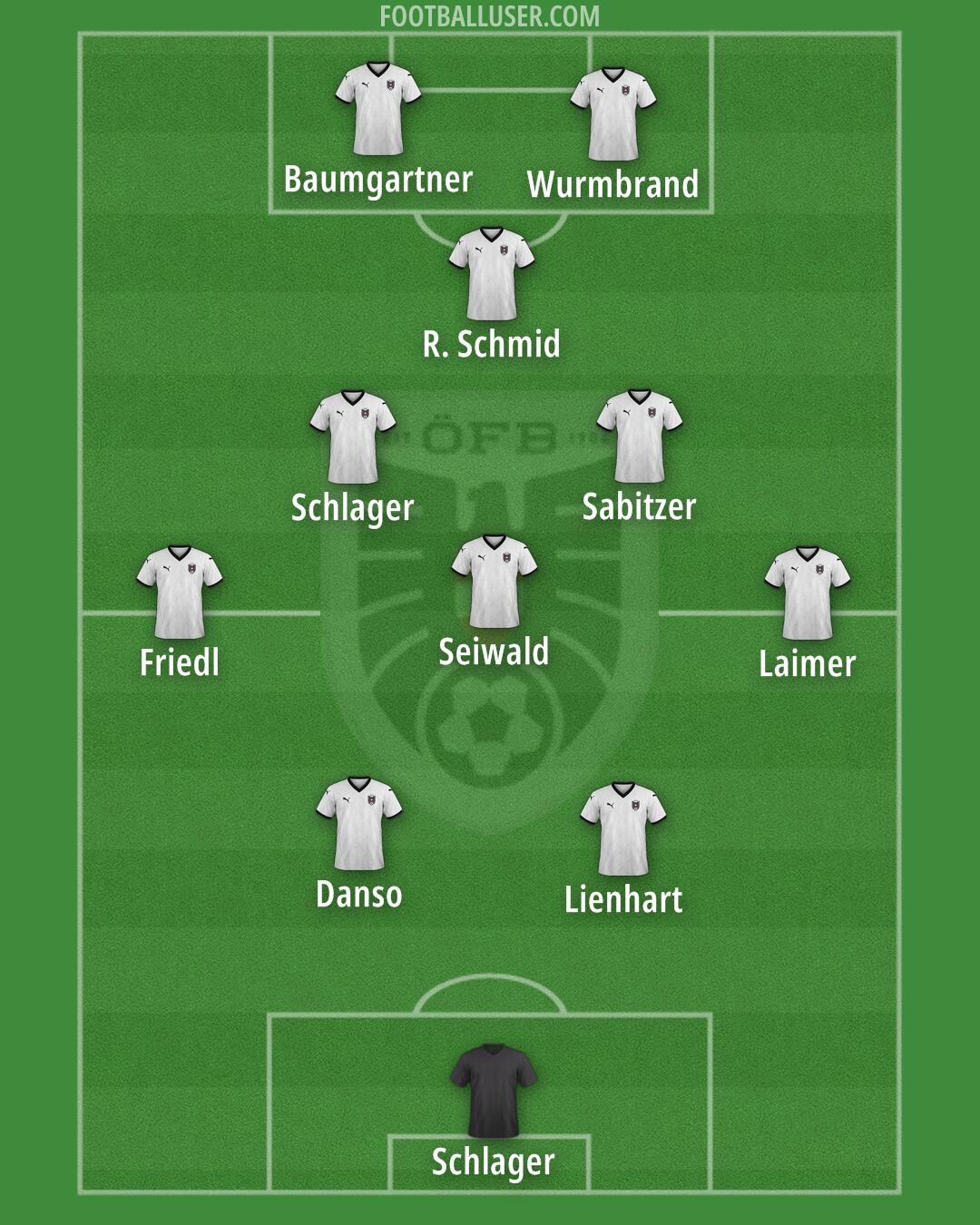

Austria National Football Team Formation
 October 30, 2025


Starting Lineup
Baumgartner · Wurmbrand · R. Schmid · Friedl · Schlager · Sabitzer · Laimer · Seiwald · Danso · Lienhart · SchlagerAustria seeks to dominate the ball through a heavy central presence using a 2-6-2 formation. This lineup is built to control the middle of the park and use massive numbers to suffocate opponents in their own half. The team plays a high pressing game where they look to win the ball back quickly in the final third.
Schlager acts as the last line of defense in goal. The back line consists of only two central defenders, Lienhart and Danso, who must stay very disciplined. Lienhart and Danso often step up to intercept passes and must be ready to cover large amounts of space behind them when the team pushes forward. This small unit relies on staying compact to prevent long balls from breaking through.
The midfield is where Austria creates its most significant presence with a massive six man block. Laimer and Friedl sit deep to shield the two defenders, while Seiwald and Schlager occupy the central spaces to link the play. Sabitzer uses his driving runs and passing range to move the ball forward, and R. Schmid operates as the attacking ten to find gaps between the lines. This dense midfield group works to pass through the opposition and keep the ball moving constantly.
In the attacking phase, the team moves with two dedicated forwards. Baumgartner and Wurmbrand lead the line, tasked with pressing the opposition defenders and making runs into the channels. Baumgartner often tries to pull defenders out of position to create space for the midfielders to arrive. The two attackers must hold up the ball to allow the six players behind them to join the assault.
The main advantage of this formation is the overwhelming numerical superiority in the center of the pitch. By crowding the middle, Austria can easily win second balls and control the tempo of the game. This lineup also allows the team to press high in coordinated waves, making it very difficult for opponents to play out from the back. The density of players in the center allows for quick short passes to break the lines of the opposing midfield.
This formation focuses on central dominance and aggressive pressing to force errors. It is best suited for matches where Austria can exploit a lack of midfield depth in the opposition.