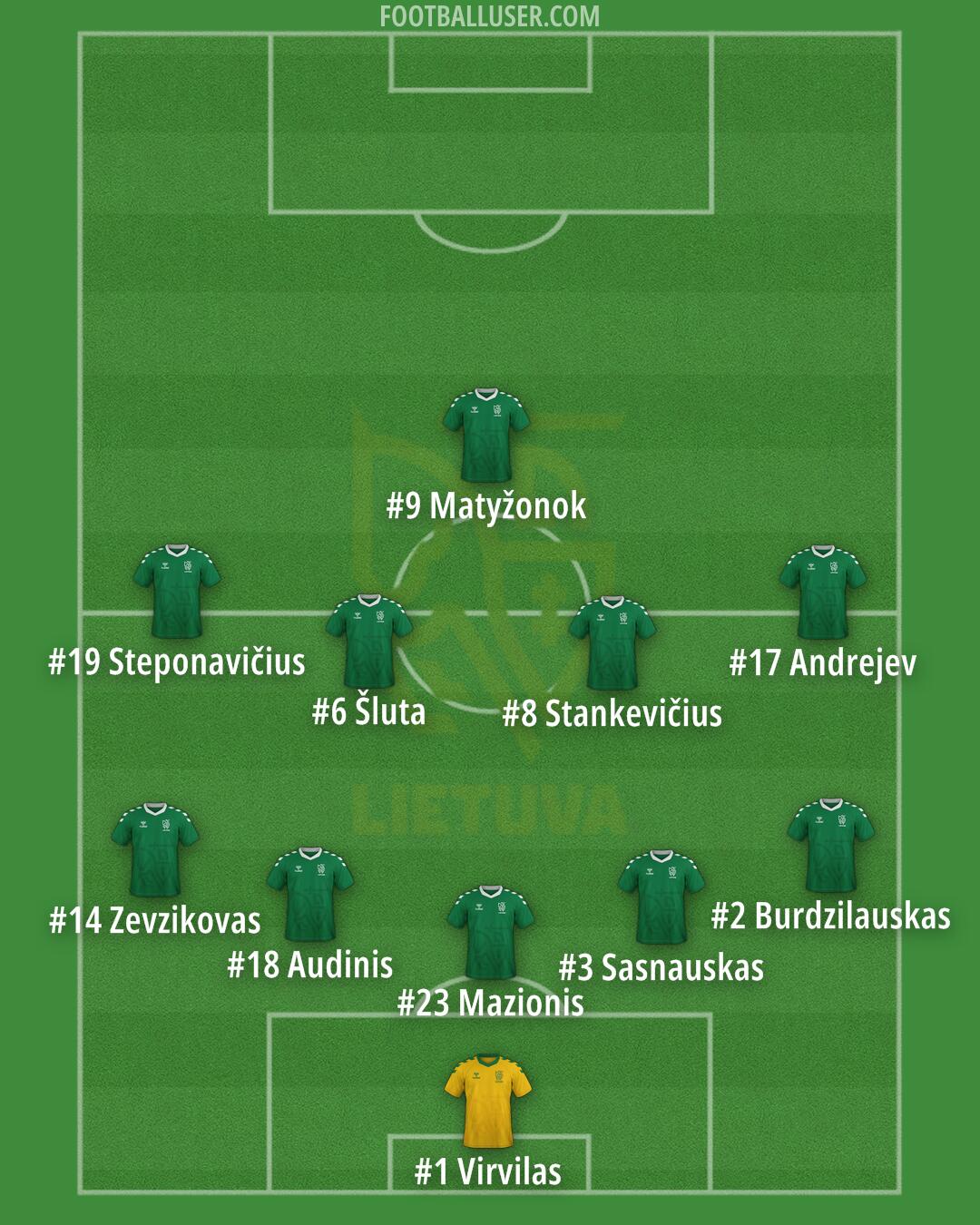

Lithuania National Football Team Formation
 November 1, 2025


Starting Lineup
#1 Virvilas · #23 Mazionis · #18 Audinis · #3 Sasnauskas · #2 Burdzilauskas · #14 Zevzikovas · #17 Andrejev · #8 Stankevičius · #19 Steponavičius · #6 Šluta · #9 MatyžonokLithuania focuses on a low block and heavy defensive discipline using a 5-4-1. This formation is built to sit deep and absorb pressure, waiting for the right moment to strike on the break. The team looks to deny space between the lines and force opponents into wide areas where they can be crowded out.
Virvilas stays between the posts to organize the defensive unit from the back. The back line consists of a central trio with Mazionis acting as the anchor, while Sasnauskas and Audinis cover the left and right sides of the central zone. Burdzilauskas and Zevzikovas act as wing backs to provide width, but their main task is to track back and prevent crosses. This five man unit works to stay compact and keep the distance between defenders very small.
The midfield works in a flat four to clog the central channels. Šluta and Stankevičius act as the central engine, where they look to intercept passes and disrupt the opponent rhythm. They shield the back three and try to win the ball back quickly. On the flanks, Andrejev and Steponavičius operate as wide midfielders, helping the wing backs when defending and pushing up to support the attack when the team wins possession.
Matyžonok operates as a lone striker, tasked with holding up the ball to allow the midfield to push up the pitch. He must lead the press from the front to force mistakes, though his primary role is to stay central and target long balls. The attacking plan relies on Matyžonok to win duels or lay the ball off to the oncoming runners from the midfield.
A major strength for Lithuania is the compactness when defending in a low block. By keeping five defenders and four midfielders close together, they make it very difficult for opponents to play through the middle. Another advantage is the ability to use the wing backs to create quick transitions, allowing the team to switch play rapidly once the ball is recovered.
This 5-4-1 formation is designed to frustrate teams that dominate possession. It is best suited for matches where the team is playing as an underdog against a more technical opponent.