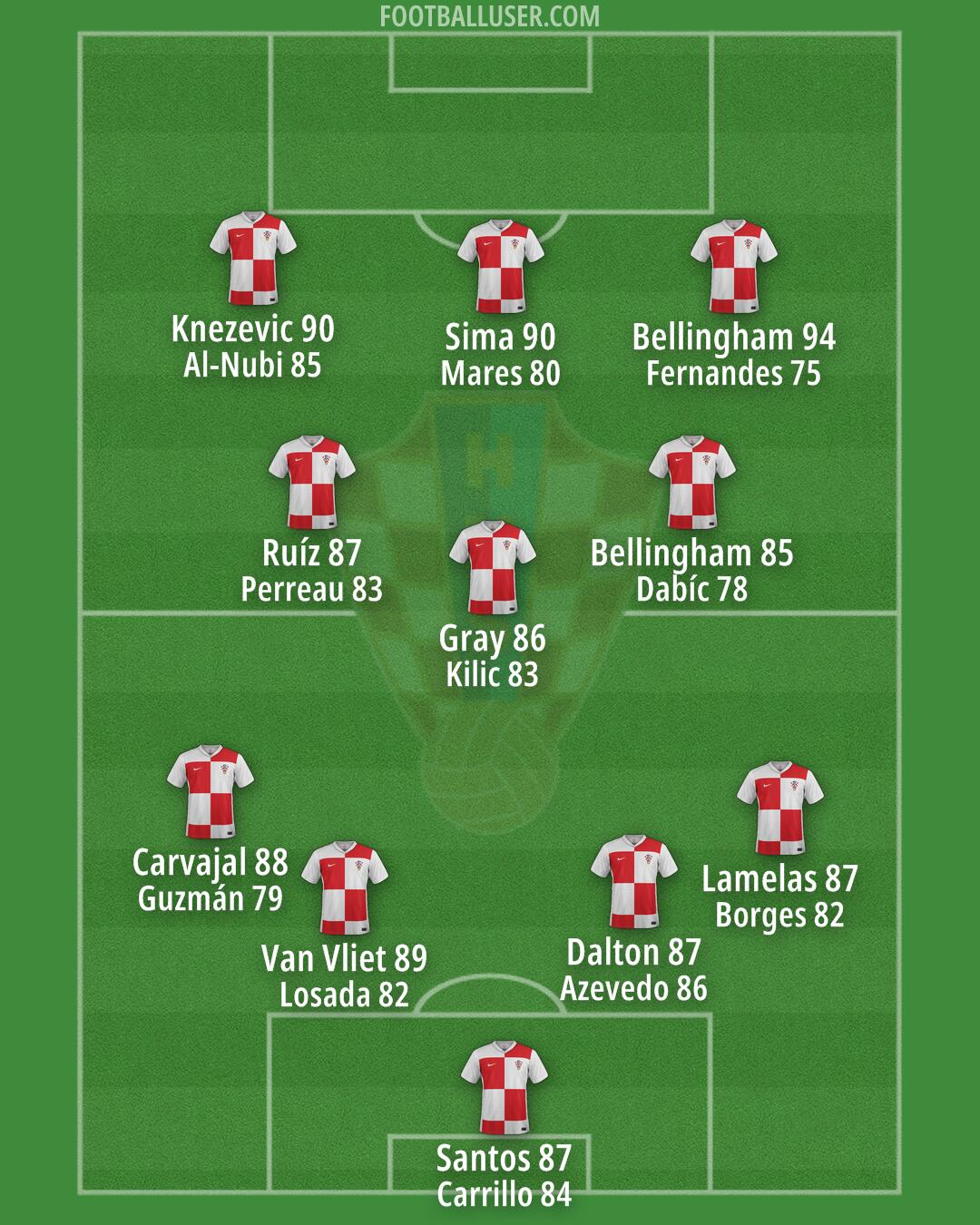

Croatia National Football Team Formation
 November 2, 2025


Starting Lineup
Knezevic 90 (Al-Nubi 85) · Sima 90 (Mares 80) · Van Vliet 89 (Losada 82) · Carvajal 88 (Guzmán 79) · Santos 87 (Carrillo 84) · Lamelas 87 (Borges 82) · Dalton 87 (Azevedo 86) · Ruíz 87 (Perreau 83) · Gray 86 (Kilic 83) · Bellingham 85 (Dabíc 78) · Bellingham 94 (Fernandes 75)Croatia plays with a high press and a vertical style of football in a 4-3-3. This lineup looks to win the ball high up the pitch and move it forward quickly to catch the opposition out of position. The goal is to dominate the ball through quick passing and rapid transitions.
Santos stays between the posts to organize the back line. A flat back four forms the base of the defense with Dalton and Van Vliet acting as the central defenders. Dalton and Van Vliet focus on staying compact to cover space, while Carvajal and Lamelas provide width. Carvajal and Lamelas are expected to step up and push into the attacking third to support the play, while the central pair must drop back to cover any space left behind.
The midfield functions as a single pivot system with Gray sitting in front of the defense to shield the back four. Gray holds his position to intercept passes and break up play. Ruíz and Bellingham work around him to connect the defense to the attack. Ruíz drives the ball forward to link play, while Bellingham uses his driving runs and passing range to break the line and create chances.
Up front, the attack relies on three players to pin the opposition defense back. Sima acts as a lone striker to hold up the ball and lead the pressing from the front. Knezevic and Bellingham occupy the wide areas, with Knezevic and Bellingham looking to cut inside to threaten the goal. This movement creates space for the midfielders to make late runs into the box.
Croatia gains an advantage through the driving runs of Bellingham in the middle of the pitch. The team can also create wide overloads when Lamelas and Carvajal push high to support the wingers. These movements allow the team to press in coordinated waves and force errors in the opponent's half.
This 4-3-3 formation relies on intense pressing and quick vertical transitions. It is best suited for matches against teams that struggle to play out from the back under pressure.